

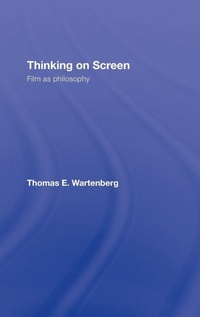
Thinking on Screen
Film as Philosophy
1st Edition
Published on 1. November 2007
Book
Hardback
174 pages
978-0-415-77430-7 (ISBN)
Description
Thinking on Screen: Film as Philosophy is an accessible and thought-provoking examination of the way films raise and explore complex philosophical ideas. Written in a clear and engaging style, Thomas Wartenberg examines films' ability to discuss, and even criticize ideas that have intrigued and puzzled philosophers over the centuries such as the nature of personhood, the basis of morality, and epistemological skepticism.
Beginning with a demonstration of how specific forms of philosophical discourse are presented cinematically, Wartenberg moves on to offer a systematic account of the ways in which specific films undertake the task of philosophy. Focusing on the films The Man Who Shot Liberty Valance, Modern Times, The Matrix, Eternal Sunshine of the Spotless Mind, The Third Man, The Flicker, and Empire, Wartenberg shows how these films express meaningful and pertinent philosophical ideas.
This book is essential reading for students of philosophy with an interest in film, aesthetics, and film theory. It will also be of interest to film enthusiasts intrigued by the philosophical implications of film.
Beginning with a demonstration of how specific forms of philosophical discourse are presented cinematically, Wartenberg moves on to offer a systematic account of the ways in which specific films undertake the task of philosophy. Focusing on the films The Man Who Shot Liberty Valance, Modern Times, The Matrix, Eternal Sunshine of the Spotless Mind, The Third Man, The Flicker, and Empire, Wartenberg shows how these films express meaningful and pertinent philosophical ideas.
This book is essential reading for students of philosophy with an interest in film, aesthetics, and film theory. It will also be of interest to film enthusiasts intrigued by the philosophical implications of film.
Reviews / Votes
'A powerful defense of the view that films can philosophize. Characterized by its clear and lively presentation, and by its intertwining of philosophical argument with detailed discussion of several important films, it will be of interest not just to those studying philosophy and film but to everyone who believes in the importance of film to our cognitive life.' - Berys Gaut, University of St Andrews, UKMore details
Language
English
Place of publication
London
United Kingdom
Publishing group
Taylor & Francis Ltd
Target group
College/higher education
Illustrations
16 s/w Photographien bzw. Rasterbilder
16 Halftones, black and white
Dimensions
Height: 240 mm
Width: 161 mm
Thickness: 14 mm
Weight
435 gr
ISBN-13
978-0-415-77430-7 (9780415774307)
Copyright in bibliographic data and cover images is held by Nielsen Book Services Limited or by the publishers or by their respective licensors: all rights reserved.
Schweitzer Classification
Other editions
Additional editions
E-Book
10/2007
1st Edition
Routledge
€55.49
Available for download
E-Book
10/2007
Routledge
€55.49
Available for download
Book
10/2007
1st Edition
Routledge
€62.80
Shipment within 15-20 days
Person
Thomas E. Wartenberg is Professor at Mount Holyoke College and author of Unlikely Couples: Movie Romance as Social Criticism. He has edited five anthologies of philosophy and film and is film editor for Philosophy Now.
Content
List of figures, Preface, 1. Can philosophy be screened?, 2. Are there limits to film's philosophical capabilities?, 3. Illustrating a philosophical theory: Modern Times, 4. A skeptical thought experiment: The Matrix, 5. Arguing against utilitarianism: Eternal Sunshine of the Spotless Mind, 6. Moral intelligence and the limits of loyalty: The Third Man, 7. Foregrounding the background: Empire and The Flicker, 8. The nature of cinematic philosophy, Notes, Bibliography, Index