

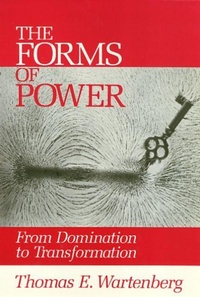
Forms of Power
From Domination to Transformation
Published on 21. August 1991
Book
Paperback/Softback
277 pages
978-0-87722-905-6 (ISBN)
Description
A field theory of power that rejects many of the reigning assumptions made about power
Reviews / Votes
"[This] excellent typology of forms of social power will be welcomed by all social theorists.... Feminist theorists in particular should find this book an important contribution to their thinking about how male domination is exercised even when immediate interactions between men and women appear harmonious."-Iris M.Young "An excellent study of the many meanings of power. The study is a strong start at filling a void in contemporary social theory...."
-Choice
"The theory of power that Wartenberg argues for in this book is carefully constructed, with perceptive analyses and fresh insights... Certainly the current debates will profit from the clarity of his criticisms and of his own constructive position.... a major systematic treatment that is ambitious in its scope and original in its results."
-David Hoy, University of California, Santa Cruz
More details
Language
English
Place of publication
Philadelphia PA
United States
Target group
College/higher education
Product notice
Paperback (trade)
Dimensions
Height: 227 mm
Width: 154 mm
Thickness: 19 mm
Weight
363 gr
ISBN-13
978-0-87722-905-6 (9780877229056)
Copyright in bibliographic data and cover images is held by Nielsen Book Services Limited or by the publishers or by their respective licensors: all rights reserved.
Schweitzer Classification
Person
Thomas E. Wartenbert is Associate Professor of Philosophy at Mount Holyoke College.
Content
Acknowledgments Introduction 1. The Problematics of Power Essentially Contested Concepts * The Meanings of "Power" * Analyzing Power-Over * Conclusion 2. The Consensual Model of Power The Ascendancy of Power * Situating Arendt's View * The Plausibility of the Consensual Model * Power and Violence * Conclusion 3. The Power Debate Ontology and Power Theory * The Power Debate * The Basis of the Power Debate * Conclusion 4. Power-Over us Constraint The Ontology of a Social Field * Terminological Remarks * The Attribution of Power-Over as a Discursive Practice * The Ontology of Human Agency * The Definition of Power-Over * Power and Freedom * Conclusion 5. The Articulation of Power Force * Coercive Power * The Productivity of Coercion * Influence and Its Forms * Manipulation * The Typology of Power 6. Structures of Domination Analyzing "Domination" * Lordship and Bondage: Hegel on Domination * Marx and the Hegelian Conception * The Logic of "Good": Nietzsche on Domination * Toward a Theory of Domination * Appendix: Foucault on Domination 7. Situated Social Power Grading and the Student-Teacher Relationship * Advantages of the Situated Conception * The Concept of a Social Alignment * Some Consequences for Social Theory * Conclusion 8. Toward a Dynamic Conception of Social Power Power and Temporality * Constraints on the Dominant Agent * The Power of the Subordinate Agent * Alternative Alignments and Social Change * The Power of a Teacher Reconsidered * Conclusion 9. Transformative Power Mothering and Male Domination * Reevaluating Mothering * Transformative Power and Social Theory * Criticisms of the Feminist Theorists of Power * Conclusion 10. Transformative Power and Social Domination Understanding Socrates * The Problematics of Transformative Power * The Superposition of Power Relationships * Power in Plurality Notes Bibliography of Works Cited Index