

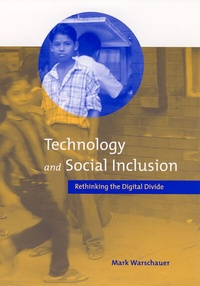
Technology and Social Inclusion
Rethinking the Digital Divide
Published on 1. February 2003
Book
Hardback
274 pages
978-0-262-23224-1 (ISBN)
Description
Going beyond the oversimplified notion of a 'digital divide' to analyze the relationship between access to information and communication technologies and social inclusion.
Much of the discussion about new technologies and social equality has focused on the oversimplified notion of a 'digital divide.' Technology and Social Inclusion moves beyond the limited view of haves and have-nots to analyze the different forms of access to information and communication technologies. Drawing on theory from political science, economics, sociology, psychology, communications, education, and linguistics, the book examines the ways in which differing access to technology contributes to social and economic stratification or inclusion. The book takes a global perspective, presenting case studies from developed and developing countries, including Brazil, China, Egypt, India, and the United States.
A central premise is that, in today's society, the ability to access, adapt, and create knowledge using information and communication technologies is critical to social inclusion. This focus on social inclusion shifts the discussion of the 'digital divide' from gaps to be overcome by providing equipment to social development challenges to be addressed through the effective integration of technology into communities, institutions, and societies. What is most important is not so much the physical availability of computers and the Internet but rather people's ability to make use of those technologies to engage in meaningful social practices.
Review text:
'The modern belief that new technologies hold the key to human progress seems to be sacrosanct. Mark Warschauer's compelling critique of technophilia offers a welcome corrective to this view. He emphasizes that new technologies are neither causes nor cures, shifting the emphasis to the social context in which such technologies appear. In so doing, he provides renewed energy for a reevaluation of the relation between technology and social inequality.'
-- Michael Cole, University Professor of Communication, Psychology, and Human Development, University of California, San Diego
'An impassioned, thoughtful, and unique analysis of the digital divide that incorporates evidence from affluent and poor nations. Warschauer shows that social context, far more than hardware, shapes access to new technologies.'
-- Larry Cuban, School of Education, Stanford University
Much of the discussion about new technologies and social equality has focused on the oversimplified notion of a 'digital divide.' Technology and Social Inclusion moves beyond the limited view of haves and have-nots to analyze the different forms of access to information and communication technologies. Drawing on theory from political science, economics, sociology, psychology, communications, education, and linguistics, the book examines the ways in which differing access to technology contributes to social and economic stratification or inclusion. The book takes a global perspective, presenting case studies from developed and developing countries, including Brazil, China, Egypt, India, and the United States.
A central premise is that, in today's society, the ability to access, adapt, and create knowledge using information and communication technologies is critical to social inclusion. This focus on social inclusion shifts the discussion of the 'digital divide' from gaps to be overcome by providing equipment to social development challenges to be addressed through the effective integration of technology into communities, institutions, and societies. What is most important is not so much the physical availability of computers and the Internet but rather people's ability to make use of those technologies to engage in meaningful social practices.
Review text:
'The modern belief that new technologies hold the key to human progress seems to be sacrosanct. Mark Warschauer's compelling critique of technophilia offers a welcome corrective to this view. He emphasizes that new technologies are neither causes nor cures, shifting the emphasis to the social context in which such technologies appear. In so doing, he provides renewed energy for a reevaluation of the relation between technology and social inequality.'
-- Michael Cole, University Professor of Communication, Psychology, and Human Development, University of California, San Diego
'An impassioned, thoughtful, and unique analysis of the digital divide that incorporates evidence from affluent and poor nations. Warschauer shows that social context, far more than hardware, shapes access to new technologies.'
-- Larry Cuban, School of Education, Stanford University
More details
Language
English
Place of publication
Cambridge, Mass.
United States
Publishing group
MIT Press Ltd
Target group
Professional and scholarly
Illustrations
22
Dimensions
Height: 229 mm
Width: 152 mm
Thickness: 20 mm
Weight
522 gr
ISBN-13
978-0-262-23224-1 (9780262232241)
Copyright in bibliographic data and cover images is held by Nielsen Book Services Limited or by the publishers or by their respective licensors: all rights reserved.
Schweitzer Classification
Other editions
Additional editions
E-Book
09/2004
MIT Press
€38.99
Available for download
Person
Mark Warschauer is Assistant Professor of Education and of Information and Computer Science at the University of California, Irvine, and founding editor of the journal Language Learning and Technology.