

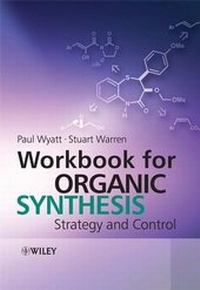
Workbook for Organic Synthesis
Strategy and Control
Published on 21. April 2008
Book
Hardback
500 pages
978-0-470-75883-0 (ISBN)
Description
Workbook for Organic Synthesis: Strategy and Control
Paul Wyatt
Senior Lecturer and Director of Undergraduate Studies, School of Chemistry, University of Bristol, UK
Stuart Warren
Reader in Organic Chemistry, Department of Chemistry, University of Cambridge, UK.
Workbook for Organic Synthesis: Strategy and Control
This workbook provides a comprehensive graded set of problems to illustrate and develop the themes of each of the chapters in the textbook Organic Synthesis: Strategy and Control. Each problem is followed by a fully explained solution and discussion. The examples extend the student's experience of the types of molecules being synthesised by organic chemists, and the strategies they employ to control their syntheses. By working through these examples students will develop their skills in analysing synthetic challenges, and build a toolkit of strategies for planning new syntheses. Together the workbook and textbook provide a complete course in advanced organic synthesis.
Organic Synthesis: Strategy and Control
Organic Synthesis: Strategy and Control is a sequel to Stuart Warren's bestseller Organic Synthesis: The Disconnection Approach. The 'Disconnection' book concentrated on the planning behind the synthesis of compounds. This book focuses on putting the planning into practice.
The two themes of the book are strategy and control: solving problems either by finding an alternative strategy or by controlling any established strategy to make it work.
The book is divided into five sections that deal with selectivity, carbon-carbon single bonds, carbon-carbon double bonds, stereochemistry and functional group strategy. Interpenetrating this structure, the 36 chapters start with classic methods and progress to modern methods and modern strategic considerations. Heterocyclic chemistry is treated throughout the book with full mechanistic explanations as part of organic chemistry rather than a separate entity.
Students and professional chemists familiar with Organic Synthesis: The Disconnection Approach will enjoy the leap into a book designed for chemists at the coalface of organic synthesis.
Reviews / Votes
?This is a must-read for any final year undergrad or PhD? student in organic chemistry, but it's more than that?it's a book for experienced chemists too.? (Reviews, May 2009)More details
Other editions
Additional editions
Book
04/2008
Wiley
€62.00
Shipment within 10-20 days
Persons
Dr Paul Wyatt, School of Chemistry, University of Bristol, Bristol
Dr Wyatt is Director of Undergraduate Studies for the School of Chemistry at Bristol University and also Director of BRISTOL ChemLabS - a HEFCE Centre for Excellence in Teaching & Learning.
Dr Stuart Warren, Department of Chemistry, University of Cambridge, Lensfield Road, Cambridge
Dr Warren is the author of the bestselling textbooks Organic Synthesis: The Disconnection Approach (Wiley) and Organic Synthesis (OUP)
Dr Wyatt is Director of Undergraduate Studies for the School of Chemistry at Bristol University and also Director of BRISTOL ChemLabS - a HEFCE Centre for Excellence in Teaching & Learning.
Dr Stuart Warren, Department of Chemistry, University of Cambridge, Lensfield Road, Cambridge
Dr Warren is the author of the bestselling textbooks Organic Synthesis: The Disconnection Approach (Wiley) and Organic Synthesis (OUP)
Content
Section A: Introduction: Selectivity
1. Planning Organic Syntheses: Tactics, Strategy and Control
2. Chemoselectivity
3. Regioselectivity: Controlled Aldol Reactions
4. Stereoselectivity: Stereoselective Aldol Reactions
5. Alternative Strategies for Enone Synthesis
6. Choosing a Strategy: The Synthesis of Cyclopentenones
Section B: Making Carbon-Carbon Bonds
7. The Ortho Strategy for Aromatic Compounds
8. s-Complexes of Metals
9. Controlling the Michael Reaction
10. Specific Enol Equivalents
11. Extended Enolates
12. Allyl Anions
13. Homoenolates
14. Acyl Anion Equivalents
Section C: Carbon-Carbon Double Bonds
15. Synthesis of Double Bonds of Defined Stereochemistry
16. Vinyl Anions
17. Electrophilic Attack on Alkenes
18. Vinyl Cations
19. Allyl Alcohols: Allyl Cation Equivalents (and More)
Section D: Stereochemistry
20. Control of Stereochemistry -- Introduction
21. Diastereoselectivity
22. Resolution
23. The Chiral Pool: Asymmetric Synthesis with Natural Products as Starting Materials
24. Asymmetric Induction I: Reagent-Based Strategy
25. Asymmetric Induction II: Asymmetric Catalysis: Formation of C-O and C-N Bonds
26. Asymmetric Induction III: Asymmetric Catalysis: Formation of C-H and C-C Bonds
27. Asymmetric Induction IV: Substrate-Based Strategy
28. Kinetic Resolution
29. Enzymes: Biological Methods in Asymmetric Synthesis
30. New Chiral Centres from Old: Enantiomerically Pure Compounds & Sophisticated Syntheses
31. Strategy of Asymmetric Synthesis
Section E: Functional Group Strategy
32. Functionalisation of Pyridine
33. Oxidation of Aromatic Rings and of Enol(ate)s
34. Functionality and Pericyclic Reactions: Nitrogen Heterocycles by Cycloadditions and Sigmatropic Rearrangements
35. Synthesis and Chemistry of Azoles and other Heterocycles with Two or more Heteroatoms
36. Tandem Organic Reactions