

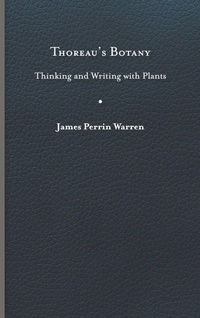
Thoreau's Botany
Thinking and Writing with Plants
Published on 31. August 2023
Book
Hardback
228 pages
978-0-8139-4947-5 (ISBN)
Description
Thoreau's last years have been the subject of debate for decades, but only recently have scholars and critics begun to appreciate the posthumous publications, unfinished manuscripts, and Journal entries that occupied the writer after Walden (1854). Until now, no critical reader has delved deeply enough into botany to see how Thoreau's plant studies impact his thinking and writing. Thoreau's Botany moves beyond general literary appreciation for the botanical works to apply Thoreau's extensive studies of botany--from 1850 to his death in 1862--to readings of his published and unpublished works in fresh, interdisciplinary ways. Bringing together critical plant studies, ecocriticism, and environmental humanities, James Perrin Warren argues that Thoreau's botanical excursions establish a meeting ground of science and the humanities that is only now ready to be recognized by readers of American literature and environmental literature.
Reviews / Votes
"Thoreau's Botany has the potential to make a significant contribution to the scholarship on Thoreau and Transcendentalist studies, as well as the fields of environmental and ecological studies. It is well researched and offers a valuable portrayal of Thoreau's gradual development into serious botanical research and efforts to develop a comprehensive understanding and treatment of plants as our true companions in nature and its life. Warren's extensive close reading of the essay "Autumnal Tints" represents a high point, and the author's disquisition on Walden's Sand Foliage passage is particularly outstanding." - David M. Robinson, Oregon State University, author of Natural Life: Thoreau's Worldly Transcendentalism"When Covid forced Jim Warren into a long spell of isolation in New Mexico's arid Jemez Mountains, he found himself on an unexpected journey into "plant thinking," with Thoreau as his botanical guide into a new mode of awareness, a new way of knowing. In this illuminating book, Warren tracks Thoreau's own experimental journey into a dynamic natural world that is thinking all the time, where plants become words spoken by the soil, bespeaking the vital language of the Earth. In this new way of understanding "the limits and possibilities of language," Warren finds, with Thoreau, a reconnection to faith in the human ability to divine meaning, even in the hard-used, drought-stricken terrain of the Anthropocene." - Laura Dassow Walls, University of Notre Dame, author of Henry David Thoreau: A Life
More details
Series
Language
English
Place of publication
Charlottesville
United States
Target group
Professional and scholarly
Dimensions
Height: 235 mm
Width: 157 mm
Thickness: 18 mm
Weight
530 gr
ISBN-13
978-0-8139-4947-5 (9780813949475)
Copyright in bibliographic data and cover images is held by Nielsen Book Services Limited or by the publishers or by their respective licensors: all rights reserved.
Schweitzer Classification
Other editions
Additional editions
E-Book
08/2023
1st Edition
Naval Institute Press
from
€84.99
Available for download
Person
James Perrin Warren is the S. Blount Mason Jr. Professor of English Emeritus at Washington and Lee University and the author of Other Country: Barry Lopez and the Community of Artists.
Content
Preface
Acknowledgments
Abbreviations
Introduction: Thoreau's Botanical Turn
1. The Two Botanical Excursions of The Maine Woods
2. Cape Cod and the Seven Excursions
3. Walden as Botanical Excursion
4. Thoreau's Kalendar: Reading the Journal through Plants
5. The Dispersion of Seeds and the Writer's Faithful Record
6. Wild Fruits and Transformative Perceptions
Epilogue: Walking in the Anthropocene
Notes
Bibliography
Index
Acknowledgments
Abbreviations
Introduction: Thoreau's Botanical Turn
1. The Two Botanical Excursions of The Maine Woods
2. Cape Cod and the Seven Excursions
3. Walden as Botanical Excursion
4. Thoreau's Kalendar: Reading the Journal through Plants
5. The Dispersion of Seeds and the Writer's Faithful Record
6. Wild Fruits and Transformative Perceptions
Epilogue: Walking in the Anthropocene
Notes
Bibliography
Index