

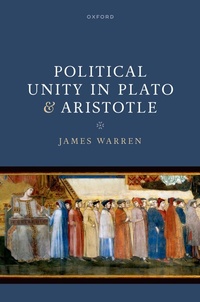
Political Unity in Plato and Aristotle
Published on 11. June 2026
Book
Hardback
208 pages
978-0-19-889832-0 (ISBN)
Description
Plato and Aristotle both think that for humans to live full and flourishing lives, we must live together in political communities. They are therefore interested in their various ways in which the people in any given political community relate to one another, how they respond to or value one another, and how they conceive of their good in relation to their fellow citizens. Plato and Aristotle think that instilling and maintaining the correct beliefs and attitudes (such as 'solidarity', 'like-mindedness', and 'friendship') among the citizens is the most important mechanism to ensure that the city is 'one' and resistant to internal strife, factionalism, and perhaps the eventual dissolution of the community. This study is an investigation of the various ways in which Plato and Aristotle approach the question of political unity, how their views differ from and are alike one another, and the ways in which their views matter for continuing discussions. James Warren investigates their arguments for what kinds of relationships are important and how citizens should relate to and think about one another, work together, and feel as part of a single unified political community.
More details
Language
English
Place of publication
Oxford
United Kingdom
Target group
College/higher education
Product notice
sewn/stitched
Cloth over boards
Dimensions
Height: 241 mm
Width: 163 mm
Thickness: 16 mm
Weight
466 gr
ISBN-13
978-0-19-889832-0 (9780198898320)
Copyright in bibliographic data and cover images is held by Nielsen Book Services Limited or by the publishers or by their respective licensors: all rights reserved.
Schweitzer Classification
Person
James Warren studied Classics at Clare College, Cambridge, where he stayed to complete his MPhil and PhD. After two years as a Research Fellow at Magdalene College, in 2001 he took up a Lectureship at the Faculty of Classics in Cambridge and a Fellowship in Philosophy at Corpus Christi college. He became Professor of Ancient Philosophy in 2017.
Content
1: Introduction: Political Unity and Prosocial Attitudes 2: Koin=onia, Community, and Solidarity 3: Homonoia and Political Friendship 4: Political Persistence 5: Ancient Allies