

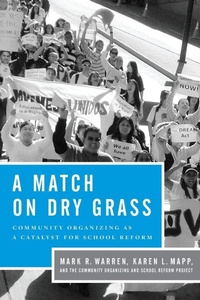
A Match on Dry Grass
Community Organizing as a Catalyst for School Reform
1st Edition
Published on 29. September 2011
Book
Paperback/Softback
328 pages
978-0-19-979358-7 (ISBN)
Description
The persistent failure of public schools in low-income neighborhoods, where fully half of black and Latino students fail to graduate with their peers, has vexed educators for decades. A Match on Dry Grass argues that community organizing represents a fresh and promising antidote to educational failure. Based on a comprehensive national study, the book presents rich and compelling case studies of prominent efforts in Chicago, New York City, Los Angeles, Denver, San Jose, and the Mississippi Delta. The authors show how organizing groups work to build the participation and leadership of parents and students so they can hold school systems accountable for real improvements. But organizing groups do not just demand change. They also collaborate with educators and other community residents to contribute to efforts to improve schooling. Out of these six case studies, Warren, Mapp, and their collaborators identify the central processes common to dynamic organizing efforts for school reform, outlining how community organizing builds the kinds of relationships that can transform schools and communities.
Reviews / Votes
Civil rights activists in the 1960s insisted in the face of terror and death that national citizenship granted in the 14th Amendment meant something. That seminal work inspired organizing groups, active agents in an historic and on-going process, to bond with and bridge across racial, faith, gender, immigrant, and youth communities to reshape the narrative about the promise of citizenship. A Match on Dry Grass draws on these organizing traditions in the work to right 'the wrong this day done' in the nation's public schools. All of us doing that work will benefit from reading this book. * Robert Moses, Founder of the Algebra Project * This is an important book for anyone interested in fundamental and sustainable school reform. Community organizing as described in A Match on Dry Grass creates new relationships, new community leadership, and new political power focused on doing what is right for kids. These are potent sources of support for true systemic change and an essential dimension to transforming our schools for the long haul. * Andres A. Alonso, Chief Executive Officer, Baltimore City Public Schools * In a context of top-down school reform preoccupied with changing administrative policies, the stories of bottom-up, community organizing initiatives in A Match on Dry Grass read like a breath of fresh air. Who better to spearhead educational reform than the young people, parents, teachers, and neighborhood residents who are committed to bringing about change in their communities? Simultaneously analytical yet full of practical organizing techniques, this important volume offers a provocative mosaic of not only what is possible, but what people are actually doing. A Match on Dry Grass's on-the-ground view of community organizing for school reform is must reading for those who see how important quality public education is for building a strong democracy. * Patricia Hill Collins, Distinguished University Professor, University of Maryland * For too long we have been waiting for Presidents, Governors and other self-declared superheroes to save our schools while overlooking the power and potential of local communities. This detailed study on community organizing for educational change in school districts and communities throughout the United States serves as a poignant lesson to those who are genuinely concerned about promoting educational change and a powerful reminder of what is possible when those with the most at stake take action to compel schools to improve. * Pedro A. Noguera, Professor of Education, New York University * A Match on Dry Grass locates the problems of public education as residing squarely in unequal power relations in a socially and economically stratified society. The diverse and engaging accounts of successful organizing efforts show that relational power develops where community organizing becomes a way of life without which sustained progressive educational change is neither possible nor desirable. This book is a treasure that I plan to reference again and again. * Angela Valenzuela, Professor of Educational Policy and Planning, University of Texas-Austin, and author of Subtractive Schooling and Leaving Children Behind *More details
Language
English
Place of publication
New York
United States
Target group
Professional and scholarly
Illustrations
18 b/w halftones, 3 b/w line
Dimensions
Height: 234 mm
Width: 156 mm
Thickness: 20 mm
Weight
577 gr
ISBN-13
978-0-19-979358-7 (9780199793587)
Copyright in bibliographic data and cover images is held by Nielsen Book Services Limited or by the publishers or by their respective licensors: all rights reserved.
Schweitzer Classification
Other editions
Additional editions
Mark R. Warren | Karen L. Mapp | The Community
A Match on Dry Grass
Community Organizing as a Catalyst for School Reform
E-Book
10/2011
1st Edition
OUP eBook
€21.99
Available for download
Mark R. Warren | Karen L. Mapp
A Match on Dry Grass
Community Organizing as a Catalyst for School Reform
Book
09/2011
1st Edition
Oxford University Press Inc
€155.50
Shipment within 15-20 days
Mark R. Warren | Karen L. Mapp | The Community
A Match on Dry Grass
Community Organizing as a Catalyst for School Reform
E-Book
07/2011
1st Edition
OUP eBook
€21.99
Available for download
Persons
Mark R. Warren is Associate Professor at Harvard Graduate School of Education and author of Fire in the Heart and Dry Bones Rattling.
Karen L. Mapp is Lecturer in Education at the Harvard Graduate School of Education and author of Beyond the Bake Sale.
The Community Organizing and School Reform Project at the Harvard Graduate School of Education, led by Mark R. Warren and Karen L. Mapp, consists of Keith Catone, Roy Cervantes, Connie K. Chung, Cynthia Gordon, Soo Hong, Ann Ishimaru, Paul Kuttner, Meredith Mira, Thomas Nikundiwe, Soojin Oh, Kenneth Russell, Amanda Taylor, Mara Tieken, Anita Wadhwa, and Helen Westmoreland.
Karen L. Mapp is Lecturer in Education at the Harvard Graduate School of Education and author of Beyond the Bake Sale.
The Community Organizing and School Reform Project at the Harvard Graduate School of Education, led by Mark R. Warren and Karen L. Mapp, consists of Keith Catone, Roy Cervantes, Connie K. Chung, Cynthia Gordon, Soo Hong, Ann Ishimaru, Paul Kuttner, Meredith Mira, Thomas Nikundiwe, Soojin Oh, Kenneth Russell, Amanda Taylor, Mara Tieken, Anita Wadhwa, and Helen Westmoreland.
Content
Preface & Acknowledgements ; Introduction: A New Movement for Equity and Justice in Education ; Chapter 1. How Community Organizing Works ; Chapter 2. "A Match on Dry Grass" ; Organizing for Great Schools in San Jose ; Chapter 3. "An Appetite for Change" ; Building Relational Cultures for Educational Reform and Civic Engagement in Los Angeles ; Chapter 4. <"Our Strength is the Power of Our Community>" ; Political Education and the Continuation of the Struggle in Denver ; Chapter 5. <"Weaving a Tapestry that won't Unravel>" ; The Transformation of Education in the Mississippi Delta ; Chapter 6. <"Acts of Leadership>" ; Building Powerful Forms of Parent Participation in Chicago ; Chapter 7. <"Cement between the Bricks>" ; Building Schools and Communities in New York City ; Chapter 8. Building Relationships and Power to Transform Communities ; and Schools ; Conclusion: Lessons for School Reform and Democracy-Building ; Appendix A Collaborative Research Process ; References