

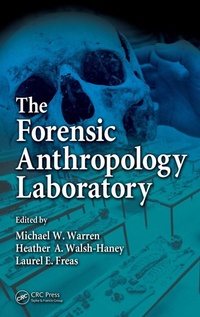
The Forensic Anthropology Laboratory
1st Edition
Published on 9. May 2008
Book
Hardback
238 pages
978-0-8493-2320-1 (ISBN)
Description
Presenting a rare glimpse into the various laboratories that involve forensic anthropology, The Forensic Anthropology Laboratory reveals the ways in which anthropologists document, process, and collect data for academic research and practical and legal applications, including time of death, trauma analyses, and the identification of unknown human remains.
Drawing from a wide range of sources, the book begins with detailed descriptions of how body donations are received and processed. It includes extraordinary photos documenting the steps taken to ensure that each body part is tracked from the moment it is received through the decomposition and skeletonization processes. Dr. David Hunt, of the Smithsonian Institution, discusses destructive analysis, diagnostic imaging, casting, and all types of anthroposcopic and anthropometric data collection methods.
The book also compares the duties of full-time forensic anthropologists in a medical examiner's office with their academic counterparts, discussing staffing, physical plant concerns, field recovery procedures, and laboratory processing. It stresses the variety of required skills, including fingerprinting and other trace evidence procedures, and highlights casework examples from FACES, illustrating the technology used to establish identifications through facial reconstruction, photographic superimposition, and age progression. Using examples from the World Trade Center, Hurricane Katrina, and the Asian Tsunami disasters, the book examines the roles of forensic anthropologists and pathologists as mass fatality responders. It discusses practical issues and explains how and where the mobile disaster morgue can be used, including morgue floor plans and equipment.
A one-of-a-kind survey of a variety of forensic anthropology laboratories, the editors provide an insider's view of functioning laboratories as reported by some of the most respected and prolific anthropologists in clinical, research, and academic settings.
Drawing from a wide range of sources, the book begins with detailed descriptions of how body donations are received and processed. It includes extraordinary photos documenting the steps taken to ensure that each body part is tracked from the moment it is received through the decomposition and skeletonization processes. Dr. David Hunt, of the Smithsonian Institution, discusses destructive analysis, diagnostic imaging, casting, and all types of anthroposcopic and anthropometric data collection methods.
The book also compares the duties of full-time forensic anthropologists in a medical examiner's office with their academic counterparts, discussing staffing, physical plant concerns, field recovery procedures, and laboratory processing. It stresses the variety of required skills, including fingerprinting and other trace evidence procedures, and highlights casework examples from FACES, illustrating the technology used to establish identifications through facial reconstruction, photographic superimposition, and age progression. Using examples from the World Trade Center, Hurricane Katrina, and the Asian Tsunami disasters, the book examines the roles of forensic anthropologists and pathologists as mass fatality responders. It discusses practical issues and explains how and where the mobile disaster morgue can be used, including morgue floor plans and equipment.
A one-of-a-kind survey of a variety of forensic anthropology laboratories, the editors provide an insider's view of functioning laboratories as reported by some of the most respected and prolific anthropologists in clinical, research, and academic settings.
More details
Language
English
Place of publication
Bosa Roca
United States
Publishing group
Taylor & Francis Inc
Target group
Professional and scholarly
Academic and Professional Practice & Development
Illustrations
10 s/w Abbildungen, 80 s/w Photographien bzw. Rasterbilder, 5 s/w Tabellen
5 Tables, black and white; 80 Halftones, black and white; 10 Illustrations, black and white
Dimensions
Height: 240 mm
Width: 161 mm
Thickness: 17 mm
Weight
526 gr
ISBN-13
978-0-8493-2320-1 (9780849323201)
Copyright in bibliographic data and cover images is held by Nielsen Book Services Limited or by the publishers or by their respective licensors: all rights reserved.
Schweitzer Classification
Other editions
Additional editions
Michael W. Warren | Heather A. Walsh-Haney | Laurel Freas
The Forensic Anthropology Laboratory
E-Book
05/2008
1st Edition
CRC Press
€225.99
Available for download
Michael W. Warren | Heather A. Walsh-Haney | Laurel Freas
The Forensic Anthropology Laboratory
E-Book
05/2008
1st Edition
CRC Press
€225.99
Available for download
Persons
Michael W. Warren, Heather A. Walsh-Haney, Laurel Freas
Content
Introduction. The Anthropology Research Facility, University of Tennessee. The Forensic Anthropology Laboratory in a Medical Examiner Setting. Joint POW/MIA Accounting Command's Central Identification Laboratory. The University of Indianapolis Archeology & Forensics Laboratory. The Mass Fatality Incident Morgue: A Laboratory for Disaster Victim Identification. The Repatriation Osteology Laboratory at the Smithsonian Institution. History and Collections of the Division of Physical Anthropology, Smithsonian Institution. The LSU Forensic Anthropology and Computer Enhancement Services Laboratory. The Working Forensic Anthropology Laboratory.