

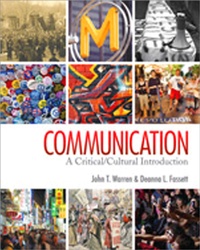
Communication
A Critical/Cultural Introduction
1st Edition
Published on 30. December 2010
Book
Paperback/Softback
232 pages
978-1-4129-5942-1 (ISBN)
Description
Stressing the interrelatedness of the many facets of communication, this introductory text explores major theories by locating those ideas and concepts in the context of current, cultural issues. The authors' narrative approach helps students more easily see the connections to their daily lives, and public communication is reframed within this text as public advocacy, helping students become critical, active citizens in their communities. By recognizing that they are members of a complex system of power that both enables and constrains their actions, students are able to explore the ways their communication constitutes and frames their social world.
Communicating Culture provides a context to see communication as both productive of power and a productive way of envisioning social movement against unethical or unjust power.
Communicating Culture provides a context to see communication as both productive of power and a productive way of envisioning social movement against unethical or unjust power.
Reviews / Votes
"I believe students will relate extremely well to the writing. The fact that the authors offer up their stories gives this textbook a unique and welcomed quality that sets it above others. The text is accessible without being elementary, and the content is important and timely. I've been looking for a book that addresses the nuances of culture and takes a critical approach to communication, and I believe I've found it!" -- Sandy Pensoneau-Conway "I like that interpersonal communication is explained as communication between people who have some sort of stake in one another. I can't help but think of what a difference it would make if all of our students thought of communication in this way. In like manner, to frame interpersonal communication as the intersection of self, Other and culture is really useful.... This book is making me think." -- Sarah Bonewits Feldner "The goals of this text are laudable and refreshing. I think its social justice focus is appropriate in demonstrating and motivating advocacy. The critical framework is exceptional, placing the theories in a perspective that is consistently maintained throughout the text. This approach is long overdue." -- Reeze Hanson "The greatest benefit of this book is its sophisticated treatment of a wide range of communication concepts from interpersonal to public speaking. The narrative examples make this a more readable text for introductory level students without skimping on challenging concepts." -- Keith Nainby "The uniqueness of this work's mission and the specific ways it gets enacted, the personalized nature of the authors' narratives, the relevant examples, the use of often avoided topics in intro communication texts, and the ways these topics get treated with depth, respect and precision.... these are the key contributions of this book." -- Keith Berry "This is the book that I have been waiting for. It respects students and interrogates theory. The critical approach teaches students to independently consider communication in all forms. The central message that knowledge allows us to change is fundamental to my teaching philosophy. This text would actually be read by my students and would support what I teach in lecture." -- John B. Ryan "The authors' style is conversational, non-didactic, and the approach encourages critical thinking.... The great advantage of this text is that it will help foster dialogic communication in the classroom and a high degree of student reflection." -- Don Rubin This text uses a narrative approach to situate communication concepts within contexts. I really like the central theories, issues focus, narrative style, and public address and activism features. These make the book unique and, I believe, engaging both for seasoned instructors and for students.... It could prove very fun to teach from. -- Deanna SellnowMore details
Language
English
Place of publication
Thousand Oaks
United States
Target group
College/higher education
Dimensions
Height: 254 mm
Width: 203 mm
Weight
567 gr
ISBN-13
978-1-4129-5942-1 (9781412959421)
Copyright in bibliographic data and cover images is held by Nielsen Book Services Limited or by the publishers or by their respective licensors: all rights reserved.
Schweitzer Classification
Other editions
New editions
Book
02/2015
2nd Edition
SAGE Publications Inc
€197.58
Shipment within 15-20 days
Persons
John T. Warren (Late) was professor of Speech Communication at Southern Illinois University, Carbondale. His major research and teaching centered in Communication Pedagogy, Performance Studies, and Communication and Critical/Cultural Studies. He was the author of numerous books including Performing Purity: Whiteness, Pedagogy and the Reconstitution of Power; Casting Gender: Women and Performance in Intercultural Contexts; Critical Communication Pedagogy; and the SAGE Handbook of Communication and Instruction. He also authored articles for several education and communication studies journals, including Educational Theory, Communication Education, and Text and Performance Quarterly. Deanna L. Fassett is Department Chair and professor of communication pedagogy at San Jose State University where she has, since 2002, mentored her department's graduate student instructors. She is the author and editor of three other books: Coordinating the Communication Course: A Guidebook, Critical Communication Pedagogy, The SAGE Handbook of Communication and Instruction, and Communication: A Critical/Cultural Introduction, Second Edition. Her published research has appeared in a broad array of communication studies journals, including Basic Communication Course Annual, Communication Education, Liminalities: A Journal of Performance Studies, and Text and Performance Quarterly.
Content
Preface
PART I: FIRST PRINCIPLES
1. Thinking Critically About Communication in Culture
The Foundations of Our Dialogue: Terms and Common Understandings
Words for Change: The Power of Communication
Public Advocacy: Process and Responsibilities
2. Communication and Power: A Cultural History
Part One: The Rhetorical Tradition
Part Two: The Elocution Era
Part Three: The Move to Science
Part Four: Social Constructionism
Part Five: The Critical/Cultural Turn
A Moral: Lessons From Our Story of a Discipline
Public Advocacy: Purpose, Audience, and Voice
3. Public Advocacy: Commitments and Responsibility
What Is Public Advocacy?
A Model for Advocacy: Paulo Freire
Listening as Public Advocacy
Public Advocacy: Integrity in Argumentation
PART II: COMMUNICATION PROCESSES AND SKILLS
4. Identity and Perception
Who Is Harper? Three Communication Paradigms
Public Advocacy: Perception and Audience Analysis
5. Language and Culture
Semiotics: Structure and Symbols
A Post-Semiotic Approach to Language
Language as Constitutive: Ideology and Everyday Speech
Public Advocacy: Inclusive Language
6. Embodied Knowing and Nonverbal Communication
Body Epistemology: Knowing
Body Identity: Being
Body Language: Communicating
Body Intentionality
Public Advocacy: The Body as a Resource
PART III: COMMUNICATION CONTEXTS
7. Language and Power in Our Cultural Lives
Myth 1: Culture Is Static
Myth 2: Culture and Power Are Separate
Myth 3: Stereotypes Are Built on Truths
Myth 4: Progress Is Progress
Myth 5: Colorblindness Is Progress
Myth 6: We're All Making a Big Deal Out of Nothing
From Myths to Critical Understanding
Public advocacy: Academic Integrity and Citationality
8. Cultural Relations: Relationships in Culture
Of Self and Other
Of Frames and Play
Of Patterns and Rituals
Of Change and Relational Dialectics
Of I and Thou
Public Advocacy: Building Relationships, Context, and Listening
9. Mediated Culture(s)
Con-constitution: Media in Our Cultural Lives
Consuming Mediated Messages
Your Mediated Self
Surveillance
Media Use, Culture(s) and Power
Resistance
Public Advocacy: Visual Aids and Organization
10. Communication as a Means of Social Action
Discipline
Simulacra
Difference
Exhaustion, Cynicism, and Nihilism
Public Avocacy: Tactics for Social Action
Glossary
Index
About the Author
PART I: FIRST PRINCIPLES
1. Thinking Critically About Communication in Culture
The Foundations of Our Dialogue: Terms and Common Understandings
Words for Change: The Power of Communication
Public Advocacy: Process and Responsibilities
2. Communication and Power: A Cultural History
Part One: The Rhetorical Tradition
Part Two: The Elocution Era
Part Three: The Move to Science
Part Four: Social Constructionism
Part Five: The Critical/Cultural Turn
A Moral: Lessons From Our Story of a Discipline
Public Advocacy: Purpose, Audience, and Voice
3. Public Advocacy: Commitments and Responsibility
What Is Public Advocacy?
A Model for Advocacy: Paulo Freire
Listening as Public Advocacy
Public Advocacy: Integrity in Argumentation
PART II: COMMUNICATION PROCESSES AND SKILLS
4. Identity and Perception
Who Is Harper? Three Communication Paradigms
Public Advocacy: Perception and Audience Analysis
5. Language and Culture
Semiotics: Structure and Symbols
A Post-Semiotic Approach to Language
Language as Constitutive: Ideology and Everyday Speech
Public Advocacy: Inclusive Language
6. Embodied Knowing and Nonverbal Communication
Body Epistemology: Knowing
Body Identity: Being
Body Language: Communicating
Body Intentionality
Public Advocacy: The Body as a Resource
PART III: COMMUNICATION CONTEXTS
7. Language and Power in Our Cultural Lives
Myth 1: Culture Is Static
Myth 2: Culture and Power Are Separate
Myth 3: Stereotypes Are Built on Truths
Myth 4: Progress Is Progress
Myth 5: Colorblindness Is Progress
Myth 6: We're All Making a Big Deal Out of Nothing
From Myths to Critical Understanding
Public advocacy: Academic Integrity and Citationality
8. Cultural Relations: Relationships in Culture
Of Self and Other
Of Frames and Play
Of Patterns and Rituals
Of Change and Relational Dialectics
Of I and Thou
Public Advocacy: Building Relationships, Context, and Listening
9. Mediated Culture(s)
Con-constitution: Media in Our Cultural Lives
Consuming Mediated Messages
Your Mediated Self
Surveillance
Media Use, Culture(s) and Power
Resistance
Public Advocacy: Visual Aids and Organization
10. Communication as a Means of Social Action
Discipline
Simulacra
Difference
Exhaustion, Cynicism, and Nihilism
Public Avocacy: Tactics for Social Action
Glossary
Index
About the Author