

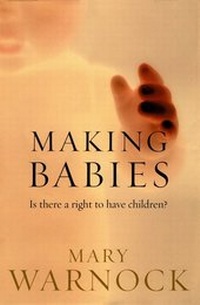
Making Babies
Is There a Right to Have Children?
Published on 18. July 2002
Book
Hardback
126 pages
978-0-19-280334-4 (ISBN)
Description
The development of new reproductive technologies has raised urgent questions and debates about how and by whom these treatments should be controlled.
On the one hand individuals and groups have claimed access to assisted reproduction as a right, and some have also claimed that this access should be available free of charge. As well as clinically infertile heterosexual couples, this right has been claimed by single women, gay couples, post-menopausal women, and couples who wish to delay having children for various reasons.
Others have argued that a desire to have children does not make it a human right, and, moreover, that there are some people who should not be assisted to become parents, on grounds of age, sexuality, or lifestyle.
Mary Warnock steers a clear path through the web of complex issues underlying these views. She begins by analysing what it means to claim something as a 'right', and goes on to discuss the cases of different groups of people. She also examines the ethical problems faced by particular types of assisted reproduction, including artificial insemination, in-vitro fertilization, and surrogacy, and argues that in the future human cloning may well be a viable and acceptable form of treatment for some types of infertility.
On the one hand individuals and groups have claimed access to assisted reproduction as a right, and some have also claimed that this access should be available free of charge. As well as clinically infertile heterosexual couples, this right has been claimed by single women, gay couples, post-menopausal women, and couples who wish to delay having children for various reasons.
Others have argued that a desire to have children does not make it a human right, and, moreover, that there are some people who should not be assisted to become parents, on grounds of age, sexuality, or lifestyle.
Mary Warnock steers a clear path through the web of complex issues underlying these views. She begins by analysing what it means to claim something as a 'right', and goes on to discuss the cases of different groups of people. She also examines the ethical problems faced by particular types of assisted reproduction, including artificial insemination, in-vitro fertilization, and surrogacy, and argues that in the future human cloning may well be a viable and acceptable form of treatment for some types of infertility.
Reviews / Votes
This is practical philosophy as it should be written: concise, elegant and comprehensible. * Telegraph *More details
Language
English
Place of publication
Oxford
United Kingdom
Dimensions
Height: 204 mm
Width: 135 mm
Thickness: 15 mm
Weight
239 gr
ISBN-13
978-0-19-280334-4 (9780192803344)
Copyright in bibliographic data and cover images is held by Nielsen Book Services Limited or by the publishers or by their respective licensors: all rights reserved.
Schweitzer Classification
Other editions
Additional editions
Book
08/2003
Oxford University Press
€27.60
Shipment within 15-20 days
Person
Mary Warnock's work in academic philosophy includes the books Imagination, Memory, and Existentialism. Much of her career was spent at Oxford University, and she ras later Mistress of Girton College Cambridge. She was made a life peer in 1985, and chaired the Committee of Enquiry into Human Fertilisation and Embryology, whose report formed the basis of legislation in the UK. Her most recent book is her autobiography, Mary Warnock: A Memoir.
Content
Introduction ; Techniques of assisted reproduction ; Who pays? ; The right that no stone should be left unturned ; What constitutes a right? ; Do people need to have children? ; A further look at the question of whether there can exist a right to do what is morally wrong ; The moral status of the human embryo ; Back to infertility ; 2. May doctors refuse treatment? ; The slippery slope ; Are those who are not infertile entitled to assisted conception? ; Openness ; Why do homosexuals want children? ; The natural and the unnatural ; The search for security ; Is fear a proper basis for moral judgement? ; Conslusions so far ; Are all methods of fertility treatment legitimate? ; Cloning: 1997-2001