

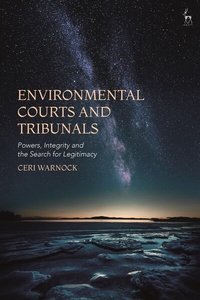
Environmental Courts and Tribunals
Powers, Integrity and the Search for Legitimacy
Published on 24. December 2020
Book
Hardback
224 pages
978-1-5099-4006-6 (ISBN)
Description
The global phenomenon of the establishment of specialist courts is one of the most important recent developments in environmental law. Although they are generally seen as a much needed innovation, they do pose challenges, particularly around questions of legitimacy. This important book tackles these questions directly, looking specifically at the courts in the common law world. It argues that to fully understand the nature of the adjudication of these courts, a bottom-up approach must be taken: ie the question before the court is determinative. Despite its theoretical focus, the book will also provide invaluable insights to practitioners engaging with these new courts for the first time. An innovative study on a seismic change in how environmental law is adjudicated.
Reviews / Votes
The book is well written, dense with ideas and filled with detail ... it will repay reading many times over. -- David Kirkpatrick, Chief Environment Court Judge * Resource Management Journal * This book is an excellent and stimulating way to prompt thinking about a big subject that will be very much a live issue in the coming years. -- Colin T Reid, University of Dundee * Scottish Planning and Environmental Law * Warnock's work makes an important and convincing contribution to our understanding of environmental adjudication. It significantly advances the scholarship and adds an enormous amount to the richness of our thinking about environmental courts. -- Emma Lees * Journal Of Environmental Law *More details
Language
English
Place of publication
Oxford
United Kingdom
Publishing group
Bloomsbury Publishing PLC
Target group
College/higher education
Dimensions
Height: 234 mm
Width: 156 mm
Weight
490 gr
ISBN-13
978-1-5099-4006-6 (9781509940066)
Copyright in bibliographic data and cover images is held by Nielsen Book Services Limited or by the publishers or by their respective licensors: all rights reserved.
Schweitzer Classification
Other editions
Additional editions
E-Book
01/2021
1st Edition
Hart Publishing
€43.49
Available for download
Person
Content
1. Introduction
I. The Rise in Specialist Environmental Adjudication
II. An Interactional Theory for Environmental Adjudication
III. The Method of Developing a Theory for Environmental Adjudication
IV. Certain Caveats
2. Specialist Environment Courts: Mapping the Landscape
I. Specialist Environment Courts: A Typology
II. Specialist Environment Courts as Dynamic Adjudicatory Forms
III. Introducing the Case Studies: The Environment Court of New Zealand and the Land and Environment Court of New South Wales
IV. Underlying Tensions
3. The Struggle to Make Legal Sense of Specialist Environment Courts
I. Normative Legitimacy and Analytical Frames
II. The 'Administrative Justice-Adjudicative Pluralism' Frame
III. The 'Generic Instrumentalism' Frame
IV. The 'Separation of Powers' Frame
V. Developing a Frame that We Can Agree On?
4. Developing the Theory: Adjudicative Integrity
I. The Malleability of Adjudication
II. Normative Justifiability and Adjudicative Integrity
5. Developing the Theory: Contextual Foundations
I. The Inherent Features of Environmental Problems
II. Interaction and Change
III. Uncertainty
IV. Drawing the Threads Together
6. The Interactional Theory in Practice
I. Acknowledging the Challenges in Environmental Adjudication
II. Responding to Uncertainty
III. Responding to the Collective Action Nature of Environmental Problems
IV. Testing the Theory
7. Conclusion
I. Findings
II. Developing the Theory
III. Filling in the Frame
IV. Employing the Theory
V. Future Directions
VI. Conclusion
I. The Rise in Specialist Environmental Adjudication
II. An Interactional Theory for Environmental Adjudication
III. The Method of Developing a Theory for Environmental Adjudication
IV. Certain Caveats
2. Specialist Environment Courts: Mapping the Landscape
I. Specialist Environment Courts: A Typology
II. Specialist Environment Courts as Dynamic Adjudicatory Forms
III. Introducing the Case Studies: The Environment Court of New Zealand and the Land and Environment Court of New South Wales
IV. Underlying Tensions
3. The Struggle to Make Legal Sense of Specialist Environment Courts
I. Normative Legitimacy and Analytical Frames
II. The 'Administrative Justice-Adjudicative Pluralism' Frame
III. The 'Generic Instrumentalism' Frame
IV. The 'Separation of Powers' Frame
V. Developing a Frame that We Can Agree On?
4. Developing the Theory: Adjudicative Integrity
I. The Malleability of Adjudication
II. Normative Justifiability and Adjudicative Integrity
5. Developing the Theory: Contextual Foundations
I. The Inherent Features of Environmental Problems
II. Interaction and Change
III. Uncertainty
IV. Drawing the Threads Together
6. The Interactional Theory in Practice
I. Acknowledging the Challenges in Environmental Adjudication
II. Responding to Uncertainty
III. Responding to the Collective Action Nature of Environmental Problems
IV. Testing the Theory
7. Conclusion
I. Findings
II. Developing the Theory
III. Filling in the Frame
IV. Employing the Theory
V. Future Directions
VI. Conclusion