

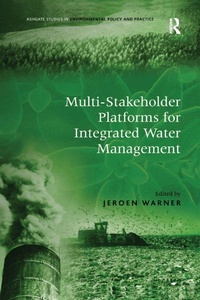
Multi-Stakeholder Platforms for Integrated Water Management
1st Edition
Published on 15. November 2016
Book
Paperback/Softback
300 pages
978-1-138-26614-8 (ISBN)
Description
As they provide a negotiating space for a diversity of interests, Multi-Stakeholder Platforms (MSPs) are an increasingly popular mode of involving civil society in resource management decisions. This book focuses on water management to take a positive, if critical, look at this phenomenon. Illustrated by a wide geographical range of case studies from both developed and developing worlds, it recognizes that MSPs will neither automatically break down divides nor bring actors to the table on an equal footing, and argues that MSPs may in some cases do more harm than good. The volume then examines how MSPs can make a difference and how they might successfully co-opt the public, private and civil-society sectors. The book highlights the particular difficulties of MSPs when dealing with integrated water management programmes, explaining how MSPs are most successful at a less complex and more local level. It finally questions whether MSPs are - or can be - sustainable, and puts forward suggestions for improving their durability.
Reviews / Votes
'This pioneering book weaves critical analysis of cases and constructive synthesis of concepts into an insightful examination of 'what sort of beasts' multistakeholder platforms may become. Highly recommended for water managers and researchers, and anyone who wants to learn more about these increasingly popular strategies for participatory problem-solving.' Bryan Bruns, Consulting Sociologist, co-editor of Negotiating Water Rights and of Water Rights Reform: Lessons for Institutional Design 'Multi-Stakeholder Platforms for Integrated Water Management provides a true introduction to participatory management. The various chapters present a broad overview of the variety of issues confronting water users as they organize themselves to manage the resource base. Based on a range of practical cases, that highlight specific issues, Warner has been able to connect water use practice to theories of public management in a very elegant and clarifying way. Overall, a very interesting and recommendable read.' Ger Bergkamp, IUCN - The World Conservation Union '...an extremely timely contribution to debates around public deliberative forums for water resources management.' Journal of Environmental Planning and Management '...the book makes a valuable contribution to planning generally, and environmental planning specifically, in its explication of methods and tools for assessing situations where MSPs might be employed and facilitating their creation and usefulness. There are few books that do this as well.' Australian PlannerMore details
Language
English
Place of publication
London
United Kingdom
Publishing group
Taylor & Francis Ltd
Target group
College/higher education
Dimensions
Height: 234 mm
Width: 156 mm
Thickness: 16 mm
Weight
462 gr
ISBN-13
978-1-138-26614-8 (9781138266148)
Copyright in bibliographic data and cover images is held by Nielsen Book Services Limited or by the publishers or by their respective licensors: all rights reserved.
Schweitzer Classification
Other editions
Additional editions
E-Book
09/2016
Routledge
€77.99
Available for download
E-Book
09/2016
Routledge
€77.99
Available for download
Book
06/2007
1st Edition
Routledge
€233.50
Shipment within 10-20 days
Person
Jeroen Warner is from Wageningen University and Research Centre, The Netherlands.
Content
1: The Beauty of the Beast: Multi-Stakeholder Participation for Integrated Catchment Management; 2: The Nature of the Beast: Towards a Comparative MSP Typology; 3: Collaborative Capital: A Key to the Successful Practice of Integrated Water Resources Management; 4: Integrated Catchment Management and MSPs: Pulling in Different Directions?; 5: Contrasting UK Experiences with Participatory Approaches to Integrated River Basin Management; 6: Arhus Convention in Practice: Access to Information and Decision-making in a Pilot Planning Process for a Flemish River Basin; 7: The International Zwin Commission: The Beauty of a Mayfly?; 8: Participating in Watershed Management: Policy and Practice in the Trahunco Watershed, Argentinean Patagonia; 9: 'Yakunchik': Coming to Agreement after Violence in Peru; 10: Multi-Stakeholder Platforms for Surface and Groundwater Management in the Lerma-Chapala Basin, Mexico; 11: Less Tension, Limited Decision: A Multi-Stakeholder Platform to Review a Contested Sanitation Project in Tiquipaya, Bolivia; 12: Multi-Stakeholder Dissonance in the South African Water Arena; 13: Mekong Region Water-Related MSPs - Unfulfilled Potential; 14: Against the Conventional Wisdom: Why Sector Reallocation of Water and Multi-Stakeholder Platforms Do Not Take Place in Uzbekistan; 15: Unpacking Participatory NRM: Distinguishing Resource Capture from Democratic Governance; 16: Towards Evaluating MSPs for Integrated Catchment Management