

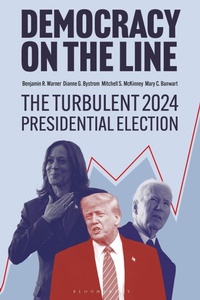
Democracy on the Line
The Turbulent 2024 Presidential Election
Will be published approx. on 20. August 2026
Book
Hardback
288 pages
979-8-7651-4493-0 (ISBN)
Description
Leading scholars of political communication analyze the most defining and groundbreaking moments of the 2024 U.S. presidential election.
With cutting-edge work on the ubiquitous presidency, a new theory of racial socialization, trailblazing theorizing on neurodiversity in political media coverage, and new conceptualizations of masculinity, this volume covers the key events and messages that defined 2024's polarizing election cycle. Chapters include analysis of some of the most significant presidential debates in the history of the United States; the replacement of Joe Biden with Kamala Harris on the Democratic presidential ticket; the memes that Harris's surprise candidacy launched; the battle on the airwaves for message supremacy; broader discourses around threats to democracy, reproductive rights, and immigrants; and cultural conversations about race, gender, and sexuality. The book will include quantitative, qualitative, and rhetorical scholarship to provide a full picture of campaign communication that engages every corner of the field. The result is an essential collection for anyone seeking to understand modern campaign communication or anyone wishing to keep a permanent record of this historic election.
With cutting-edge work on the ubiquitous presidency, a new theory of racial socialization, trailblazing theorizing on neurodiversity in political media coverage, and new conceptualizations of masculinity, this volume covers the key events and messages that defined 2024's polarizing election cycle. Chapters include analysis of some of the most significant presidential debates in the history of the United States; the replacement of Joe Biden with Kamala Harris on the Democratic presidential ticket; the memes that Harris's surprise candidacy launched; the battle on the airwaves for message supremacy; broader discourses around threats to democracy, reproductive rights, and immigrants; and cultural conversations about race, gender, and sexuality. The book will include quantitative, qualitative, and rhetorical scholarship to provide a full picture of campaign communication that engages every corner of the field. The result is an essential collection for anyone seeking to understand modern campaign communication or anyone wishing to keep a permanent record of this historic election.
More details
Language
English
Place of publication
New York
United States
Publishing group
Bloomsbury Publishing Plc
Target group
College/higher education
Product notice
Laminated cover
Dimensions
Height: 229 mm
Width: 153 mm
Thickness: 16 mm
Weight
411 gr
ISBN-13
979-8-7651-4493-0 (9798765144930)
Copyright in bibliographic data and cover images is held by Nielsen Book Services Limited or by the publishers or by their respective licensors: all rights reserved.
Schweitzer Classification
Persons
Benjamin R. Warner is Professor of Communication and Director of the Political Communication Institute at the University of Missouri, USA. Along with Dianne G. Bystrom, Mitchell S. McKinney, and Mary C. Banwart, he is a co-editor of Democracy Disrupted: Communication in the Volatile 2020 Presidential Election (Bloomsbury, 2022) and An Unprecedented Election: Media, Communication, and the Electorate in the 2016 Campaign (2018). His research focuses on the polarizing effects of partisan media, new media echo-chambers, political campaigns, and presidential debates.
Dianne G. Bystrom is Director Emerita of the Carrie Chapman Catt Center for Women and Politics, Iowa State University, USA. Her research focuses on the role of gender in political campaigns, primarily the self-presentation of female and male political candidates in their television ads and their coverage by the media.
Mitchell S. McKinney is Professor of Communication and Dean of the Buchtel College of Arts and Sciences, University of Akron, USA. He is a leading scholar of presidential debates, having served as an adviser to the U.S. Commission on Presidential Debates where his work was instrumental in developing the Town Hall debate format.
Mary Christine Banwart is Professor of Communication Studies and Associate Vice Provost for Faculty Affairs, University of Kansas, USA. Her research focuses on political campaign communication and the role of gender in political campaigns.
Dianne G. Bystrom is Director Emerita of the Carrie Chapman Catt Center for Women and Politics, Iowa State University, USA. Her research focuses on the role of gender in political campaigns, primarily the self-presentation of female and male political candidates in their television ads and their coverage by the media.
Mitchell S. McKinney is Professor of Communication and Dean of the Buchtel College of Arts and Sciences, University of Akron, USA. He is a leading scholar of presidential debates, having served as an adviser to the U.S. Commission on Presidential Debates where his work was instrumental in developing the Town Hall debate format.
Mary Christine Banwart is Professor of Communication Studies and Associate Vice Provost for Faculty Affairs, University of Kansas, USA. Her research focuses on political campaign communication and the role of gender in political campaigns.
Content
Introduction
Part One: The Candidates
1. Feeding the Content Beast: The Demands of the Ubiquitous Presidency in Campaign 2024
Joshua M. Scacco (University of South Florida, USA) and Kevin Coe (University of Utah, USA)
2. From Worst to Best: Examining the Content and Effects of the 2024 Presidential Debates
Mitchell S. McKinney (University of Akron, USA)
3. The Battle Between Nationalist and Progressive Populism
Robert C. Rowland (University of Kansas, USA)
4. Candidates as a Source of Mis- and Disinformation During the 2024 U.S. Presidential Election
Qin Li (University of Missouri, USA)
5. Chapter 5: Red and Blue Bibles on the Campaign Trail
Brian Kaylor (Independent Scholar, USA)
6. Coconuts and Dad Jokes: Humor and Affect in the Biden to Harris Campaign Transition
Calvin Coker, (University of Louisville, USA) and Michelle Funk (Pennsylvania State University, USA)
Part Two: The Media
7. She Said, He Said...and Did They Say It, Too? Comparing the Harris and Trump Political Ads and Media
Coverage
Mary C. Banwart (University of Kansas, USA) and Dianne G. Bystrom (Iowa State University, USA)
8. Digital and Legacy Media as Forces in the 2024 Presidential Election
Benjamin R. Warner (University of Missouri, USA)
9. Think Local: 2024 Election Coverage in Kansas, Missouri, and Oklahoma
Ashley Muddiman (University of Kansas, USA)
10. The Myth of the Spoiler: Political Containment of Third Parties in the 2024 Presidential Election
Ryan Neville-Shepard (University of Arkansas, USA)
11. Neurodivergence and Politics: Press Coverage of Gus Walz at the Democratic National Convention
Joel Lansing Reed (University of Arkansas, USA), Evan Kirksey (University of Missouri, USA), Astrid M. Villamil (University of Missouri, USA), Scott E. Branton II (University of Arkansas, USA)
Part 3: The Electorate
12. Approaching Politics: Latino Perceptions of Media and Candidate Messaging in the Presidential Election
Alcides Velasquez and Rikki Roscoe (University of Kansas, USA)
13. From Playboys to Cat Ladies: Masculinity and Gender in the 2024 Presidential Election
Kelly L. Winfrey (Iowa State University, USA)
14. Socializing Race and Politics in Black Families
Xavier Scruggs (University of Missouri, USA)
15. Do Vice Presidential Debates Matter? Implications on Polarization and Vote Choice
Freddie Jennings (University of Arkansas, USA) and Jihye Park (University of Zurich, Switzerland)
Part One: The Candidates
1. Feeding the Content Beast: The Demands of the Ubiquitous Presidency in Campaign 2024
Joshua M. Scacco (University of South Florida, USA) and Kevin Coe (University of Utah, USA)
2. From Worst to Best: Examining the Content and Effects of the 2024 Presidential Debates
Mitchell S. McKinney (University of Akron, USA)
3. The Battle Between Nationalist and Progressive Populism
Robert C. Rowland (University of Kansas, USA)
4. Candidates as a Source of Mis- and Disinformation During the 2024 U.S. Presidential Election
Qin Li (University of Missouri, USA)
5. Chapter 5: Red and Blue Bibles on the Campaign Trail
Brian Kaylor (Independent Scholar, USA)
6. Coconuts and Dad Jokes: Humor and Affect in the Biden to Harris Campaign Transition
Calvin Coker, (University of Louisville, USA) and Michelle Funk (Pennsylvania State University, USA)
Part Two: The Media
7. She Said, He Said...and Did They Say It, Too? Comparing the Harris and Trump Political Ads and Media
Coverage
Mary C. Banwart (University of Kansas, USA) and Dianne G. Bystrom (Iowa State University, USA)
8. Digital and Legacy Media as Forces in the 2024 Presidential Election
Benjamin R. Warner (University of Missouri, USA)
9. Think Local: 2024 Election Coverage in Kansas, Missouri, and Oklahoma
Ashley Muddiman (University of Kansas, USA)
10. The Myth of the Spoiler: Political Containment of Third Parties in the 2024 Presidential Election
Ryan Neville-Shepard (University of Arkansas, USA)
11. Neurodivergence and Politics: Press Coverage of Gus Walz at the Democratic National Convention
Joel Lansing Reed (University of Arkansas, USA), Evan Kirksey (University of Missouri, USA), Astrid M. Villamil (University of Missouri, USA), Scott E. Branton II (University of Arkansas, USA)
Part 3: The Electorate
12. Approaching Politics: Latino Perceptions of Media and Candidate Messaging in the Presidential Election
Alcides Velasquez and Rikki Roscoe (University of Kansas, USA)
13. From Playboys to Cat Ladies: Masculinity and Gender in the 2024 Presidential Election
Kelly L. Winfrey (Iowa State University, USA)
14. Socializing Race and Politics in Black Families
Xavier Scruggs (University of Missouri, USA)
15. Do Vice Presidential Debates Matter? Implications on Polarization and Vote Choice
Freddie Jennings (University of Arkansas, USA) and Jihye Park (University of Zurich, Switzerland)