

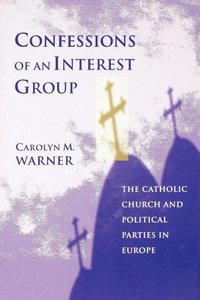
Confessions of an Interest Group
The Catholic Church and Political Parties in Europe
Published on 16. April 2000
Book
Paperback/Softback
240 pages
978-0-691-01026-7 (ISBN)
Description
Following World War II, the Catholic Church in Europe faced the challenge of establishing political influence with newly emerging democratic governments. The Church became, as Carolyn Warner pointedly argues, an interest group like any other, seeking to attain and solidify its influence by forming alliances with political parties. The author analyzes the Church's differing strategies in Italy, France, and Germany using microeconomic theories of the firm and historical institutionalism. She demonstrates how only a strategic perspective can explain the choice and longevity of the alliances in each case. In so doing, the author challenges earlier work that ignores the costs to interest groups and parties of sustaining or breaking their reciprocal links. Confessions of an Interest Group challenges the view of the Catholic Church as solely a moral force whose interests are seamlessly represented by the Christian Democratic parties. Blending theory, cultural narrative, and archival research, Warner demonstrates that the French Church's superficial and brief connection with a political party was directly related to its loss of political influence during the War.
The Italian Church's power, on the other hand, remained stable through the War, so the Church and the Christian Democrats more easily found multiple grounds for long-term cooperation. The German Church chose yet another path, reluctantly aligning itself with a new Catholic-Protestant party. This book is an important work that expands the growing literature on the economics of religion, interest group behavior, and the politics of the Catholic Church.
The Italian Church's power, on the other hand, remained stable through the War, so the Church and the Christian Democrats more easily found multiple grounds for long-term cooperation. The German Church chose yet another path, reluctantly aligning itself with a new Catholic-Protestant party. This book is an important work that expands the growing literature on the economics of religion, interest group behavior, and the politics of the Catholic Church.
Reviews / Votes
A detailed, comparative study of the relationship between the Catholic Church and political parties in post-war Italy and France... -- David J. Levy Catholic HeraldMore details
Language
English
Place of publication
New Jersey
United States
Target group
Professional and scholarly
College/higher education
Product notice
Paperback (trade)
Illustrations
3 tables
Dimensions
Height: 229 mm
Width: 152 mm
Thickness: 16 mm
Weight
437 gr
ISBN-13
978-0-691-01026-7 (9780691010267)
Copyright in bibliographic data and cover images is held by Nielsen Book Services Limited or by the publishers or by their respective licensors: all rights reserved.
Schweitzer Classification
Other editions
Additional editions
Carolyn M. Warner
Confessions of an Interest Group
The Catholic Church and Political Parties in Europe
E-Book
03/2000
1st Edition
Princeton University Press
€188.95
Available for download
Person
Carolyn M. Warner is Assistant Professor of Political Science at Arizona State University.
Content
List of Tables ix Acknowledgments xi List of Abbreviations xv Chapter 1. Introduction: The Catholic Church and Democracy 3 Chapter 2. Interest Groups, Political Parties, and Religion 17 Chapter 3. The Constraints and Opportunities of History 40 Chapter 4. Interests, Identities, and Role Definition 74 Chapter 5. Selecting an Ally: The Catholic Church and Christian Democracy in Italy and France 97 Chapter 6. Evaluating the Alliance: Exit or Voice? 116 Chapter 7. Getting Out the Vote: Mobilization Techniques 135 Chapter 8. Christian Democratic Parties and Their Search for Allies 163 Chapter 9. Comparative Perspectives: Germany 185 Chapter 10. The Political Crossroads of Catholicism in Postwar Europe: Contributions to a Theory of Interest Groups 203 References 223 Index 243