

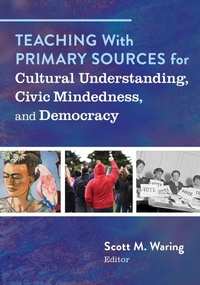
Teaching with Primary Sources for Cultural Understanding, Civic Mindedness, and Democracy
Published on 22. March 2024
Book
Hardback
272 pages
978-0-8077-6971-3 (ISBN)
Description
This resource has been developed for Pre-K-20 educators in order to help students use primary sources to go beyond simple acquisition of content knowledge and rote memorization. The procedures and approaches outlined in this book are designed to be used with Pre-K-20 students to help them use primary sources in discipline and inquiry-based ways to develop and enhance understandings for cultural understanding, civic mindedness, and democracy. Expert authors demonstrate how the skills students learn through this process can be applied to their everyday life and allow them to think critically about the world around them, better understand various cultures, communicate their understandings effectively, and enhance their democratic values. Grounded in the National Council for the Social Studies C3 Framework, topics include social emotional learning, inclusion, higher order thinking, civic agency, project-based learning, democracy-building across cultures, teaching about war, enacting change through intentional civic engagement, and systemic racism in the United States.
Book Features:
Chapters by leading experts in the areas of civic education and teaching with primary sources.
Guidance for supporting multilingual learners and students with disabilities.
Detailed examples of classroom-tested instructional ideas and approaches from educators teaching with primary sources in Pre-K-20 classrooms.
Primary sources and links to resources throughout the book.
Book Features:
Chapters by leading experts in the areas of civic education and teaching with primary sources.
Guidance for supporting multilingual learners and students with disabilities.
Detailed examples of classroom-tested instructional ideas and approaches from educators teaching with primary sources in Pre-K-20 classrooms.
Primary sources and links to resources throughout the book.
More details
Language
English
Place of publication
New York
United States
Target group
Professional and scholarly
Primary & secondary/elementary & high school
Product notice
sewn/stitched
Cloth over boards
Dimensions
Height: 260 mm
Width: 184 mm
Thickness: 17 mm
Weight
540 gr
ISBN-13
978-0-8077-6971-3 (9780807769713)
Copyright in bibliographic data and cover images is held by Nielsen Book Services Limited or by the publishers or by their respective licensors: all rights reserved.
Schweitzer Classification
Person
Scott M. Waring is a professor and program coordinator for the Social Science Education Program at the University of Central Florida. His books include The Educator's Handbook for Teaching With Primary Sources, Integrating Primary and Secondary Sources Into Teaching: The SOURCES Framework for Authentic Investigation, and Conducting Authentic Historical Inquiry: Engaging Learners with SOURCES and Emerging Technologies.
Content
Contents (Tentative)
Part I: Introduction to and Strategies for Teaching with Primary Sources
1. ?Making the Invisible Visible: Demystifying Sources and Disciplinary Practice
Heather M. Nice
2. ?A Culture of Questioning: How to Use Student Questions to Springboard Powerful Primary Source Learning
Sarah Westbrook and Johnny Walker
3. ?Strategies for Close Reading With Primary Sources
Melissa Starkey
4. ?In Their Hands, Hearts, and Minds: Strategies for Helping Students Touch, Inquire, and Think Deeply Using Primary Sources
Michael M. Yell and GeoffreyScheurman
5. ?Building Into Inquiry: Trade Books and Primary Sources to Drive Inquiry-Based Learning
Allie Whitford
Part II: Developing an Environment for Conducting Authentic Inquiries With Primary Sources
6. ?Learning About Children's Lives at the Turn of the Century Through Visual Discovery and SOURCES
Scott M. Waring
7. ?Inquiry by Design: Unit Planning to Ensure Authentic Use of Primary Sources
Stefanie Rosenberg Wager
Part III: Applying Disciplinary Tools and Concepts, Evaluating Sources, andUsing Evidence in the Creation of Evidence-Based Narratives ?
8. ?Pairing Primary Sources with Literature to Improve Critical Reading and Comprehension
Salika A. Lawrence, Nancy Osborn, Marie Donnantuono, and Tiffany Labissiere
9. ?Curating Curiosity
Michael Gurlea
10. ?What Does "Primary Source" Mean in Science Education?
Loris Chen, Kathy Biernat, Donna Governor, Heather Anglin, and Eric J. Pyle
11. ?Using Arts-Based Primary Sources to Connect Students' Lives to Learning
Catherine Cooney and Erin Elman
12. ?Using Primary Sources in the PK-12 Mathematics and Statistics Classrooms
Peter DeCraene
13. ?Teaching Economics Using Primary Sources
Stephen Day, Genevieve Podleski, Scott Wolla, and Diego Mendez-Carbajo
Part IV: Emerging Technologies and Primary Sources
14. ?Engaging Students With Emerging Technologies
Scott M. Waring and Richard Hartshorne
15. ?My Place in History
William Toledo and Esther A. Enright
16. ?Using Emerging Technologies to Deepen Instruction With Historical Artifacts
Index
About the Authors
Part I: Introduction to and Strategies for Teaching with Primary Sources
1. ?Making the Invisible Visible: Demystifying Sources and Disciplinary Practice
Heather M. Nice
2. ?A Culture of Questioning: How to Use Student Questions to Springboard Powerful Primary Source Learning
Sarah Westbrook and Johnny Walker
3. ?Strategies for Close Reading With Primary Sources
Melissa Starkey
4. ?In Their Hands, Hearts, and Minds: Strategies for Helping Students Touch, Inquire, and Think Deeply Using Primary Sources
Michael M. Yell and GeoffreyScheurman
5. ?Building Into Inquiry: Trade Books and Primary Sources to Drive Inquiry-Based Learning
Allie Whitford
Part II: Developing an Environment for Conducting Authentic Inquiries With Primary Sources
6. ?Learning About Children's Lives at the Turn of the Century Through Visual Discovery and SOURCES
Scott M. Waring
7. ?Inquiry by Design: Unit Planning to Ensure Authentic Use of Primary Sources
Stefanie Rosenberg Wager
Part III: Applying Disciplinary Tools and Concepts, Evaluating Sources, andUsing Evidence in the Creation of Evidence-Based Narratives ?
8. ?Pairing Primary Sources with Literature to Improve Critical Reading and Comprehension
Salika A. Lawrence, Nancy Osborn, Marie Donnantuono, and Tiffany Labissiere
9. ?Curating Curiosity
Michael Gurlea
10. ?What Does "Primary Source" Mean in Science Education?
Loris Chen, Kathy Biernat, Donna Governor, Heather Anglin, and Eric J. Pyle
11. ?Using Arts-Based Primary Sources to Connect Students' Lives to Learning
Catherine Cooney and Erin Elman
12. ?Using Primary Sources in the PK-12 Mathematics and Statistics Classrooms
Peter DeCraene
13. ?Teaching Economics Using Primary Sources
Stephen Day, Genevieve Podleski, Scott Wolla, and Diego Mendez-Carbajo
Part IV: Emerging Technologies and Primary Sources
14. ?Engaging Students With Emerging Technologies
Scott M. Waring and Richard Hartshorne
15. ?My Place in History
William Toledo and Esther A. Enright
16. ?Using Emerging Technologies to Deepen Instruction With Historical Artifacts
Index
About the Authors