

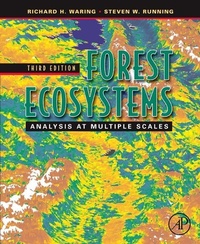
Forest Ecosystems
Analysis at Multiple Scales
3rd Edition
Published on 10. September 2007
Book
Paperback/Softback
440 pages
978-0-12-370605-8 (ISBN)
Description
This revision maintains the position of Forest Ecosystems as the one source for the latest information on the advanced methods that have enhanced our understating of forest ecosystems. Further understanding is given to techniques to explore the changes in climatic cycles, the implications of wide-scale pollution, fire and other ecological disturbances that have a global effect. The inclusion of models, equations, graphs, and tabular examples provides readers with a full understanding of the methods and techniques.
Reviews / Votes
Praise for previous editions:"Represents a tour de force of modeling, synthesis and integration. I doubt there is anyone else who would be able to pull all this together in a credible way. The authors have succeeded admirably in capturing the essence of landscape processes, their description and simulation." --Ron Neilson, USDA Forest Service and Oregon State University, Corvallis
"A nice synthesis and textbookfor forest ecosystems. The depth and breadth of their synthesis is admirable, and the work is well-balanced. The book will be a major contribution." --Michael G. Ryan, USDA Forest Service, Fort Collins
"There is a huge wealth of exciting information in this book. I loved the focus on models. This will be a great book and it will be widely used." --Kate Lajtha, Oregon State University, Corvallis
"The idea of putting this ecosystem textbook into a modeling framework is a very significant improvement over the 1985 book. Putting scaling as the over-arching theme makes this book most timely." --Hank Margolis, NASA Biospheric Sciences Branch
More details
Edition
3rd edition
Language
English
Place of publication
San Diego
United States
Publishing group
Elsevier Science Publishing Co Inc
Target group
Professional and scholarly
researchers and individuals interested in ecology, forestry, plant and environmental sciences; advanced undergraduate students, graduate students, faculty in forestry and ecology programs
Edition type
New edition
Product notice
Paperback (trade)
Unsewn / adhesive bound
Illustrations
Approx. 180 illustrations
Dimensions
Height: 231 mm
Width: 190 mm
Thickness: 23 mm
Weight
920 gr
ISBN-13
978-0-12-370605-8 (9780123706058)
Copyright in bibliographic data and cover images is held by Nielsen Book Services Limited or by the publishers or by their respective licensors: all rights reserved.
Schweitzer Classification
Other editions
Additional editions
E-Book
07/2010
3rd Edition
Academic Press
€65.95
Available for download
Previous edition
Richard H. Waring | Steven W. Running | W. H. Schlesinger
Forest Ecosystems
Analysis at Multiple Scales
Book
04/1998
2nd Edition
Academic Press
€69.43
Article exhausted; check for reprint
Persons
www.fsl.orst.edu/~waring/
Dr. Waring is an accomplished writter and professor of forest science. His notable publications include the first edition of Forest Ecosystems written in 1985.
Waring, R.H. and W.H. Schlesinger. 1985. Forest ecosystems: Concepts and management. Academic Press, Inc., Orlando, FL. 338 p Steven W. Running is trained as a terrestrial ecologist, receiving the B.S. (1972) and M.S. (1973) degrees from Oregon State University, and the Ph.D. (1979) degree in Forest Ecology from Colorado State University. He has been with the University of Montana, Missoula, since 1979, where he is a Professor of Ecology. His primary research interest is the development of global and regional ecosystem biogeochemical models by integration of remote sensing with climatology and terrestrial ecology. He is a Team Member for the NASA Earth Observing System, Moderate Resolution Imaging Spectroradiometer and is responsible for the EOS global terrestrial net primary production and evaporative index datasets. He has published over 240 scientific articles. He currently serves on the standing Committee for Earth Studies of the National Research Council, and on the federal Interagency Carbon Cycle Science Committee. He is a Co-Chair of the National Center for Atmospheric Research Community Climate System Model Land Working Group, a Member of the International Geosphere-Biosphere Program Executive Committee, and the World Climate Research Program, Global Terrestrial Observing System. Dr. Running is a chapter Lead Author for the 4th Assessment of the Intergovernmental Panel on Climate Change. Prof. Running is an elected Fellow of the American Geophysical Union and is designated a Highly Cited Researcher by the Institute for Scientific Information.
Dr. Waring is an accomplished writter and professor of forest science. His notable publications include the first edition of Forest Ecosystems written in 1985.
Waring, R.H. and W.H. Schlesinger. 1985. Forest ecosystems: Concepts and management. Academic Press, Inc., Orlando, FL. 338 p Steven W. Running is trained as a terrestrial ecologist, receiving the B.S. (1972) and M.S. (1973) degrees from Oregon State University, and the Ph.D. (1979) degree in Forest Ecology from Colorado State University. He has been with the University of Montana, Missoula, since 1979, where he is a Professor of Ecology. His primary research interest is the development of global and regional ecosystem biogeochemical models by integration of remote sensing with climatology and terrestrial ecology. He is a Team Member for the NASA Earth Observing System, Moderate Resolution Imaging Spectroradiometer and is responsible for the EOS global terrestrial net primary production and evaporative index datasets. He has published over 240 scientific articles. He currently serves on the standing Committee for Earth Studies of the National Research Council, and on the federal Interagency Carbon Cycle Science Committee. He is a Co-Chair of the National Center for Atmospheric Research Community Climate System Model Land Working Group, a Member of the International Geosphere-Biosphere Program Executive Committee, and the World Climate Research Program, Global Terrestrial Observing System. Dr. Running is a chapter Lead Author for the 4th Assessment of the Intergovernmental Panel on Climate Change. Prof. Running is an elected Fellow of the American Geophysical Union and is designated a Highly Cited Researcher by the Institute for Scientific Information.
Content
1. Forest Ecosystem Analysis at Multiple Time and Space Scales
I. Introduction
II. The Scientific Domain of Forest Ecosystem Analysis
III. The Space/Time Domain of Ecosystem Analysis
IV. Time and Space Scaling from the Stand/Seasonal Level
V. Management Applications of Ecosystem Analysis
VI. Related Textbooks
VII. Web Site for Updated Materials
Section I. Introduction to Analysis of Seasonal Cycles of Water, Carbon, and Minerals through Forest Stands
2. Water Cycles
I. Introduction
II. Heat and Water Vapor Transfer from Vegetation
III. Water Flow through Trees
IV. Water Storage and Losses from Snow
V. Water Flow across and through Soil
VI. Coupled Water Balance Models
VII. Summary
3. Carbon Cycle
I. Introduction
II. Photosynthesis
III. Autotrophic Respiration
IV. Heterotrophic Respiration
V. Modeling Photosynthesis and Respiration
VI. Net Primary Production and Allocation
VII. Comparison of Forest Ecosystem Models
VIII. Summary
4. Mineral Cycles
I. Introduction
II. Plant Processes Affecting Nutrient Cycling
III. Sources of Nutrients
IV. Soil and Litter Processes
V. Mass Balance and Models of Mineral Cycles
VI. Summary
Section II. Introduction to Temporal Scaling
5. Temporal Changes in Forest Structure and Function
I. Introduction
II. Structural Stages in Stand Development
III. Functional Responses of Stands at Different Stages in Development
IV. Looking Back in Time
V. Ecosystem Models, Projections Forward in Time
VI. Summary
6. Susceptibility and Response of Forests to Disturbance
I. Introduction
II. Biotic Factors
III. Abiotic Factors
IV. Summary
Section III. Introduction to Spatial Scaling and Spatial/Temporal Modeling
7. Spatial Scaling Methods for Landscape and Regional Ecosystem Analysis
I. Introduction
II. Abiotic Site Variables
III. Providing the Driving Variables, Climatology
IV. Describing the Ecosystem
V. Spatially Explicit Landscape Pattern Analysis
VI. Data Layer Inconsistencies
VII. Summary
8. Regional and Landscape Ecological Analysis
I. Introduction
II. Horizontal Connections: Biotic Analysis of Forest Patterns
III. Vertical Connections: Forest-Atmosphere Interactions
IV. Vertical and Horizontal Connections: Regional Biogeochemistry
V. Summary
9. The Role of Forests in Global Ecology
I. Introduction
II. Global Forest Distribution
III. Forest-Climate Interactions
IV. Forests in the Global Carbon Cycle
V. Forests and Biodiversity
VI. Sustainability of Global Forests
VII. Summary
10. Advances in Eddy-Flux Analyses, Remote Sensing, and Evidence of Climate Change
I. Introduction
II. Eddy-Covariance Fluxes
III. New Remote Sensing of Forests
IV. Climate Change and Forests
Epilogue
Bibliography
Index
I. Introduction
II. The Scientific Domain of Forest Ecosystem Analysis
III. The Space/Time Domain of Ecosystem Analysis
IV. Time and Space Scaling from the Stand/Seasonal Level
V. Management Applications of Ecosystem Analysis
VI. Related Textbooks
VII. Web Site for Updated Materials
Section I. Introduction to Analysis of Seasonal Cycles of Water, Carbon, and Minerals through Forest Stands
2. Water Cycles
I. Introduction
II. Heat and Water Vapor Transfer from Vegetation
III. Water Flow through Trees
IV. Water Storage and Losses from Snow
V. Water Flow across and through Soil
VI. Coupled Water Balance Models
VII. Summary
3. Carbon Cycle
I. Introduction
II. Photosynthesis
III. Autotrophic Respiration
IV. Heterotrophic Respiration
V. Modeling Photosynthesis and Respiration
VI. Net Primary Production and Allocation
VII. Comparison of Forest Ecosystem Models
VIII. Summary
4. Mineral Cycles
I. Introduction
II. Plant Processes Affecting Nutrient Cycling
III. Sources of Nutrients
IV. Soil and Litter Processes
V. Mass Balance and Models of Mineral Cycles
VI. Summary
Section II. Introduction to Temporal Scaling
5. Temporal Changes in Forest Structure and Function
I. Introduction
II. Structural Stages in Stand Development
III. Functional Responses of Stands at Different Stages in Development
IV. Looking Back in Time
V. Ecosystem Models, Projections Forward in Time
VI. Summary
6. Susceptibility and Response of Forests to Disturbance
I. Introduction
II. Biotic Factors
III. Abiotic Factors
IV. Summary
Section III. Introduction to Spatial Scaling and Spatial/Temporal Modeling
7. Spatial Scaling Methods for Landscape and Regional Ecosystem Analysis
I. Introduction
II. Abiotic Site Variables
III. Providing the Driving Variables, Climatology
IV. Describing the Ecosystem
V. Spatially Explicit Landscape Pattern Analysis
VI. Data Layer Inconsistencies
VII. Summary
8. Regional and Landscape Ecological Analysis
I. Introduction
II. Horizontal Connections: Biotic Analysis of Forest Patterns
III. Vertical Connections: Forest-Atmosphere Interactions
IV. Vertical and Horizontal Connections: Regional Biogeochemistry
V. Summary
9. The Role of Forests in Global Ecology
I. Introduction
II. Global Forest Distribution
III. Forest-Climate Interactions
IV. Forests in the Global Carbon Cycle
V. Forests and Biodiversity
VI. Sustainability of Global Forests
VII. Summary
10. Advances in Eddy-Flux Analyses, Remote Sensing, and Evidence of Climate Change
I. Introduction
II. Eddy-Covariance Fluxes
III. New Remote Sensing of Forests
IV. Climate Change and Forests
Epilogue
Bibliography
Index