

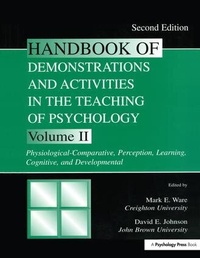
Handbook of Demonstrations and Activities in the Teaching of Psychology
Volume II: Physiological-Comparative, Perception, Learning, Cognitive, and Developmental
2nd Edition
Published on 6. May 2016
Book
Hardback
358 pages
978-1-138-14207-7 (ISBN)
Description
For those who teach students in psychology, education, and the social sciences, the Handbook of Demonstrations and Activities in the Teaching of Psychology, Second Edition provides practical applications and rich sources of ideas. Revised to include a wealth of new material (56% of the articles are new), these invaluable reference books contain the collective experience of teachers who have successfully dealt with students' difficulty in mastering important concepts about human behavior. Each volume features a table that lists the articles and identifies the primary and secondary courses in which readers can use each demonstration. Additionally, the subject index facilitates retrieval of articles according to topical headings, and the appendix notes the source as it originally appeared in Teaching of Psychology--especially useful for users needing to cite information. The official journal of the Society for the Teaching of Psychology, Division Two of the American Psychological Association, Teaching of Psychology is a highly respected publication devoted to improving teaching and learning at all educational levels.
Volume II consists of 99 articles about teaching physiology, perception, learning, memory, and developmental psychology. Divided into eight sections (four devoted to developmental psychology and one for each of the other specialties), the book suggests ways to stimulate interest, promote participation, collect data, structure field experience, and observe and interact with patients.
Volume II consists of 99 articles about teaching physiology, perception, learning, memory, and developmental psychology. Divided into eight sections (four devoted to developmental psychology and one for each of the other specialties), the book suggests ways to stimulate interest, promote participation, collect data, structure field experience, and observe and interact with patients.
Reviews / Votes
"...the second [edition] has something to offer to all teachers of psychology. It is well organized, with a structure that parallels most introductory psychology texts....This three-volume set of class activities complied by Ware and Johnson remains a potentially valuable resource for the faculty member who desires to be more effective in the classroom. It is arguably the most complete source of its kind available to teachers of psychology."-Contemporary Psychology
More details
Edition
2nd edition
Language
English
Place of publication
Hove
United Kingdom
Publishing group
Taylor & Francis Ltd
Target group
Professional and scholarly
Dimensions
Height: 276 mm
Width: 219 mm
Weight
820 gr
ISBN-13
978-1-138-14207-7 (9781138142077)
Copyright in bibliographic data and cover images is held by Nielsen Book Services Limited or by the publishers or by their respective licensors: all rights reserved.
Schweitzer Classification
Other editions
Additional editions
Mark E. Ware | David E. Johnson
Handbook of Demonstrations and Activities in the Teaching of Psychology
Volume II: Physiological-Comparative, Perception, Learning, Cognitive, and Developmental
E-Book
09/2013
2nd Edition
Psychology Press Ltd
€87.49
Available for download
Mark E. Ware | David E. Johnson
Handbook of Demonstrations and Activities in the Teaching of Psychology
Volume II: Physiological-Comparative, Perception, Learning, Cognitive, and Developmental
E-Book
09/2013
2nd Edition
Psychology Press Ltd
€87.49
Available for download
Mark E. Ware | David E. Johnson
Handbook of Demonstrations and Activities in the Teaching of Psychology
Volume II: Physiological-Comparative, Perception, Learning, Cognitive, and Developmental
Book
02/2000
2nd Edition
Psychology Press
€96.70
Shipment within 10-20 days
Persons
Mark E. Ware, David E. Johnson
Content
Contents: Preface. Part I: Physiological-Comparative. Preparing for Exams. Teaching Neuroanatomy and Neurophysiology. Teaching Hemispheric Laterality. Collecting Physiological Data From Students. Teaching Comparative Psychology. Part II: Perception. Acquiring Demonstrations. Teaching Sensation. Illustrating Illusions. Teaching Various Concepts in Perception. Part III: Learning. Introducing Learning. Using Animals to Teach Learning. Teaching Classical Conditioning. Teaching Operant Conditioning. Using Computers to Teach Learning. Part IV: Cognitive. Starting and Planning the Course. Teaching Concepts and Theories. Improving Memory. Examining Miscellaneous Issues. Part V: Developmental--Child. Emphasizing Writing. Using Videotapes. Observing and Interacting With Children. Incorporating Piagetian Concepts. Part VI: Developmental--Adolescent.Part VII: Developmental--Adult and Aging.Part VIII: Developmental--Life Span. Emphasizing Writing. Structuring Field Experience. Examining Topical Issues. Using Toys and Games.