

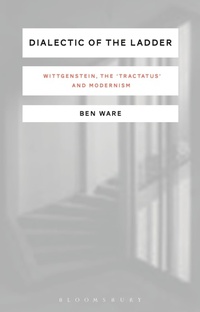
Dialectic of the Ladder
Wittgenstein, the 'Tractatus' and Modernism
Published on 20. April 2017
Book
Paperback/Softback
240 pages
978-1-350-05092-1 (ISBN)
Description
Ludwig Wittgenstein's Tractatus Logico-Philosophicus (1922) remains one of the most enigmatic works of twentieth century thought. In this bold and original new study, Ben Ware argues that Wittgenstein's early masterpiece is neither an analytic treatise on language and logic, nor a quasi-mystical work seeking to communicate 'ineffable' truths. Instead, we come to understand the Tractatus by grasping it in a twofold sense: first, as a dialectical work which invites the reader to overcome certain 'illusions of thought'; and second as a modernist work whose anti-philosophical ambition is intimately tied to its radical aesthetic character.
By placing the Tractatus in the force field of modernism, Dialectic of the Ladder clears the ground for a new and challenging exploration of the work's ethical dimension. It also casts new light upon the cultural, aesthetic and political significances of Wittgenstein's writing, revealing hitherto unacknowledged affinities with a host of philosophical and literary authors, including Hegel, Kierkegaard, Marx, Nietzsche, Adorno, Benjamin, and Kafka.
By placing the Tractatus in the force field of modernism, Dialectic of the Ladder clears the ground for a new and challenging exploration of the work's ethical dimension. It also casts new light upon the cultural, aesthetic and political significances of Wittgenstein's writing, revealing hitherto unacknowledged affinities with a host of philosophical and literary authors, including Hegel, Kierkegaard, Marx, Nietzsche, Adorno, Benjamin, and Kafka.
Reviews / Votes
Given the fierce complexity of Wittgenstein's thought, Ware is to be praised for the clear exposition of his philosophy and for the many helpful suggestions he proffers for how the philosopher's ideas might be relevant to those studying modernism. * Key Words * Overall, Benjamin Ware's dialectical reading of the Tractacus is a very stimulating and successful attempt to interpret the literature. I hope to read more from him! * Wittgenstein-Studien (Bloomsbury translation) * [Ware] broadens the context of existing discussions of the early Wittgenstein's relation to modernist critiques of culture in a very helpful way ... Anyone interested in the text will benefit from engaging with this stimulating work. * British Wittgenstein Society * Ben Ware's superb study does not only offer a lucid and original reading of Wittgenstein's Tractatus; it also situate it with admirable skill in the context of literary modernism and in doing so casts radical new light on this notoriously difficult philosophical text. * Terry Eagleton * Ben Ware writes a refreshing, opinionated book about Tractatus, in which Ezra Pound, Ludwig Uhland, Oswald Spengler, Thomas Mann and Julien Benda get a non-obvious place in a reading of Wittgenstein. (Bloomsbury translation) * Tijdschrift voor Filosofie * Departing from Wittgenstein's claim that the Tractatus is 'strictly philosophical and at the same time literary' Ben Ware succeeds in showing not only how it works as a contribution to literary modernism but also how this is inseparable from its philosophical achievement. He restores the strangeness to a text that we thought had become familiar and places it in the company of Kierkegaard, Nietzsche, Hofmannsthal and Kafka. It is sure to send readers back to the Tractatus with renewed wonder and curiosity. * Howard Caygill, Professor Of Modern European Philosophy, Kingston University, UK * Ludwig Wittgenstein notoriously wrote to Bertrand Russell that nobody would ever understand his Tractatus Logico-Philosophicus; for students of modernism and the avant-gardes this is no longer true, thanks to Ben Ware's exciting new study. With a majestic authorial voice Ware leads his readers to appreciate Wittgenstein's short text as a vital part of modern literary history. In a challenging reading of Kafka, Ware further shows how Wittgenstein's book carries within itself a singular way of reading and experiencing literature, as well as oneself. There is little more one can expect from a scholar's work. A formidable achievement. * Sascha Bru, Assistant Professor Modern Literature and Theory, University of Leuven, Belgium *More details
Language
English
Place of publication
London
United Kingdom
Publishing group
Bloomsbury Publishing PLC
Target group
College/higher education
Dimensions
Height: 216 mm
Width: 140 mm
Thickness: 12 mm
Weight
293 gr
ISBN-13
978-1-350-05092-1 (9781350050921)
Copyright in bibliographic data and cover images is held by Nielsen Book Services Limited or by the publishers or by their respective licensors: all rights reserved.
Schweitzer Classification
Other editions
Additional editions
E-Book
08/2015
1st Edition
Bloomsbury Academic
€42.99
Available for download
E-Book
08/2015
1st Edition
Bloomsbury Academic
€42.99
Available for download
Person
Ben Ware is a Visiting Research Fellow at the Institute of English Studies, School of Advanced Study, University of London, UK.
Content
Acknowledgements
Abbreviations
Preface
1 Modernity-Modernism-Avant-Garde
2 Ethics and the Literary in Wittgenstein's Tractatus
3 Modernity, Culture and the Question of Politics
4 The Tractatus, Modernism and the Limits of Language
5 Towards a Literary Use of Wittgenstein: The Tractatus
and Kafka's 'Der Bau'
Notes
References
Index
Abbreviations
Preface
1 Modernity-Modernism-Avant-Garde
2 Ethics and the Literary in Wittgenstein's Tractatus
3 Modernity, Culture and the Question of Politics
4 The Tractatus, Modernism and the Limits of Language
5 Towards a Literary Use of Wittgenstein: The Tractatus
and Kafka's 'Der Bau'
Notes
References
Index