

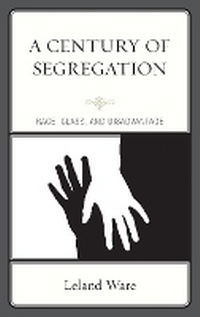
A Century of Segregation
Race, Class, and Disadvantage
Published on 13. August 2020
Book
Paperback/Softback
298 pages
978-1-4985-6471-7 (ISBN)
Description
This book explains how race and class intersect in ways that uniquely disadvantage racial minorities. The narrative begins with the 1896 decision in Plessy v. Ferguson. The Supreme Court ruled that separate facilities for blacks were permissible under the Fourteenth Amendment if they were "equal" to those reserved for whites.
One reaction was the establishment of the NAACP to lead the fight for Civil Rights. After more than two decades of lobbying and public education, a long-range, carefully orchestrated, litigation campaign was launched. Segregation would be challenged with lawsuits insisting that black schools be made physically and otherwise equal to white schools. The lawyers calculated that the resulting burden and expense would ultimately cause segregation to collapse under its own weight.
A series of successful "equalization" suits spanning over two decades laid the foundation for the direct challenge in Brown v. Board of Education. That 1954 decision inspired a large-scale, grass roots Civil Rights Movement. A decade of marches, boycotts, and mass protests persuaded Congress to enact the Civil Rights laws of the 1960s.
Today, conditions for ethnic minorities are far better than they were a generation ago. However, the story of the nation's black and brown communities is a tale of two cities; one prosperous, educated and affluent adjacent to another suffering from grinding poverty and a lack of opportunities for advancement. For those able to take advantage of the opportunities created by the Civil Rights revolution, the gains have been dramatic. For those left behind in impoverished communities, the obstacles to advancement are more daunting today than they were a generation ago.
One reaction was the establishment of the NAACP to lead the fight for Civil Rights. After more than two decades of lobbying and public education, a long-range, carefully orchestrated, litigation campaign was launched. Segregation would be challenged with lawsuits insisting that black schools be made physically and otherwise equal to white schools. The lawyers calculated that the resulting burden and expense would ultimately cause segregation to collapse under its own weight.
A series of successful "equalization" suits spanning over two decades laid the foundation for the direct challenge in Brown v. Board of Education. That 1954 decision inspired a large-scale, grass roots Civil Rights Movement. A decade of marches, boycotts, and mass protests persuaded Congress to enact the Civil Rights laws of the 1960s.
Today, conditions for ethnic minorities are far better than they were a generation ago. However, the story of the nation's black and brown communities is a tale of two cities; one prosperous, educated and affluent adjacent to another suffering from grinding poverty and a lack of opportunities for advancement. For those able to take advantage of the opportunities created by the Civil Rights revolution, the gains have been dramatic. For those left behind in impoverished communities, the obstacles to advancement are more daunting today than they were a generation ago.
Reviews / Votes
Leland Ware's excellent book, Century of Segregation, reminds us that racial segregation has deep roots in the United States, and while progress has been made, its legacy remains with us today and in no small way contributes to the current polarization of American society. The book is a wake-up call to all Americans. -- Douglas S. Massey, Princeton University A Century of Segregation is a well-crafted, provocative, and insightful analysis of one of the nation's most pressing social issues - entrenched racial inequality. It provides a unique historical synthesis that is both timely and urgent, a 'must-read'. -- Elijah Anderson, author of Code of the StreetMore details
Language
English
Place of publication
United States
Publishing group
Bloomsbury Publishing Plc
Target group
Professional and scholarly
Illustrations
1 tables;
Dimensions
Height: 224 mm
Width: 153 mm
Thickness: 21 mm
Weight
422 gr
ISBN-13
978-1-4985-6471-7 (9781498564717)
Copyright in bibliographic data and cover images is held by Nielsen Book Services Limited or by the publishers or by their respective licensors: all rights reserved.
Schweitzer Classification
Other editions
Additional editions
E-Book
10/2018
1st Edition
Bloomsbury eBooks US
€40.49
Available for download
Person
Leland Ware is the Louis L. Redding Chair for the Study of Law and Public Policy at the University of Delaware
Content
Chapter 1: Plessy v. Ferguson and the NAACP's Battle Against Segregation
Chapter 2: The School Desegregation Campaign
Chapter 3: Fordice, Black Colleges and the Duty to Desegregate
Chapter 4: The Curriculum's Implicit Bias
Chapter 5: Diversity, Inclusion and Affirmative Action
Chapter 6: America's Apartheid: Residential SegregationChapter 7: The Persistence of Isolated Neighborhoods and Segregated SchoolsChapter 8: Discipline DisparitiesChapter 9: Latino/as and Asians: America's Changing DemographicsChapter 10: Racial Resentment, Presidential Campaigns and Donald TrumpChapter 11: The Promised Land
Chapter 2: The School Desegregation Campaign
Chapter 3: Fordice, Black Colleges and the Duty to Desegregate
Chapter 4: The Curriculum's Implicit Bias
Chapter 5: Diversity, Inclusion and Affirmative Action
Chapter 6: America's Apartheid: Residential SegregationChapter 7: The Persistence of Isolated Neighborhoods and Segregated SchoolsChapter 8: Discipline DisparitiesChapter 9: Latino/as and Asians: America's Changing DemographicsChapter 10: Racial Resentment, Presidential Campaigns and Donald TrumpChapter 11: The Promised Land