

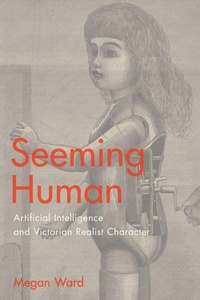
Seeming Human
Artificial Intelligence and Victorian Realist Character
Published on 3. January 2022
Book
Paperback/Softback
216 pages
978-0-8142-5487-5 (ISBN)
Description
Offers a new theory of realist character through character's unexpected afterlife: the intelligent machine.
In Seeming Human, Megan Ward contends that mid-twentieth-century versions of artificial intelligence (AI) offer a theory of verisimilitude omitted by traditional histories of character, which often focus on the development of interiority and the shift from "flat" to "round" characters in the Victorian era. Instead, by reading character through AI, Megan Ward's Seeming Human argues that routinization, predictability, automation, and even flatness are all features of realist characters.
Early artificial intelligence movements such as cybernetics, information theory, and the Turing test define ways of seeming-rather than being-human. Using these theories of verisimilitude to read Victorian novelists such as Elizabeth Gaskell, Margaret Oliphant, Anthony Trollope, Thomas Hardy, and Henry James, Seeming Human argues that mechanicity has been perceived as anti-realist because it is the element that we least want to identify as human. Because AI produces human-like intelligence, it makes clear that we must actually turn to machines in order to understand what makes realist characters seem so human.
More details
Language
English
Place of publication
Columbus, OH
United States
Product notice
Paperback (trade)
Unsewn / adhesive bound
Dimensions
Height: 229 mm
Width: 152 mm
Thickness: 10 mm
Weight
284 gr
ISBN-13
978-0-8142-5487-5 (9780814254875)
Copyright in bibliographic data and cover images is held by Nielsen Book Services Limited or by the publishers or by their respective licensors: all rights reserved.
Schweitzer Classification
Person
Megan Ward is Associate Professor in the School of Writing, Literature, and Film at Oregon State University, where she teaches courses on British literature from 1800 to the present, the history of the novel, and archival theory. Her work on technology and realism has appeared or is forthcoming in edited collections such as AI Narratives and The Routledge Guide to Politics and Literature as well as journals such as New Literary History and Public Humanities. She is also Co-Editor of the Nineteenth-Century Data Collective and has published writing on the Victorian antecedents of contemporary culture for general audiences in The Atlantic, Wired, The Washington Post, and the Los Angeles Review of Books. Seeming Human is her first book.