

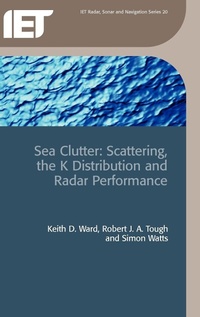
Sea Clutter
Scattering, the K distribution and radar performance
Published on 25. April 2006
Book
Hardback
472 pages
978-0-86341-503-6 (ISBN)
Description
This book provides an authoritative account of the current understanding of radar sea clutter, describing its phenomenology, EM scattering and statistical modelling and simulation, and their use in the design of detection systems and the calculation and practical evaluation of radar performance.
The book pays particular attention to the compound K distribution model developed by the authors during the past 20 years. The evidence for this model, its mathematical formulation and development and practical application to the specification, design and evaluation of radar systems are all discussed. In addition, the book sets the previously empirical development of the K distribution model in the wider context of recent advances in the calculation of low grazing angle electromagnetic scattering and oceanographic modelling of the statistics of the sea surface.
The authors discuss in detail the prediction of the performance of specified radar systems; at the same time, their presentation of the underlying physical principles and analytic and computational techniques employed in these calculations is sufficiently comprehensive for the reader to be well equipped to tackle related problems with confidence.
These features, and appendices reviewing pertinent mathematical background material and the calculation of low grazing angle scattering by corrugated surfaces, make this book invaluable to specialist radar engineers and academic researchers, while being of considerable interest to the wider applied physics and mathematics communities.
The book pays particular attention to the compound K distribution model developed by the authors during the past 20 years. The evidence for this model, its mathematical formulation and development and practical application to the specification, design and evaluation of radar systems are all discussed. In addition, the book sets the previously empirical development of the K distribution model in the wider context of recent advances in the calculation of low grazing angle electromagnetic scattering and oceanographic modelling of the statistics of the sea surface.
The authors discuss in detail the prediction of the performance of specified radar systems; at the same time, their presentation of the underlying physical principles and analytic and computational techniques employed in these calculations is sufficiently comprehensive for the reader to be well equipped to tackle related problems with confidence.
These features, and appendices reviewing pertinent mathematical background material and the calculation of low grazing angle scattering by corrugated surfaces, make this book invaluable to specialist radar engineers and academic researchers, while being of considerable interest to the wider applied physics and mathematics communities.
More details
Series
Language
English
Place of publication
Stevenage
United Kingdom
Target group
Professional and scholarly
Dimensions
Height: 240 mm
Width: 161 mm
Thickness: 29 mm
Weight
877 gr
ISBN-13
978-0-86341-503-6 (9780863415036)
Copyright in bibliographic data and cover images is held by Nielsen Book Services Limited or by the publishers or by their respective licensors: all rights reserved.
Schweitzer Classification
Other editions
New editions
Keith Ward | Robert Tough | Simon Watts
Sea Clutter
Scattering, the K distribution and radar performance
Book
04/2013
2nd Edition
Institution of Engineering and Technology
€170.50
Shipment within 3-4 weeks
Additional editions
Keith D. Ward | Robert J.A. Tough | Simon Watts
Sea Clutter
Scattering, the K distribution and radar performance
E-Book
11/2008
1st Edition
Institution of Engineering and Technology
€168.89
Available for download
Persons
Keith D. Ward is a director of TW Research Ltd, a small company set up in 1995 to develop and exploit models of all aspects of radar operation and performance. Previously they worked for the UK Ministry of Defence at RSRE Malvern on topics ranging from theoretical physics to maritime radar, seekers and remote sensing. They are both authors of numerous journal and conference papers.
Robert J.A. Tough is a director of TW Research Ltd, a small company set up in 1995 to develop and exploit models of all aspects of radar operation and performance. Previously they worked for the UK Ministry of Defence at RSRE Malvern on topics ranging from theoretical physics to maritime radar, seekers and remote sensing. They are both authors of numerous journal and conference papers.
Simon Watts is Deputy Scientific Director of Thales UK, Aerospace Division. He joined Thales (then EMI Electronics) in 1967 and has subsequently worked on a wide range of radar and EW projects, particularly airborne maritime surveillance radar systems. He is author and co-author of over 30 journal and conference papers and several patents, mainly relating to radar performance in sea clutter. He was appointed MBE in 2000 for services to the defence industry.
Robert J.A. Tough is a director of TW Research Ltd, a small company set up in 1995 to develop and exploit models of all aspects of radar operation and performance. Previously they worked for the UK Ministry of Defence at RSRE Malvern on topics ranging from theoretical physics to maritime radar, seekers and remote sensing. They are both authors of numerous journal and conference papers.
Simon Watts is Deputy Scientific Director of Thales UK, Aerospace Division. He joined Thales (then EMI Electronics) in 1967 and has subsequently worked on a wide range of radar and EW projects, particularly airborne maritime surveillance radar systems. He is author and co-author of over 30 journal and conference papers and several patents, mainly relating to radar performance in sea clutter. He was appointed MBE in 2000 for services to the defence industry.
Content
Chapter 1: Introduction
Chapter 2: The characteristics of radar sea clutter
Chapter 3: Modelling radar scattering by the ocean surface
Chapter 4: Statistical models of sea clutter
Chapter 5: The simulation of clutter and other random processes
Chapter 6: Detection of small targets in sea clutter
Chapter 7: Imaging ocean surface features
Chapter 8: Radar detection performance calculations
Chapter 9: CFAR detection
Chapter 10: The specification and measurement of radar performance
Appendices
Chapter 2: The characteristics of radar sea clutter
Chapter 3: Modelling radar scattering by the ocean surface
Chapter 4: Statistical models of sea clutter
Chapter 5: The simulation of clutter and other random processes
Chapter 6: Detection of small targets in sea clutter
Chapter 7: Imaging ocean surface features
Chapter 8: Radar detection performance calculations
Chapter 9: CFAR detection
Chapter 10: The specification and measurement of radar performance
Appendices