

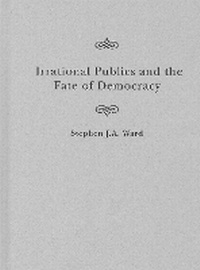
Irrational Publics and the Fate of Democracy
Published on 15. October 2024
Book
Hardback
450 pages
978-0-2280-2002-8 (ISBN)
Description
Across cultures, democracies struggle with intolerant groups, misinformation, social media conspiracies, and extreme populists. Egalitarian cultures cannot always withstand this swing towards the irrational.
In Irrational Publics and the Fate of Democracy Stephen Ward combines history and evolutionary psychology for a comprehensive view of the problem, arguing that social irrationality is likely to occur when social tensions trigger a person's enemy stance: ancient extreme traits in human nature such as aggressiveness, desire for domination, paranoia of the other, and us-versus-them tribalism. Analyzing eruptions of public irrationality - from apocalyptic medieval crusades and Nazi doctors in extermination camps to suicidal cults - Ward presents his evolutionary theory of public irrationalism, demonstrating that human nature has both extreme Darwinian traits promoting competition and sociable traits of cooperation and empathy. The issue is which set of traits will be activated by the social ecology. Extreme traits, once adaptive when humans were hunter-gatherers, have become maladaptive and dangerous. Catalyzed by intolerant media and demagogues, the swing towards the irrational weakens democracy and may lead to human extinction through nuclear holocaust.
Irrational Publics and the Fate of Democracy concludes with practical recommendations on what society should do to resist the engines of unreason within and without us.
In Irrational Publics and the Fate of Democracy Stephen Ward combines history and evolutionary psychology for a comprehensive view of the problem, arguing that social irrationality is likely to occur when social tensions trigger a person's enemy stance: ancient extreme traits in human nature such as aggressiveness, desire for domination, paranoia of the other, and us-versus-them tribalism. Analyzing eruptions of public irrationality - from apocalyptic medieval crusades and Nazi doctors in extermination camps to suicidal cults - Ward presents his evolutionary theory of public irrationalism, demonstrating that human nature has both extreme Darwinian traits promoting competition and sociable traits of cooperation and empathy. The issue is which set of traits will be activated by the social ecology. Extreme traits, once adaptive when humans were hunter-gatherers, have become maladaptive and dangerous. Catalyzed by intolerant media and demagogues, the swing towards the irrational weakens democracy and may lead to human extinction through nuclear holocaust.
Irrational Publics and the Fate of Democracy concludes with practical recommendations on what society should do to resist the engines of unreason within and without us.
Reviews / Votes
"Ward offers original insights into what increasingly appears to be a systemic crisis of Western democracies, demonstrating the imperative need to call on the humanities to untangle the multilayered, complex emergencies of our times." Francois Heinderyckx, Universite libre de Bruxelles "Irrational Publics and the Fate of Democracy is meaty, and also a remarkably readable example of a philosophy and politics text." Miramichi ReaderMore details
Series
Language
English
Place of publication
Montreal
Canada
Target group
Professional and scholarly
Dimensions
Height: 229 mm
Width: 152 mm
ISBN-13
978-0-2280-2002-8 (9780228020028)
Copyright in bibliographic data and cover images is held by Nielsen Book Services Limited or by the publishers or by their respective licensors: all rights reserved.
Schweitzer Classification
Other editions
Additional editions
Stephen J.A. Ward
Irrational Publics and the Fate of Democracy
E-Book
10/2024
1st Edition
McGill-Queen's University Press
€55.99
Available for download
Stephen J.A. Ward
Irrational Publics and the Fate of Democracy
E-Book
10/2024
1st Edition
McGill-Queen's University Press
€55.99
Available for download
Person
Stephen J.A. Ward is professor emeritus and distinguished lecturer in ethics at the University of British Columbia and award-winning author ot editor of thirteen books on ethics and media ethics, including Objectively Engaged Journalism: An Ethic.