

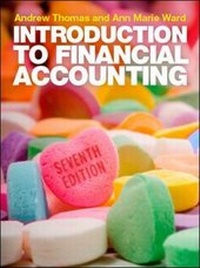
Introduction to Financial Accounting
7th Edition
Published on 16. January 2012
Book
Paperback/Softback
872 pages
978-0-07-713268-2 (ISBN)
Description
The new seventh edition of Introduction to Financial Accounting by Andrew Thomas and Anne Marie Ward has been fully revised and updated to reflect the very latest developments in this dynamic field and offers contemporary and comprehensive coverage of Financial Accounting today.
More details
Edition
7th edition
Language
English
Place of publication
London
United States
Publishing group
McGraw-Hill Education - Europe
Target group
College/higher education
Illustrations
Illustrations
Dimensions
Height: 264 mm
Width: 198 mm
Thickness: 35 mm
Weight
2 gr
ISBN-13
978-0-07-713268-2 (9780077132682)
Copyright in bibliographic data and cover images is held by Nielsen Book Services Limited or by the publishers or by their respective licensors: all rights reserved.
Schweitzer Classification
Persons
Dr. Anne Marie Ward is a Professor of Accounting in the Department of Accounting, Finance and Economics at the University of Ulster at Jordanstown, Northern Ireland. She is also a qualified Chartered Accountant.
Andrew Thomas is a senior lecturer in the Accounting and Finance Group at the University of Birmingham Business School.
Andrew Thomas is a senior lecturer in the Accounting and Finance Group at the University of Birmingham Business School.
Content
Part 1: The Framework of Accounting
1. Entities and financial reporting statements
2. International accounting: institutional framework and standards
3. The history and purpose of the conceptual framework
4. The nature and objectives of financial accounting (corporate social responsibility and accountability)6. The conceptual framework of accounting
7. Auditing, corporate governance and ethics
Part 2: Double-entry bookkeeping (recording transactions and the books of account)
8. The accounting equation and its components
9. Basic documentation and books of account
10. Double entry and the general ledger
11. The balancing of accounts and the trial balance
12. Day books and the journal
13. The cash book
14. The petty cash book
Part 3: Preparing final financial statements for sole traders
15. The final financial statements of sole traders (introductory)
16. Depreciation and non-current assets
17. Bad debts and provisions for bad debts
18. Accruals and prepayments
19. The preparation of final financial statements from the trial balance (advanced)
Part 4: Internal control and check
20. The bank reconciliation statement
21. Control accounts
22. Errors and suspense accounts
23. Single entry and incomplete records
Part 5: Preparing final financial statements for manufacturing entities
24. Inventory valuation
25. Financial statements for manufacturing entities
Part 6: Clubs
26. The final financial statements of clubs
Part 7: Partnerships
27. The final financial statements of partnerships
28. Changes in partnerships
29. Partnership dissolution and conversion to a limited company
Part 8: Companies
30. The nature of limited companies and their capital
31. The final financial statements of limited companies
32. Statement of cash flows
33. The appraisal of company financial statements using ratio analysis
1. Entities and financial reporting statements
2. International accounting: institutional framework and standards
3. The history and purpose of the conceptual framework
4. The nature and objectives of financial accounting (corporate social responsibility and accountability)6. The conceptual framework of accounting
7. Auditing, corporate governance and ethics
Part 2: Double-entry bookkeeping (recording transactions and the books of account)
8. The accounting equation and its components
9. Basic documentation and books of account
10. Double entry and the general ledger
11. The balancing of accounts and the trial balance
12. Day books and the journal
13. The cash book
14. The petty cash book
Part 3: Preparing final financial statements for sole traders
15. The final financial statements of sole traders (introductory)
16. Depreciation and non-current assets
17. Bad debts and provisions for bad debts
18. Accruals and prepayments
19. The preparation of final financial statements from the trial balance (advanced)
Part 4: Internal control and check
20. The bank reconciliation statement
21. Control accounts
22. Errors and suspense accounts
23. Single entry and incomplete records
Part 5: Preparing final financial statements for manufacturing entities
24. Inventory valuation
25. Financial statements for manufacturing entities
Part 6: Clubs
26. The final financial statements of clubs
Part 7: Partnerships
27. The final financial statements of partnerships
28. Changes in partnerships
29. Partnership dissolution and conversion to a limited company
Part 8: Companies
30. The nature of limited companies and their capital
31. The final financial statements of limited companies
32. Statement of cash flows
33. The appraisal of company financial statements using ratio analysis