

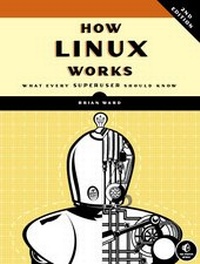
How Linux Works
What Every Superuser Should Know
2nd Edition
Will be published approx. on 14. November 2014
Book
Paperback/Softback
XXIV, 366 pages
978-1-59327-567-9 (ISBN)
Description
Unlike some operating systems, Linux doesn't try to hide the important bits from you-it gives you full control of your computer. But to truly master Linux, you need to understand its internals, like how the system boots, how networking works, and what the kernel actually does.
In this completely revised second edition of the perennial best seller How Linux Works, author Brian Ward makes the concepts behind Linux internals accessible to anyone curious about the inner workings of the operating system. Inside, you'll find the kind of knowledge that normally comes from years of experience doing things the hard way. You'll learn:
- How Linux boots, from boot loaders to init implementations (systemd, Upstart, and System V)
- How the kernel manages devices, device drivers, and processes
- How networking, interfaces, firewalls, and servers work
- How development tools work and relate to shared libraries
- How to write effective shell scripts
You'll also explore the kernel and examine key system tasks inside user space, including system calls, input and output, and filesystems. With its combination of background, theory, real-world examples, and patient explanations, How Linux Works will teach you what you need to know to solve pesky problems and take control of your operating system.
In this completely revised second edition of the perennial best seller How Linux Works, author Brian Ward makes the concepts behind Linux internals accessible to anyone curious about the inner workings of the operating system. Inside, you'll find the kind of knowledge that normally comes from years of experience doing things the hard way. You'll learn:
- How Linux boots, from boot loaders to init implementations (systemd, Upstart, and System V)
- How the kernel manages devices, device drivers, and processes
- How networking, interfaces, firewalls, and servers work
- How development tools work and relate to shared libraries
- How to write effective shell scripts
You'll also explore the kernel and examine key system tasks inside user space, including system calls, input and output, and filesystems. With its combination of background, theory, real-world examples, and patient explanations, How Linux Works will teach you what you need to know to solve pesky problems and take control of your operating system.
Reviews / Votes
"If you are interested in Linux, How Linux Works: What Every Superuser Should Know is a must-read title."-Linux Insider
"Lots to offer on almost every aspect of the Linux architecture."
-Everyday Linux User
"You'll get an essential understanding of what's going on under the hood without getting bogged down in minutiae - making this a very refreshing (and wholly recommended) addition to the Linux literature."
-Phil Bull, co-author of Ubuntu Made Easy and member of the Ubuntu documentation team
"Dives straight into the transparent depths of Linux-based operating systems and shows us how all the pieces fit together."
-DistroWatch
"Earns its place on the shelf as an essential reference."
-MagPi Magazine
More details
Other editions
New editions
Book
04/2021
3rd Edition
No Starch Press
€47.00
Available immediately
Previous edition
Book
01/2004
1st Edition
No Starch Press
€38.00
Article exhausted; check for reprint
Person
Brian Ward has been working with Linux since 1993. He is the author of The Linux Kernel-HOWTO, The Book of VMware (No Starch Press), and The Linux Problem Solver (No Starch Press).
Content
Chapter 1: The Big Picture
Chapter 2: Basic Commands and Directory Hierarchy
Chapter 3: Devices
Chapter 4: Disks and Filesystems
Chapter 5: Linux Booting: Boot Loaders and Kernel
Chapter 6: How User Space Starts
Chapter 7: System Configuration: Logging, System Time, Batch Jobs, and Users
Chapter 8: A Closer Look at Processes and Resource Utilization
Chapter 9: Understanding Your Network and Its Configuration
Chapter 10: Network Applications and Services
Chapter 11: Introduction to Shell Scripts
Chapter 12: Moving Files Across the Network
Chapter 13: User Environments
Chapter 14: A Brief Survey of the Linux Desktop
Chapter 15: Development Tools
Chapter 16: Compiling Software from Source Code
Chapter 17: Building on the Basics
Chapter 2: Basic Commands and Directory Hierarchy
Chapter 3: Devices
Chapter 4: Disks and Filesystems
Chapter 5: Linux Booting: Boot Loaders and Kernel
Chapter 6: How User Space Starts
Chapter 7: System Configuration: Logging, System Time, Batch Jobs, and Users
Chapter 8: A Closer Look at Processes and Resource Utilization
Chapter 9: Understanding Your Network and Its Configuration
Chapter 10: Network Applications and Services
Chapter 11: Introduction to Shell Scripts
Chapter 12: Moving Files Across the Network
Chapter 13: User Environments
Chapter 14: A Brief Survey of the Linux Desktop
Chapter 15: Development Tools
Chapter 16: Compiling Software from Source Code
Chapter 17: Building on the Basics