

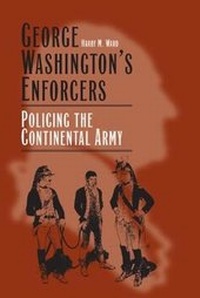
George Washington's Enforcers
Policing the Continental Army
Published on 24. March 2006
Book
Hardback
296 pages
978-0-8093-2688-4 (ISBN)
Description
A well-disciplined army was vital to win American independence, but policing soldiers during the Revolution presented challenges. "George Washington's Enforcers: Policing the Continental Army" examines how justice was left to the overlapping duties of special army personnel and how an improvised police force imposed rules and regulations on the common soldier. Historian Harry M. Ward describes these methods of police enforcement, emphasizing the brutality experienced by the enlisted men who were punished severely for even light transgressions. This volume explores the influences that shaped army practice and the quality of the soldiery, the enforcement of military justice, the use of guards as military police, and the application of punishment. Washington's army, which adopted the organization and justice code of the British army, labored under the direction of ill-trained and arrogant officers. Ward relates how the enlisted men, who had a propensity for troublemaking and desertion, not only were victims of the double standard that existed between officers and regular troops, but also lacked legal protection in the army.
The enforcement of military justice afforded the accused with little due process support. Ward discusses the duties of the various personnel responsible for training and enforcing the standards of behavior. He includes the roles of life guards, camp guards, quarter guards, picket men, and safe guards, whose responsibilities ranged from escorting the commander in chief, intercepting spies and stragglers, and protecting farmers from marauding soldiers to searching for deserters, rounding up unauthorized personnel, and looking for delinquents in local towns and taverns. "George Washington's Enforcer"s, which includes sixteen illustrations, also addresses the executions of the period, as both ritual and spectacle, and the deterrent value of capital punishment. Ward explains how Washington himself mixed clemency with severity and examines how army policies tested the mettle of this chief disciplinarian, who operated by the dictates of military necessity as perceived by the time.
The enforcement of military justice afforded the accused with little due process support. Ward discusses the duties of the various personnel responsible for training and enforcing the standards of behavior. He includes the roles of life guards, camp guards, quarter guards, picket men, and safe guards, whose responsibilities ranged from escorting the commander in chief, intercepting spies and stragglers, and protecting farmers from marauding soldiers to searching for deserters, rounding up unauthorized personnel, and looking for delinquents in local towns and taverns. "George Washington's Enforcer"s, which includes sixteen illustrations, also addresses the executions of the period, as both ritual and spectacle, and the deterrent value of capital punishment. Ward explains how Washington himself mixed clemency with severity and examines how army policies tested the mettle of this chief disciplinarian, who operated by the dictates of military necessity as perceived by the time.
More details
Language
English
Place of publication
Carbondale
United States
Target group
College/higher education
Professional and scholarly
Dimensions
Height: 229 mm
Width: 152 mm
Thickness: 25 mm
ISBN-13
978-0-8093-2688-4 (9780809326884)
Copyright in bibliographic data and cover images is held by Nielsen Book Services Limited or by the publishers or by their respective licensors: all rights reserved.
Schweitzer Classification
Person
Harry M. Ward, William Binford Vest Professor of History Emeritus, at the University of Richmond, is the author of fifteen books, including Major General Adam Stephen and the Cause of American Liberty, Between the Lines: Banditti of the American Revolution, and The American Revolution: Nationhood Achieved, 1763-1788.