

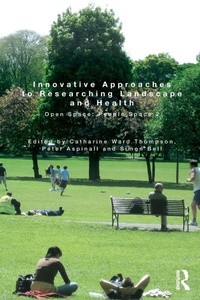
Innovative Approaches to Researching Landscape and Health
Open Space: People Space 2
1st Edition
Published on 24. March 2014
Book
Paperback/Softback
290 pages
978-1-138-78793-3 (ISBN)
Description
Our modern lifestyles often cause us to spend more time sitting behind a desk than being active outdoors. At the same time, our general health is deteriorating. The alarming rise in obesity, sedentary lifestyles and mental ill-health across the developed world has resulted in an urgent desire to understand how the environment, in particular the outdoor environment, influences health.
This book addresses the growing interest in salutogenic environments - landscapes that support healthy lifestyles and promote well-being - and the need for innovative methods to research them. Drawing on multidisciplinary approaches from environmental psychology, health sciences, urban design, landscape architecture and horticulture, it questions how future research can be better targeted to inform policy and practice in health promotion.
The contributing authors are international experts in researching landscape, health and the environment, drawn together by OPENspace directors who have a unique reputation in this area. This pioneering book is a valuable resource for postgraduate researchers and practitioners in both environmental and health studies.
This book addresses the growing interest in salutogenic environments - landscapes that support healthy lifestyles and promote well-being - and the need for innovative methods to research them. Drawing on multidisciplinary approaches from environmental psychology, health sciences, urban design, landscape architecture and horticulture, it questions how future research can be better targeted to inform policy and practice in health promotion.
The contributing authors are international experts in researching landscape, health and the environment, drawn together by OPENspace directors who have a unique reputation in this area. This pioneering book is a valuable resource for postgraduate researchers and practitioners in both environmental and health studies.
Reviews / Votes
"An interesting read for landscape designers and academics alike." - Housing Studies Journal"This is an interesting and thought provoking addition to the literature on health and the built environment which not only details some new ways of approaching research in this area but also provides a comprehensive summary of the evidence so far and possible future direction for new work... I feel better informed and even inspired from reading it." - Journal of Environmental Policy & Planning "An interesting read for landscape designers and academics alike." -Alice Oldfield, Centre for Housing Research, University of St Andrews Scotland, Hosuing Studies Journal
More details
Language
English
Place of publication
London
United Kingdom
Publishing group
Taylor & Francis Ltd
Target group
College/higher education
Illustrations
88 s/w Photographien bzw. Rasterbilder, 39 s/w Zeichnungen
39 Line drawings, black and white; 88 Halftones, black and white
Dimensions
Height: 234 mm
Width: 156 mm
Thickness: 17 mm
Weight
477 gr
ISBN-13
978-1-138-78793-3 (9781138787933)
Copyright in bibliographic data and cover images is held by Nielsen Book Services Limited or by the publishers or by their respective licensors: all rights reserved.
Schweitzer Classification
Other editions
Additional editions
Catharine Ward Thompson | Peter Aspinall | Simon Bell
Innovative Approaches to Researching Landscape and Health
Open Space: People Space 2
E-Book
04/2010
Routledge
€64.49
Available for download
Catharine Ward Thompson | Peter Aspinall | Simon Bell
Innovative Approaches to Researching Landscape and Health
Open Space: People Space 2
E-Book
04/2010
Routledge
€64.49
Available for download
Catharine Ward Thompson | Peter Aspinall | Simon Bell
Innovative Approaches to Researching Landscape and Health
Open Space: People Space 2
Book
04/2010
1st Edition
Routledge
€206.90
Shipment within 15-20 days
Persons
Catharine Ward Thompson is Professor of Landscape Architecture at the University of Edinburgh. She is Director of OPENspace research centre, based at Edinburgh and Heriot-Watt Universities, and directs the Landscape Architecture PhD programme at Edinburgh.
Peter Aspinall is Associate Director of OPENspace Research Centre and is an environmental psychologist. He is currently an Honorary Fellow of the University of Edinburgh and Emeritus Professor of Vision and Environment at Heriot-Watt University.
Simon Bell is Associate Director of OPENspace Research Centre, University of Edinburgh and a forester and landscape architect. He is also Professor of Landscape Architecture at the Estonian University of Life Sciences, Tartu, Estonia.
Peter Aspinall is Associate Director of OPENspace Research Centre and is an environmental psychologist. He is currently an Honorary Fellow of the University of Edinburgh and Emeritus Professor of Vision and Environment at Heriot-Watt University.
Simon Bell is Associate Director of OPENspace Research Centre, University of Edinburgh and a forester and landscape architect. He is also Professor of Landscape Architecture at the Estonian University of Life Sciences, Tartu, Estonia.
Content
Introduction Part 1: Affordances in the Landscape: A Theoretical Approach 1. Affordances and the Perception of Landscape: An Inquiry into Environmental Perception and Aesthetics 2. Using Behaviour Mapping to Investigate Healthy Outdoor Environments for Children and Families: Conceptual Framework, Procedures, and Applications Part 2: Evidence on the Relationship between Landscape and Health 3. Nearby Nature and Human Health: Looking at Mechanisms and their Implications 4. Active Landscapes: The Methodological Challenges in Developing the Evidence on Urban Environments and Physical Activity 5. Using Affordances as a Health-Promoting Tool in a Therapeutic Garden Part 3: Different Perspectives on Methodology 6. Opening Space for Project Pursuit: Affordance, Restoration and Chills 7. On Environmental Preference: Applying Conjoint Analysis to Visiting Parks and Buying Houses Part 4: Applications in Practice: Spatial Structure, Landscape Design and Landscape Use 8. Feeling Good and Feeling Safe in the Landscape: A 'Syntactic' Approach 9. Landscape Quality and Quality of Life Part 5: Conclusions 10. Challenges for Research in Landscape and Heath