

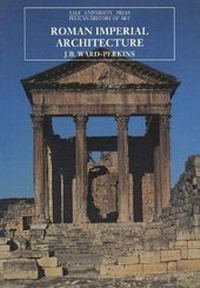
Roman Imperial Architecture
Published on 25. November 1992
Book
Paperback/Softback
532 pages
978-0-300-05292-3 (ISBN)
Description
The history of Roman Imperial architecture is one of the interaction of two dominant themes: in Rome itself the emergence of a new architecture based on the use of a revolutionary new material, Roman concrete; and in the provinces, the development of interrelated but distinctive Romano-provicial schools. The metropolitan school, exemplified in the Pantheon, the Imperial Baths, and the apartment houses of Ostia, constitutes Rome's great original contribution. The role of the provinces ranged from the preservation of a lively Hellenistic tradition to the assimilation of ideas from the east and from the military frontiers. It was-finally-Late Roman architecture that transmitted the heritage of Greece and Rome to the medieval world.
More details
Series
Language
English
Place of publication
United States
Target group
College/higher education
Professional and scholarly
Product notice
Paperback (trade)
Illustrations
316 color illus.
Weight
816 gr
ISBN-13
978-0-300-05292-3 (9780300052923)
Copyright in bibliographic data and cover images is held by Nielsen Book Services Limited or by the publishers or by their respective licensors: all rights reserved.
Schweitzer Classification
Content
Part 1 Architecture in Rome and Italy from Augustus to the mid 3rd century: Augustan Rome; architecture in Rome under the Julio-Claudian emperors (AD 14-68) - Tiberius (AD 14-37), Caligula (AD 37-41), Claudius (AD 41-54), Nero (AD 54-68); archiecture in Rome from Vespasian to Trajan (AD 69-117) - Vespasian (AD 69-79), Titus (AD 79-81), Domitian (AD 81-96), Nerva and Trajan (AD 96-117); materials and methods - the Roman architectural revolution; architecture in Rome from Hadrian to Alexander Severus (AD 117-235) - Hadrian (AD 117-38), Antoninus Pius to Commodus (AD 138-93), the Severan emperors (AD 193-235), private funerary architecture in the 2nd century; Ostia - the early imperial city, Ostia in the 2nd and 3rd centuries; Italy under the early empire - Campania, Northern Italy; domestic architecture in town and country - the towns, suburbs and countryside, the late Roman town houses of Ostia. Part 2 The architecture of the Roman provinces: Gaul and the European provinces - the Iberian peninsula, Gaul, Britain and the Germanies, central and south-eastern Europe; Greece - Corinth, Athens, other Roman sites; Asia Minor - building materials and techniques, the central plateau, the western coastlands, Pamphylia and Cilicia, the contribution of Asia Minor to the architecture of the empire; the architecture of the Roman east - Judaea - the buildings of Herod the Great, Baalbek and the Lebannon, north-west Syria, Damascus, southern Syria - Petra and the Decapolis, the Hauran, the Mesopotamian frontier lands - Dura-Europos and Hatra, Palmyra; the North African provinces - Egypt, Cyrenaica, Tripolitania, Tunisia, Algeria, Morocco. Part 3 Late pagan archiecture in Rome and in the provinces: architecture in Rome from Maximin to Constantine (AD 235-337); the architecture of the tetrarchy in the provinces - Trier, Thessalonike (Salonica), Spalato (Split), Piazza Armerina, north Italy, Constantinople.