

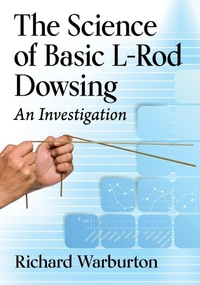
The Science of Basic L-Rod Dowsing
An Investigation
Published on 25. July 2024
Book
Paperback/Softback
120 pages
978-1-4766-9401-6 (ISBN)
Description
Dowsing has been a known practice for at least 500 years, with some evidence suggesting it may have been used for millennia. Historically, dowsers used a forked, Y-shaped stick, following the movement toward the presence of water, minerals, or other objects located beneath the ground. Today, the most common tool used is a wire bent into the shape of an "L," leading to the term L-rod dowsing. Only a few of dowsing's many forms appear to have a clear physical basis, such that some physical phenomenon in the environment causes a physiological response in the body. Despite the many studies performed in the past, none have resulted in a comprehensive, testable explanation for how dowsing works.
This book reviews and critiques some of the common explanations for L-rod field dowsing, describes an investigation into various aspects of L-rod dowsing, and proposes a mechanism which explains the physical observations. Building on the prior scientific studies, it presents a theory based on well-known scientific principles for the physical component of dowsing.
This book reviews and critiques some of the common explanations for L-rod field dowsing, describes an investigation into various aspects of L-rod dowsing, and proposes a mechanism which explains the physical observations. Building on the prior scientific studies, it presents a theory based on well-known scientific principles for the physical component of dowsing.
More details
Language
English
Place of publication
Jefferson, NC
United States
Target group
Professional and scholarly
Interest Age: From 18 years
Product notice
Paperback (trade)
Illustrations
ca. 115 photos, appendix, notes, bibliography, index
Dimensions
Height: 254 mm
Width: 178 mm
Thickness: 17 mm
Weight
579 gr
ISBN-13
978-1-4766-9401-6 (9781476694016)
Copyright in bibliographic data and cover images is held by Nielsen Book Services Limited or by the publishers or by their respective licensors: all rights reserved.
Schweitzer Classification
Person
Richard Warburton, who holds a Ph.D. in chemistry from the University of Southampton and a J.D. from Duquesne University School of Law, has spent most of his career in new product development and is an inventor with more than 20 patents. He lives near Pittsburgh, Pennsylvania.
Content
Table of Contents
Acknowledgments
Symbols and Abbreviations Used in This Book
Preface
1.¿Introduction
2.¿General Observations of the Dowsing Signal
3.¿Preliminary Observations and Requirements for the Dowsing Effect
4.¿The Psychology of Dowsing
5.¿Radioactivity and Subatomic Particles
6.¿Gravity
7.¿Parallel Bands and Fields Produced by Rotating Objects
8.¿Nuclear Magnetic Resonance
9.¿Sound
10.¿Electric Fields and Static Electricity
11.¿Telluric Magnetism and Currents
12.¿Nature of the Dowsing Response
13.¿Location of Dowsing Sense Organ
14.¿Magnetism and Magnetic Fields
15.¿Electromagnetic Fields and Dowsing
16.¿Dowsing Frequency Band
17.¿Source of Electromagnetic Radiation
18.¿Resolution of Dowsing Signal
19.¿Memory Effects
20.¿Depth
21.¿Measuring the Dowsing Response Instrumentally
22.¿Dowsing in Three Dimensions
23.¿Mechanisms for Detection of Magnetic Fields in Animals
24.¿Interaction of Electromagnetic Fields with Biological Systems
25.¿Remaining Mysteries and Interesting Reports
26.¿Conclusions
Final Words
Appendix: Properties of Waves
Annex: Instrumentation Used
Chapter Notes
Selected Bibliography
Index
Acknowledgments
Symbols and Abbreviations Used in This Book
Preface
1.¿Introduction
2.¿General Observations of the Dowsing Signal
3.¿Preliminary Observations and Requirements for the Dowsing Effect
4.¿The Psychology of Dowsing
5.¿Radioactivity and Subatomic Particles
6.¿Gravity
7.¿Parallel Bands and Fields Produced by Rotating Objects
8.¿Nuclear Magnetic Resonance
9.¿Sound
10.¿Electric Fields and Static Electricity
11.¿Telluric Magnetism and Currents
12.¿Nature of the Dowsing Response
13.¿Location of Dowsing Sense Organ
14.¿Magnetism and Magnetic Fields
15.¿Electromagnetic Fields and Dowsing
16.¿Dowsing Frequency Band
17.¿Source of Electromagnetic Radiation
18.¿Resolution of Dowsing Signal
19.¿Memory Effects
20.¿Depth
21.¿Measuring the Dowsing Response Instrumentally
22.¿Dowsing in Three Dimensions
23.¿Mechanisms for Detection of Magnetic Fields in Animals
24.¿Interaction of Electromagnetic Fields with Biological Systems
25.¿Remaining Mysteries and Interesting Reports
26.¿Conclusions
Final Words
Appendix: Properties of Waves
Annex: Instrumentation Used
Chapter Notes
Selected Bibliography
Index