

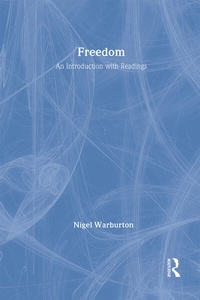
Freedom
An Introduction with Readings
1st Edition
Will be published approx. on 14. September 2000
Book
Hardback
264 pages
978-0-415-21245-8 (ISBN)
Description
This introduction to the arguments about individual freedom is ideal for newcomers to philosophy or political thought. Each chapter considers a fundamental argument about the scope of individual freedom, including the concepts of negative and positive freedom, freedom of belief, the Harm Principle, and freedom of speech and expression. Each argument is then clearly linked to a reading from key thinkers on each of these problems: Isaiah Berlin, Jeremy Waldron, Jonathan Wolff, Bernard Williams, Ronald Dworkin, H.L.A. Hart and Charles Taylor.
Key features include clear activities and discussion points, chapter summaries, and guides to further reading.
^Freedom will be of interest to students of philosophy, politics and critical thinking.
Key features include clear activities and discussion points, chapter summaries, and guides to further reading.
^Freedom will be of interest to students of philosophy, politics and critical thinking.
More details
Series
Language
English
Place of publication
London
United Kingdom
Publishing group
Taylor & Francis Ltd
Target group
College/higher education
Undergraduate
Dimensions
Height: 246 mm
Width: 174 mm
Weight
771 gr
ISBN-13
978-0-415-21245-8 (9780415212458)
Copyright in bibliographic data and cover images is held by Nielsen Book Services Limited or by the publishers or by their respective licensors: all rights reserved.
Schweitzer Classification
Other editions
Additional editions
Book
09/2000
1st Edition
Routledge
€69.59
Shipment within 15-20 days
Person
Nigel Warburton is lecturer in philosophy at the Open University. He is author of the bestsellers Philosophy: The Basics; Thinking from A-Z; Philosophy: The Classics; and Philosophy: The Basic Readings, all available from Routledge. >
Content
1. Two concepts of freedom 2. Freedom and Belief 3. The Harm Principle 4. Freedom of Speech 5. 'Experiments of Living' 6. Positive Freedom