

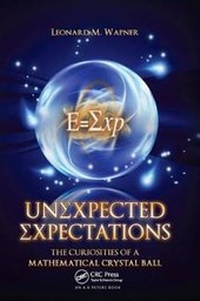
Unexpected Expectations
The Curiosities of a Mathematical Crystal Ball
1st Edition
Published on 23. September 2019
Book
Paperback/Softback
220 pages
978-0-367-38128-8 (ISBN)
Description
Unexpected Expectations: The Curiosities of a Mathematical Crystal Ball explores how paradoxical challenges involving mathematical expectation often necessitate a reexamination of basic premises. The author takes you through mathematical paradoxes associated with seemingly straightforward applications of mathematical expectation and shows how these unexpected contradictions may push you to reconsider the legitimacy of the applications.
The book requires only an understanding of basic algebraic operations and includes supplemental mathematical background in chapter appendices. After a history of probability theory, it introduces the basic laws of probability as well as the definition and applications of mathematical expectation/expected value (E). The remainder of the text covers unexpected results related to mathematical expectation, including:
The roles of aversion and risk in rational decision making
A class of expected value paradoxes referred to as envelope problems
Parrondo's paradox-how negative (losing) expectations can be combined to give a winning result
Problems associated with imperfect recall
Non-zero-sum games, such as the game of chicken and the prisoner's dilemma
Newcomb's paradox-a great philosophical paradox of free will
Benford's law and its use in computer design and fraud detection
While useful in areas as diverse as game theory, quantum mechanics, and forensic science, mathematical expectation generates paradoxes that frequently leave questions unanswered yet reveal interesting surprises. Encouraging you to embrace the mysteries of mathematics, this book helps you appreciate the applications of mathematical expectation, "a statistical crystal ball."
The book requires only an understanding of basic algebraic operations and includes supplemental mathematical background in chapter appendices. After a history of probability theory, it introduces the basic laws of probability as well as the definition and applications of mathematical expectation/expected value (E). The remainder of the text covers unexpected results related to mathematical expectation, including:
The roles of aversion and risk in rational decision making
A class of expected value paradoxes referred to as envelope problems
Parrondo's paradox-how negative (losing) expectations can be combined to give a winning result
Problems associated with imperfect recall
Non-zero-sum games, such as the game of chicken and the prisoner's dilemma
Newcomb's paradox-a great philosophical paradox of free will
Benford's law and its use in computer design and fraud detection
While useful in areas as diverse as game theory, quantum mechanics, and forensic science, mathematical expectation generates paradoxes that frequently leave questions unanswered yet reveal interesting surprises. Encouraging you to embrace the mysteries of mathematics, this book helps you appreciate the applications of mathematical expectation, "a statistical crystal ball."
More details
Language
English
Place of publication
London
United Kingdom
Publishing group
Taylor & Francis Ltd
Target group
College/higher education
Dimensions
Height: 229 mm
Width: 152 mm
Weight
410 gr
ISBN-13
978-0-367-38128-8 (9780367381288)
Copyright in bibliographic data and cover images is held by Nielsen Book Services Limited or by the publishers or by their respective licensors: all rights reserved.
Schweitzer Classification
Other editions
Additional editions
Book
06/2012
1st Edition
A K Peters
€165.70
Shipment within 3-4 weeks
E-Book
06/2012
CRC Press
€73.99
Available for download
E-Book
06/2012
CRC Press
€73.99
Available for download
Person
Wapner, Leonard M.
Content
The Crystal Ball. Looking Back. The ABCs of E. Doing the Right Thing. Aversion Perversion. And the Envelope Please! Parrondo's Paradox: You Can Win for Losing. Imperfect Recall. Non-Zero-Sum Games: The Inadequacy of Individual Rationality. Newcomb's Threat. Benford's Law. Let the Mystery Be! Bibliography. Index.