

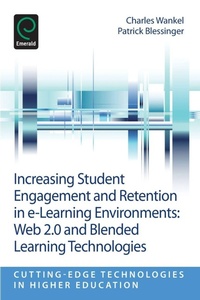
Increasing Student Engagement and Retention in E-Learning Environments
Web 2.0 and Blended Learning Technologies
Published on 2. April 2013
Book
Paperback/Softback
250 pages
978-1-78190-515-9 (ISBN)
Description
Increasing Student Engagement and Retention in e-Learning Environments: Web 2.0 and Blended Learning Technologies examines new research on how online and blended learning technologies are being used in higher education to increase learner engagement in an era of increasing technological convergence and dependence. These enabling technologies are reshaping and reframing the practice of teaching and learning in higher education. Through case studies, surveys, and literature reviews, this volume will examine online and blended technologies are being used to improve academic literacies in students, to create engaging communities of practice, and how these technologies are being used to improve learner motivation and self-empowered learners. This volume will also discuss a framework for adopting and deploying these technologies.
More details
Series
Language
English
Place of publication
Bingley
United Kingdom
Publishing group
Emerald Publishing Limited
Target group
College/higher education
Dimensions
Height: 234 mm
Width: 156 mm
Thickness: 23 mm
Weight
655 gr
ISBN-13
978-1-78190-515-9 (9781781905159)
Copyright in bibliographic data and cover images is held by Nielsen Book Services Limited or by the publishers or by their respective licensors: all rights reserved.
Schweitzer Classification
Other editions
Additional editions
Charles Wankel | Patrick Blessinger
Increasing Student Engagement and Retention in E-Learning Environments
Web 2.0 and Blended Learning Technologies
E-Book
04/2013
1st Edition
Emerald Publishing Limited
from
€126.19
Available for download
Persons
Wankel C. - St. John's University, NY, USA Blessinger P. - International Higher Education Teaching and Learning Association (HETL), USA
Content
Novel Approaches in Higher Education: An Introduction to Web 2.0 and Blended Learning Technologies.
Leadership from ID (Instructional Design) for Web 2.0 Adoption: Appropriate use of Emerging Technologies in Online Courses.
Controlling Engagement: The Effects of Learner Control on Engagement and Satisfaction.
Increasing Learner Engagement of Learning Technologies and Science TPACK Through Representational Challenges.
From Connectivity to Connected Learners: Transactional Distance and Social Presence.
Promoting Learner Engagement and Academic Literacies Through Blended Course Design.
Engaging Learners as Moderators in an Online Management Course.
Engaging Entrepreneurs with a Blended Problem-based Learning Degree Programme.
Engaging Distance and Blended Learners Online.
A Pedagogical Framework for Collaborative Learning in a Social Blended E-Learning Context.
Developing Technology and Collaborative Group Work Skills: Supporting Student and Group Success in Online and Blended Courses.
Balancing Students' Privacy Concerns While Increasing Student Engagement in E-learning Environments.
Problem-Based Learning in Hybrid, Blended, or Online Courses: Instructional and Change Management Implications for Supporting Learner Engagement.
About the Authors.
Subject Index.
Author Index.
Increasing Student Engagement and Retention in E-Learning Environments: Web 2.0 and Blended Learning Technologies.
Cutting-Edge Technologies in Higher Education.
Cutting-Edge Technologies in Higher Education.
Copyright page.
Leadership from ID (Instructional Design) for Web 2.0 Adoption: Appropriate use of Emerging Technologies in Online Courses.
Controlling Engagement: The Effects of Learner Control on Engagement and Satisfaction.
Increasing Learner Engagement of Learning Technologies and Science TPACK Through Representational Challenges.
From Connectivity to Connected Learners: Transactional Distance and Social Presence.
Promoting Learner Engagement and Academic Literacies Through Blended Course Design.
Engaging Learners as Moderators in an Online Management Course.
Engaging Entrepreneurs with a Blended Problem-based Learning Degree Programme.
Engaging Distance and Blended Learners Online.
A Pedagogical Framework for Collaborative Learning in a Social Blended E-Learning Context.
Developing Technology and Collaborative Group Work Skills: Supporting Student and Group Success in Online and Blended Courses.
Balancing Students' Privacy Concerns While Increasing Student Engagement in E-learning Environments.
Problem-Based Learning in Hybrid, Blended, or Online Courses: Instructional and Change Management Implications for Supporting Learner Engagement.
About the Authors.
Subject Index.
Author Index.
Increasing Student Engagement and Retention in E-Learning Environments: Web 2.0 and Blended Learning Technologies.
Cutting-Edge Technologies in Higher Education.
Cutting-Edge Technologies in Higher Education.
Copyright page.