

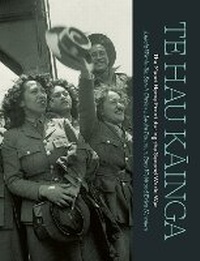
Te Hau Kainga
The Maori Home Front during the Second World War
Published on 7. November 2024
Book
Hardback
296 pages
978-1-86940-999-9 (ISBN)
Description
Taking readers to the farms and factories, the marae and churches where
Maori lived, worked and raised their families, Te Hau Kainga tells the
story of the profound transformation in Maori life during the Second World War.
While the Maori Battalion fought overseas, the Maori War Effort
Organisation and its tribal committees engaged Maori men and women throughout
Aotearoa in the home guard, the women's auxiliary forces, and national
agricultural and industrial production. Maori mobilisation was an exercise of
rangatiratanga and it changed how Maori engaged with the state. And, as Maori
men and women took up new roles, the war was to become a watershed event for
Maori society that set the stage for post-war urbanisation.
From ammunition factories to kumara fields, from Te Puea Herangi to Te
Paipera Tapu, Te Hau Kainga provides the first substantial account of
how hapori Maori were shaped by the wartime experience at home. It is a story
of sacrifice and remarkable resilience among whanau, hapu and iwi Maori.
Te Hau Kainga is
published alongside its companion volume Raupanga: Nga Pito Korero o te
Pakanga Tuarua no te Hau Kainga, edited by Angela Wanhalla and Lachy
Paterson. Raupanga features thirty-five succinct,
illustrated essays exploring the Maori home front, translated into te reo Maori
by Lachy Paterson.
Maori lived, worked and raised their families, Te Hau Kainga tells the
story of the profound transformation in Maori life during the Second World War.
While the Maori Battalion fought overseas, the Maori War Effort
Organisation and its tribal committees engaged Maori men and women throughout
Aotearoa in the home guard, the women's auxiliary forces, and national
agricultural and industrial production. Maori mobilisation was an exercise of
rangatiratanga and it changed how Maori engaged with the state. And, as Maori
men and women took up new roles, the war was to become a watershed event for
Maori society that set the stage for post-war urbanisation.
From ammunition factories to kumara fields, from Te Puea Herangi to Te
Paipera Tapu, Te Hau Kainga provides the first substantial account of
how hapori Maori were shaped by the wartime experience at home. It is a story
of sacrifice and remarkable resilience among whanau, hapu and iwi Maori.
Te Hau Kainga is
published alongside its companion volume Raupanga: Nga Pito Korero o te
Pakanga Tuarua no te Hau Kainga, edited by Angela Wanhalla and Lachy
Paterson. Raupanga features thirty-five succinct,
illustrated essays exploring the Maori home front, translated into te reo Maori
by Lachy Paterson.
Reviews / Votes
'The war caused revolutionary changes at all levels: it proved to be astimulus for the Maori leadership at home as well as laying the basis for new
developments in the following years. This book provides a lens for
understanding the years both before and after the war.' - Dame Claudia
Orange
'The depth and detail presented here affords
a greater understanding of the critical roles and significant contributions of Maori
that previously have not been explained and accounted for, or have not been
recorded in such detail. There is a great need to supply information on the
Second World War from a Maori perspective, and this fills a void that has been
wanting and waiting for rich and detailed contributions.' - Professor
Tangiwai Rewi, Dean of Maori and Indigenous Studies, Te Whare Wananga o Waikato
- University of Waikato
'Sir Apirana Ngata spoke of Maori contribution to the war effort as the
price of citizenship; it is a price which should not have had to be paid, and
this book reminds us what a huge opportunity for Maori self-determination was
destroyed by the power structure at war's end.' - Jim
McAloon, Professor of History, Te Herenga Waka Victoria University of
Wellington
'This is not simply a story of Maori during the war. Two themes stood out
for me: first, the enormous cost carried by Maori during the war and its impact
on communities, whenua and moana. Second, Maori sacrifice - both in terms of
human life and hardship - are alongside stories of creative survival in the
face of the long-term effects of colonisation. Te Hau Kainga will attract a general readership, both
Pakeha and Maori, while contributing to scholarly arguments around indigenous
responses to global war.' - Rowan Light, Waipapa Taumata Rau University of Auckland
More details
Language
English
Place of publication
Auckland
New Zealand
Product notice
sewn/stitched
Cloth over boards
Dimensions
Height: 252 mm
Width: 188 mm
Thickness: 28 mm
Weight
1039 gr
ISBN-13
978-1-86940-999-9 (9781869409999)
Copyright in bibliographic data and cover images is held by Nielsen Book Services Limited or by the publishers or by their respective licensors: all rights reserved.
Schweitzer Classification
Persons
Sarah Christie was a postdoctoral fellow in the History Programme at Otakou
Whakaihu Waka, where she completed her doctorate on the social and cultural
histories of women in the workforce in New Zealand. She is currently a
researcher at the Ngai Tahu Archive, Christchurch.
Erica Newman (Ngapuhi) is a senior lecturer at Te Tumu: School of Maori,
Pacific and Indigenous Studies at Otakou Whakaihu Waka. She researches
adoption, whangai, kinship and identity (internationally and nationally) with a
focus on Indigenous perspectives, and has published on transracial adoption in
New Zealand. Erica was awarded a Marsden Fund Fast-Start grant to explore the
intergenerational impact of the 1955 Adoption Act and to journey with
descendants of Maori adoptees who are searching for their turangawaewae.
Lachy Paterson is emeritus professor at Te Tumu, Otakou Whakaihu Waka, where he
taught te reo Maori and Maori history. He researches Maori history, especially
relating to newspapers and other texts in Maori, and the relationship between
Maori and the government in the nineteenth and first half of the twentieth
century.
Angela Wanhalla (Ngai Tahu, Ngai Te Ruahikihiki, Pakeha) is a professor in the
History Programme, Otakou Whakaihu Waka. Her primary research area is Maori
women's history. Her most recent book is Of Love and War: Pacific Brides of
World War II (University of Nebraska Press, 2023).
Ross Webb has a PhD from Victoria University of Wellington and is a
historian with an interest in organised labour and oral history. He is
principal researcher analyst in the Research Team at the Waitangi Tribunal
Unit, and is working on a book, 'In Defence of Living Standards: The Federation
of Labour, Politics, and Economic Crisis, 1975-1987'.
Whakaihu Waka, where she completed her doctorate on the social and cultural
histories of women in the workforce in New Zealand. She is currently a
researcher at the Ngai Tahu Archive, Christchurch.
Erica Newman (Ngapuhi) is a senior lecturer at Te Tumu: School of Maori,
Pacific and Indigenous Studies at Otakou Whakaihu Waka. She researches
adoption, whangai, kinship and identity (internationally and nationally) with a
focus on Indigenous perspectives, and has published on transracial adoption in
New Zealand. Erica was awarded a Marsden Fund Fast-Start grant to explore the
intergenerational impact of the 1955 Adoption Act and to journey with
descendants of Maori adoptees who are searching for their turangawaewae.
Lachy Paterson is emeritus professor at Te Tumu, Otakou Whakaihu Waka, where he
taught te reo Maori and Maori history. He researches Maori history, especially
relating to newspapers and other texts in Maori, and the relationship between
Maori and the government in the nineteenth and first half of the twentieth
century.
Angela Wanhalla (Ngai Tahu, Ngai Te Ruahikihiki, Pakeha) is a professor in the
History Programme, Otakou Whakaihu Waka. Her primary research area is Maori
women's history. Her most recent book is Of Love and War: Pacific Brides of
World War II (University of Nebraska Press, 2023).
Ross Webb has a PhD from Victoria University of Wellington and is a
historian with an interest in organised labour and oral history. He is
principal researcher analyst in the Research Team at the Waitangi Tribunal
Unit, and is working on a book, 'In Defence of Living Standards: The Federation
of Labour, Politics, and Economic Crisis, 1975-1987'.