

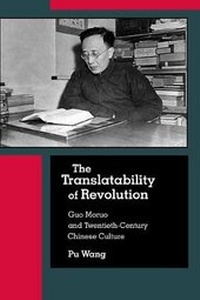
The Translatability of Revolution
Guo Moruo and Twentieth-Century Chinese Culture
Published on 6. August 2018
Book
Hardback
352 pages
978-0-674-98718-0 (ISBN)
Description
The first comprehensive study of the lifework of Guo Moruo (1892-1978) in English, this book explores the dynamics of translation, revolution, and historical imagination in twentieth-century Chinese culture. Guo was a romantic writer who eventually became Mao Zedong's last poetic interlocutor; a Marxist historian who evolved into the inaugural president of China's Academy of Sciences; and a leftist politician who devoted almost three decades to translating Goethe's Faust. His career, embedded in China's revolutionary century, has generated more controversy than admiration. Recent scholarship has scarcely treated his oeuvre as a whole, much less touched upon his role as a translator.
Leaping between different genres of Guo's works, and engaging many other writers' texts, The Translatability of Revolution confronts two issues of revolutionary cultural politics: translation and historical interpretation. Part 1 focuses on the translingual making of China's revolutionary culture, especially Guo's translation of Faust as a "development of Zeitgeist." Part 2 deals with Guo's rewritings of antiquity in lyrical, dramatic, and historiographical-paleographical forms, including his vernacular translation of classical Chinese poetry. Interrogating the relationship between translation and historical imagination-within revolutionary cultural practice-this book finds a transcoding of different historical conjunctures into "now-time," saturated with possibilities and tensions.
Leaping between different genres of Guo's works, and engaging many other writers' texts, The Translatability of Revolution confronts two issues of revolutionary cultural politics: translation and historical interpretation. Part 1 focuses on the translingual making of China's revolutionary culture, especially Guo's translation of Faust as a "development of Zeitgeist." Part 2 deals with Guo's rewritings of antiquity in lyrical, dramatic, and historiographical-paleographical forms, including his vernacular translation of classical Chinese poetry. Interrogating the relationship between translation and historical imagination-within revolutionary cultural practice-this book finds a transcoding of different historical conjunctures into "now-time," saturated with possibilities and tensions.
Reviews / Votes
The Translatability of Revolution brings together Guo Moruo's poetry, dramas, personal essays, and theoretical and polemical writings to present the most sophisticated and far-ranging study in English of this author and his works. Scholars and students of Chinese literature and history, Japanese studies, comparative literature, and translation will all benefit from Pu Wang's discussion of Guo's translingual creation of a new poetic subject and from many other insights found in this study. -- Michael Gibbs Hill, College of William & Mary Guo Moruo is arguably one of the most controversial figures in modern Chinese literary history. Because of his highly contested image, Guo has never been a popular scholarly subject. In this groundbreaking book, Pu Wang seeks to assess Guo's literary and political career in terms of his engagement as a 'translator.' He defines translation as a transcultural practice that involves not only linguistic rendition but also ideological brokering as well as psychological invocation. Above all, he finds in Guo's case a compelling testimony to the relationships between language and revolution, historical fabulation and political engagement. Wang's book is a most important source for anyone interested in translation studies, Chinese and comparative literature, and cultural politics. -- David Der-wei Wang, Harvard University A towering figure and the Renaissance Man of Chinese New Culture, Guo Moruo holds the key to a critical and historical decoding of its Zeitgeist and its DNA strains-from lyrical poetry to autobiography, from the modern spoken drama to translation, from literary criticism to archeological philology and Marxist historiography. Pu Wang's work is an inspiring contribution to the untimely, even heroic, effort at addressing this glaring absence in contemporary scholarship and intellectual discussion. -- Xudong Zhang, New York University An inspiring book that offers new ideas for readers to chew and digest. -- Q. Edward Wang * Chinese Historical Studies *More details
Series
Language
English
Place of publication
Cambridge
United States
Target group
Professional and scholarly
Illustrations
5 halftones, 4 line illustrations
Dimensions
Height: 229 mm
Width: 152 mm
ISBN-13
978-0-674-98718-0 (9780674987180)
Copyright in bibliographic data and cover images is held by Nielsen Book Services Limited or by the publishers or by their respective licensors: all rights reserved.
Schweitzer Classification
Person
Pu Wang is Assistant Professor of Chinese Literature and the Helaine and Alvin Allen Chair in Literature at Brandeis University.