

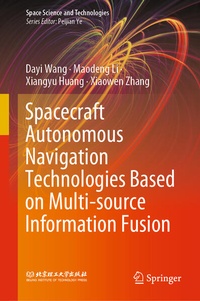
Spacecraft Autonomous Navigation Technologies Based on Multi-source Information Fusion
Published on 1. August 2020
Book
Hardback
XXI, 340 pages
978-981-15-4878-9 (ISBN)
Description
Dayi Wang, Professor, is currently serving as Vice President of the Beijing Institute of Spacecraft System Engineering, CAST. He is a recipient of the National Science Fund for Distinguished Young Scholars and the Chief Technologist of the "973" Project. Dr. Wang has carried out innovative work on spacecraft autonomous navigation and control, making great contributions to the success of China's Chang'E lunar missions. He received the 2016 Science and Technology Innovation Award from Ho Leung Ho Lee Foundation and has won one National Technological Innovation prize (second class) and several ministerial level prizes (first class 4 times and second class 3 times).
Maodeng Li received his B.S. and Ph.D. degrees in Aerospace Engineering from Harbin Institute of Technology, Harbin, P.R. China, in 2006 and 2011, respectively. From September 2011 to August 2013, he was a Postdoctoral Research Associate at Beijing Institute of Control Engineering(BICE). Since August 2013, he has been a Senior Engineer at BICE. His current research interests include spacecraft autonomous navigation and GNC design for planetary landing missions. Xiangyu Huang received his B.S. and Ph.D. degrees in Aerospace Engineering from Harbin Institute of Technology, Harbin, P.R. China, in 1999 and 2005, respectively. Since August 2005, he has been working at the Space Intelligent Control Laboratory, Beijing Institute of Control Engineering (BICE), where he is currently a Professor and Senior Research Specialist. He was a GNC Engineer for the Chang'E-3 lunar landing mission, and his current research focus is on GNC design for planetary landing missions. He has won one National Technological Innovation prize (second class) and three ministerial level prizes (first class).
Xiaowen Zhang received his B.E. degree from Harbin Engineering University, Harbin, China, in 2005,and his M.E. degree in Control Theory and Control Engineering from China Academy of Space Technology, Beijing, China, in 2009. He is currently a Senior Engineer at Beijing Institute of Control Engineering. His research interests include GNC system design for deep space exploration missions and spacecraft autonomous navigation and guidance technologies. He has won one first class ministerial level prize.
Maodeng Li received his B.S. and Ph.D. degrees in Aerospace Engineering from Harbin Institute of Technology, Harbin, P.R. China, in 2006 and 2011, respectively. From September 2011 to August 2013, he was a Postdoctoral Research Associate at Beijing Institute of Control Engineering(BICE). Since August 2013, he has been a Senior Engineer at BICE. His current research interests include spacecraft autonomous navigation and GNC design for planetary landing missions. Xiangyu Huang received his B.S. and Ph.D. degrees in Aerospace Engineering from Harbin Institute of Technology, Harbin, P.R. China, in 1999 and 2005, respectively. Since August 2005, he has been working at the Space Intelligent Control Laboratory, Beijing Institute of Control Engineering (BICE), where he is currently a Professor and Senior Research Specialist. He was a GNC Engineer for the Chang'E-3 lunar landing mission, and his current research focus is on GNC design for planetary landing missions. He has won one National Technological Innovation prize (second class) and three ministerial level prizes (first class).
Xiaowen Zhang received his B.E. degree from Harbin Engineering University, Harbin, China, in 2005,and his M.E. degree in Control Theory and Control Engineering from China Academy of Space Technology, Beijing, China, in 2009. He is currently a Senior Engineer at Beijing Institute of Control Engineering. His research interests include GNC system design for deep space exploration missions and spacecraft autonomous navigation and guidance technologies. He has won one first class ministerial level prize.
More details
Series
Edition
2021 ed.
Language
English
Place of publication
Singapore
Singapore
Target group
Professional and scholarly
Illustrations
23 s/w Abbildungen, 93 farbige Abbildungen
XXI, 340 p. 116 illus., 93 illus. in color.
Dimensions
Height: 241 mm
Width: 160 mm
Thickness: 26 mm
Weight
711 gr
ISBN-13
978-981-15-4878-9 (9789811548789)
DOI
10.1007/978-981-15-4879-6
Schweitzer Classification
Other editions
Additional editions
Dayi Wang | Maodeng Li | Xiangyu Huang
Spacecraft Autonomous Navigation Technologies Based on Multi-source Information Fusion
Book
08/2021
Springer
€235.39
Shipment within 3-4 weeks
Dayi Wang | Maodeng Li | Xiangyu Huang
Spacecraft Autonomous Navigation Technologies Based on Multi-source Information Fusion
E-Book
07/2020
1st Edition
Springer
€223.63
Available for download
Persons
Dayi Wang, Professor, is currently serving as Vice President of the Beijing Institute of Spacecraft System Engineering, CAST. He is a recipient of the National Science Fund for Distinguished Young Scholars and the Chief Technologist of the "973" Project. Dr. Wang has carried out innovative work on spacecraft autonomous navigation and control, making great contributions to the success of China's Chang'E lunar missions. He received the 2016 Science and Technology Innovation Award from Ho Leung Ho Lee Foundation and has won one National Technological Innovation prize (second class) and several ministerial level prizes (first class 4 times and second class 3 times).
Maodeng Li received his B.S. and Ph.D. degrees in Aerospace Engineering from Harbin Institute of Technology, Harbin, P.R. China, in 2006 and 2011, respectively. From September 2011 to August 2013, he was a Postdoctoral Research Associate at Beijing Institute of Control Engineering(BICE). Since August 2013, he has been a Senior Engineer at BICE. His current research interests include spacecraft autonomous navigation and GNC design for planetary landing missions. Xiangyu Huang received his B.S. and Ph.D. degrees in Aerospace Engineering from Harbin Institute of Technology, Harbin, P.R. China, in 1999 and 2005, respectively. Since August 2005, he has been working at the Space Intelligent Control Laboratory, Beijing Institute of Control Engineering (BICE), where he is currently a Professor and Senior Research Specialist. He was a GNC Engineer for the Chang'E-3 lunar landing mission, and his current research focus is on GNC design for planetary landing missions. He has won one National Technological Innovation prize (second class) and three ministerial level prizes (first class).
Xiaowen Zhang received his B.E. degree from Harbin Engineering University, Harbin, China, in 2005,and his M.E. degree in Control Theory and Control Engineering from China Academy of Space Technology, Beijing, China, in 2009. He is currently a Senior Engineer at Beijing Institute of Control Engineering. His research interests include GNC system design for deep space exploration missions and spacecraft autonomous navigation and guidance technologies. He has won one first class ministerial level prize.
Maodeng Li received his B.S. and Ph.D. degrees in Aerospace Engineering from Harbin Institute of Technology, Harbin, P.R. China, in 2006 and 2011, respectively. From September 2011 to August 2013, he was a Postdoctoral Research Associate at Beijing Institute of Control Engineering(BICE). Since August 2013, he has been a Senior Engineer at BICE. His current research interests include spacecraft autonomous navigation and GNC design for planetary landing missions. Xiangyu Huang received his B.S. and Ph.D. degrees in Aerospace Engineering from Harbin Institute of Technology, Harbin, P.R. China, in 1999 and 2005, respectively. Since August 2005, he has been working at the Space Intelligent Control Laboratory, Beijing Institute of Control Engineering (BICE), where he is currently a Professor and Senior Research Specialist. He was a GNC Engineer for the Chang'E-3 lunar landing mission, and his current research focus is on GNC design for planetary landing missions. He has won one National Technological Innovation prize (second class) and three ministerial level prizes (first class).
Xiaowen Zhang received his B.E. degree from Harbin Engineering University, Harbin, China, in 2005,and his M.E. degree in Control Theory and Control Engineering from China Academy of Space Technology, Beijing, China, in 2009. He is currently a Senior Engineer at Beijing Institute of Control Engineering. His research interests include GNC system design for deep space exploration missions and spacecraft autonomous navigation and guidance technologies. He has won one first class ministerial level prize.
Content
Introduction.- Point Estimation Theory.- Estimation Fusion Algorithm.- Performance Analysis.- Time and Coordinate Systems.- Dynamic Models and Environment Models.- Inertial Autonomous Navigation Technology.- Optical Autonomous Navigation Technology.- Optical/Pulsar Integrated Autonomous Navigation Technology.- Altimeter and Velocimeter/Optical Aided Inertial Navigation Technology.- Simulation Testing Techniques for Autonomous Navigation Based on Multi-source Information Fusion.- Prospect for Multi-source Information Fusion Navigation.