

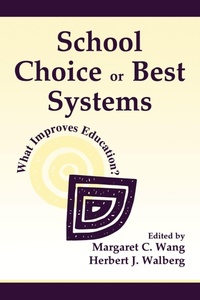
School Choice Or Best Systems
What Improves Education?
Published on 1. March 2001
Book
Paperback/Softback
410 pages
978-0-8058-3487-1 (ISBN)
Description
This book addresses one of the most urgent questions in American society today, one that is currently in the spotlight and hotly debated on all sides: Who shall rule the schools--parents or educators?
School Choice or Best Systems: What Improves Education? presents an overview of research and practical applications of innovative--even radical--school reforms being implemented across the United States. These fall along a continuum ranging from "parental choice" to "best systems." At the one extreme are schools of choice, which allow parents to choose and even govern schools for their children. These include charter schools, traditional private and parochial schools, schools that are privately governed but publicly funded through vouchers, and those that are funded by private scholarships provided by both corporations and wealthy individuals. At the other extreme are centralized state or district systems, based on reform initiatives and new systems of education that have been developed in response to views of citizens and legislators that schools can do much better. These schools, which specify uniform goals, policies, and programs for each school, are highly innovative systems based on research or representing advanced thinking about "what works," and have attracted wide interest.
Important questions related to schools of choice and best systems are addressed: How can we choose among schools of choice and best systems? Among the various approaches within each of these alternatives? How can we understand their guiding principles and operational practices? What results do they produce? How can we evaluate their claims? In choosing among the alternatives, how should issues of student achievement, accountability, costs, feasibility, and equity be factored in?
This volume brings together leading researchers and education leaders who have carried out the latest studies and advances in the field, providing a forum for them to set forth the arguments and evidence that will be most helpful in making choices for tomorrow's schools. It does not provide a single "right" answer--values and preferences differ across parents, schools, districts, and states. However, there are benefits for all from seeing the rigorous research, challenging thinking, and alternate points of view this volume presents.
School Choice or Best Systems: What Improves Education? presents an overview of research and practical applications of innovative--even radical--school reforms being implemented across the United States. These fall along a continuum ranging from "parental choice" to "best systems." At the one extreme are schools of choice, which allow parents to choose and even govern schools for their children. These include charter schools, traditional private and parochial schools, schools that are privately governed but publicly funded through vouchers, and those that are funded by private scholarships provided by both corporations and wealthy individuals. At the other extreme are centralized state or district systems, based on reform initiatives and new systems of education that have been developed in response to views of citizens and legislators that schools can do much better. These schools, which specify uniform goals, policies, and programs for each school, are highly innovative systems based on research or representing advanced thinking about "what works," and have attracted wide interest.
Important questions related to schools of choice and best systems are addressed: How can we choose among schools of choice and best systems? Among the various approaches within each of these alternatives? How can we understand their guiding principles and operational practices? What results do they produce? How can we evaluate their claims? In choosing among the alternatives, how should issues of student achievement, accountability, costs, feasibility, and equity be factored in?
This volume brings together leading researchers and education leaders who have carried out the latest studies and advances in the field, providing a forum for them to set forth the arguments and evidence that will be most helpful in making choices for tomorrow's schools. It does not provide a single "right" answer--values and preferences differ across parents, schools, districts, and states. However, there are benefits for all from seeing the rigorous research, challenging thinking, and alternate points of view this volume presents.
Reviews / Votes
"Wang and Walberg close by restating their purpose, 'to describe rather than endorse' examples of school choice and 'best systems.' This book fulfills that purpose by providing an overview of efforts to improve education written by well-known researchers and educational leaders presenting their views."-TC Record
More details
Language
English
Place of publication
New York
United States
Publishing group
Taylor & Francis Inc
Target group
College/higher education
Professional and scholarly
Dimensions
Height: 229 mm
Width: 152 mm
Thickness: 22 mm
Weight
594 gr
ISBN-13
978-0-8058-3487-1 (9780805834871)
Copyright in bibliographic data and cover images is held by Nielsen Book Services Limited or by the publishers or by their respective licensors: all rights reserved.
Schweitzer Classification
Other editions
Additional editions
Book
03/2001
Routledge
€197.40
Article not available at the moment
E-Book
03/2001
1st Edition
Routledge
€63.49
Available for download
E-Book
03/2001
1st Edition
Routledge
€63.49
Available for download
Persons
Margaret C Wang, Herbert J. Walberg
Content
Contents: M.C. Wang, H.J. Walberg, Preface. Part I:School Choice.H.J. Walberg, J.L. Bast, Understanding Market-Based School Reform. B.V. Manno, Chartered Governance of Urban Public Schools. T.M. Moe, Private Vouchers: Politics and Evidence. P.E. Peterson, School Choice Experiments in Urban Education. Part II:Best Systems.K.K. Wong, Integrated Governance in Chicago and Birmingham (UK). M.C. Wang, J. Manning, Turning Around Low-Performing Schools: The Case of the Washington, D.C. Schools. D. Lam, Redefining Success: The San Antonio Case. R. Paige, S. Sclafani, Strategies for Reforming Houston Schools. J.H. Bishop, F. Mane, Incentive Effects New York's Minimum Competency Exams. J.W. Guthrie, Contracted Solutions to Urban Education Problems. M.C. Wang, H.J. Walberg, Epilogue.