

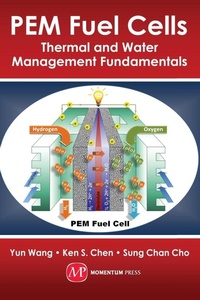
PEM Fuel Cells
Thermal and Water Management Fundamentals
Published on 6. April 2013
Book
Hardback
418 pages
978-1-60650-245-7 (ISBN)
Description
Polymer Electrolyte Membrane (PEM) fuel cells convert chemical energy in hydrogen into electrical energy with water as the only by-product. Thus, PEM fuel cells hold great promise to reduce both pollutant emissions and dependency on fossil fuels, especially for transportation-passenger cars, utility vehicles, and buses-and small-scale stationary and portable power generators. But one of the greatest challenges to realizing the high efficiency and zero emissions potential of PEM fuel cells technology is heat and water management. This book provides an introduction to the essential concepts for effective thermal and water management in PEM fuel cells and an assessment on the current status of fundamental research in this field. The book offers you: * An overview of current energy and environmental challenges and their imperatives for the development of renewable energy resources, including discussion of the role of PEM fuel cells in addressing these issues; * Reviews of basic principles pertaining to PEM fuel cells, including thermodynamics, electrochemical reaction kinetics, flow, heat and mass transfer; and * Descriptions and discussions of water transport and management within a PEM fuel cell, including vapor- and liquid-phase water removal from the electrodes, the effects of two-phase flow, and solid water or ice dynamics and removal, particularly the specialized case of starting a PEM fuel cell at sub-freezing temperatures (cold start) and the various processes related to ice formation.
More details
Language
English
Place of publication
Highland Park
United States
Target group
Professional and scholarly
Dimensions
Height: 260 mm
Width: 183 mm
Thickness: 27 mm
Weight
981 gr
ISBN-13
978-1-60650-245-7 (9781606502457)
Copyright in bibliographic data and cover images is held by Nielsen Book Services Limited or by the publishers or by their respective licensors: all rights reserved.
Schweitzer Classification
Persons
Yu Wang obtained his BS from Peking (Beijing) University in China in 1998, and his PhD in Mechanical Engineering from Pennsylvania State University (PSU) in 2006. At PSU, he worked with Prof. Chao-Yang Wang on PEM fuel cells at the Electrochemical Engine Center. He joined the Mechanical and Aerospace Engineering faculty at the University of California, Irvine in 2006. He is currently the director of the Renewable Energy Resources Lab and Associate Professor at the UC Irvine.
Ken S. Chen earned his PhD from the University of Minnesota in Chemical Engineering. He joined Sandia National Labs in 1993, where he is currently a principal member of the technical staff. Dr. Chen has led several collaborative research efforts involving academic, industry, and national labs, which have focused on critical phenomena controlling PEM fuel cell performance. Dr. Chen is an author or co-author of more than 110 archival publications, of which about half are on PEM fuel cells and related topics.
Ken S. Chen earned his PhD from the University of Minnesota in Chemical Engineering. He joined Sandia National Labs in 1993, where he is currently a principal member of the technical staff. Dr. Chen has led several collaborative research efforts involving academic, industry, and national labs, which have focused on critical phenomena controlling PEM fuel cell performance. Dr. Chen is an author or co-author of more than 110 archival publications, of which about half are on PEM fuel cells and related topics.