

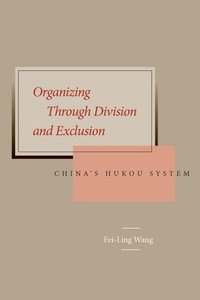
Organizing Through Division and Exclusion
China's Hukou System
Published on 5. January 2005
Book
Hardback
320 pages
978-0-8047-5039-4 (ISBN)
Description
This book is the first comprehensive examination of China's hukou (household registration) system. The hukou system registers and governs the 1.3 billion Chinese, while creating deep and rigid divisions and exclusions; in many domains the system determines how the Chinese live and shapes China's sociopolitical structure and socioeconomic development. This book shows that the system has made both positive and negative contributions to contemporary Chinese society: it has helped foster rapid economic growth and political stability, but also has reinforced social stratification, the rural-urban divide, regional inequalities, and discrimination and injustice.
Using rich new materials, this book traces the history and development of the hukou system. It describes the functions, impact, and operational mechanisms of the system. It also analyzes the hukou in comparison with the systems of exclusion and discrimination in other nations, notably Brazil and India. This book presents important insights for understanding China's past, present, and future.
Using rich new materials, this book traces the history and development of the hukou system. It describes the functions, impact, and operational mechanisms of the system. It also analyzes the hukou in comparison with the systems of exclusion and discrimination in other nations, notably Brazil and India. This book presents important insights for understanding China's past, present, and future.
Reviews / Votes
"Readers will have no doubt, after reading this book, that China's Hukou system discriminates against the 70 percent of its population who just happen to be born in the rural areas."-Journal of Chinese Political Science "What makes this book indispensable for understanding Chinese state-building is its comprehensive analysis of the hukou (household registration) system, a little understood institution responsible for the rural-urban inequality in contemporary China. . . The book's excellent organization allows readers to select relevant chapters and circumvent potholes in the overarching narrative."-Choice "Organizing Through Division and Exclusion is a long-overdue work that will provide and excellent source of information on the ins and outs of Chinas registration system."-The China Journal "Wangs book is a major contribution to our understanding of a system that has largely escaped attention, particularly in its security aspect as a means of control over targeted people, because its operations are considered state secrets. . . . This work provides us with the most comprehensive account so far, and is an indispensable tool for specialists in contemporary China, while being completely accessible to the general public."-China Perspectives "As the first published comprehensive examination of China's hukou (household registration) system, Fei-Ling Wang's book has certainly made a significant contribution to helping us better understand China's rapid economic development in general, and its social control and stratification in particular."-Pacific AffairsMore details
Edition
New edition
Language
English
Place of publication
Palo Alto
United States
Edition type
New edition
Product notice
Cloth
Illustrations
12 tables, 6 figures
Dimensions
Height: 237 mm
Width: 160 mm
Thickness: 24 mm
Weight
562 gr
ISBN-13
978-0-8047-5039-4 (9780804750394)
Copyright in bibliographic data and cover images is held by Nielsen Book Services Limited or by the publishers or by their respective licensors: all rights reserved.
Schweitzer Classification
Other editions
Additional editions
E-Book
01/2005
1st Edition
De Gruyter
€168.99
Available for download
Person
Fei-ling Wang is Associate Professor at the Georgia Institute of Technology's Sam Nunn School of International Affairs. He has published two earlier books, Institutions and Institutional Change in China: Premodernity and Modernization (1998), and From Family to Market: Labor Allocation in Contemporary China (1998).
Content
Table of Contents for Organizing Through Division and Exclusion Preface 1. Institutional Exclusion and the Case of China 2. The Origin and Evolution of China's Hukou System 3. The Registrations: Structural and Operational Features of the PRC Hukou System 4. The PRC Hukou System in Action: Division, Exclusion, and Control 5. The Impact of the PRC Hukou System 6. China's Hukou System in Comparative Perspective 7. The Future of China's Hukou System Notes Bibliography Index