

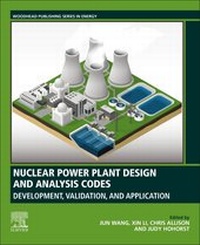
Nuclear Power Plant Design and Analysis Codes
Development, Validation, and Application
Published on 13. November 2020
Book
Paperback/Softback
608 pages
978-0-12-818190-4 (ISBN)
Description
Nuclear Power Plant Design and Analysis Codes: Development, Validation, and Application presents the latest research on the most widely used nuclear codes and the wealth of successful accomplishments which have been achieved over the past decades by experts in the field. Editors Wang, Li,Allison, and Hohorst and their team of authors provide readers with a comprehensive understanding of nuclear code development and how to apply it to their work and research to make their energy production more flexible, economical, reliable and safe.
Written in an accessible and practical way, each chapter considers strengths and limitations, data availability needs, verification and validation methodologies and quality assurance guidelines to develop thorough and robust models and simulation tools both inside and outside a nuclear setting. This book benefits those working in nuclear reactor physics and thermal-hydraulics, as well as those involved in nuclear reactor licensing. It also provides early career researchers with a solid understanding of fundamental knowledge of mainstream nuclear modelling codes, as well as the more experienced engineers seeking advanced information on the best solutions to suit their needs.
Written in an accessible and practical way, each chapter considers strengths and limitations, data availability needs, verification and validation methodologies and quality assurance guidelines to develop thorough and robust models and simulation tools both inside and outside a nuclear setting. This book benefits those working in nuclear reactor physics and thermal-hydraulics, as well as those involved in nuclear reactor licensing. It also provides early career researchers with a solid understanding of fundamental knowledge of mainstream nuclear modelling codes, as well as the more experienced engineers seeking advanced information on the best solutions to suit their needs.
More details
Series
Language
English
Place of publication
United States
Publishing group
Elsevier Science Publishing Co Inc
Target group
Professional and scholarly
Engineers in the nuclear industry; professors & post-grad students involved in code development; senior professionals involve in code development from a computer science perspective; early career researchers and professionals requiring a foundational understanding of nuclear code development carried out by their predecessors, and how it applies to their specific area of research.
Illustrations
Approx. 150 illustrations
Dimensions
Height: 235 mm
Width: 191 mm
Weight
1260 gr
ISBN-13
978-0-12-818190-4 (9780128181904)
Copyright in bibliographic data and cover images is held by Nielsen Book Services Limited or by the publishers or by their respective licensors: all rights reserved.
Schweitzer Classification
Other editions
Additional editions
Jun Wang | Xin Li | Chris Allison
Nuclear Power Plant Design and Analysis Codes
Development, Validation, and Application
E-Book
11/2020
Woodhead Publishing
€210.00
Available for download
Persons
Dr. Jun Wang is a Research Scientist at the University of Wisconsin, Madison. He has over 10 years of experience in code development, validation, and application, and his research areas include nuclear thermal hydraulics and safety, severe accident, fuel performance, and advanced reactors. Wang has over 50 peer-review articles published on top nuclear journals and conferences. He also has over 200 peer-review experience in 20 journals and conferences, such as the International Journal of Heat and Mass Transfer, Applied Thermal Engineering, Annals of Nuclear Energy, Nuclear Technology, Nuclear Engineering and Design, and Progress in Nuclear Energy. Dr. Xin Li has years of experience in numerical modeling both at the macroscopic nuclear power plant system level and at the microscopic phenomenological level. Her research interests and expertise are analysis of severe accident phenomenology and thermal-hydraulics as well as Computer Fluid Dynamics. Dr. Chris Allison worked at Idaho National Laboratory as a technical specialist for over 20 years, involved in experimental and code development activities. Now Dr. Allison is the general manager and co-founder of Innovative Systems Software (ISS), LLC. Dr. Allison serves as a technical consultant for the International Atomic Energy Agency (IAEA) for severe accident management and analysis. He has served as a guest lecturer for IAEA-sponsored training workshops on RELAP5 and RELAPS/SCDAP. He has served in a similar capacity for the U.S. Nuclear Regulatory Commission (NRC) and U.S. Department of Energy (DOE). Dr. Judy Hohorst works at Innovative Systems Software LLC as a senior engineer. She is in charge of the work RELAP/SCDAP training, and RELAP/SCDPASIM validation.
Content
I MAP OF CODE DEVELOPMENT
1. Roadmap
2. Guidance of Nuclear Code development
3. Nuclear Engineering Software Quality Assurance
4. Multi-physics Coupling Plan
II PHYSICS AND FUELS CODES
5. Nuclear Physics Deterministic Code
6. Nuclear Physics Probability Code: OpenMC
III FUELS AND SUB-CHANNEL CODES
7. Fuels and Assemblies Codes: FRAPCON/FRAPTRAN
8. Fuels and Assemblies Codes: TRANSURANUS
9. Fuels and Assemblies Codes: ALCYONE and GERMINAL
10. Sub-Channel Codes: CTF and VIPRE-01
IV THERMAL-HYDRAULIC CODES
11. RCS Systems Thermal Hydraulic Codes: RELAP5-based codes
12. RCS Systems Thermal Hydraulic Codes: TRACE
13. ATHLET
14. SAM
15. Other Thermal Hydraulic Codes
V SEVERE ACCIDENT CODES
16. RCS SA Codes: RELAP/SCDAPSIM
17. ATHLET-CD
18. Integral SA Codes: IMPACT/SAMPSON
19. MELCOR
VI Noval CFD methods
20. MPS Code
21. LBM Code
VII SPECIAL OR NEW DIRECTION
22. Code for Nuclear materials
23. Nuclear Power Plant Cybersecurity
24. Artificial Neural Network
25. Artificial Intelligence Code
26.Temporal Data Mining (TDM)
1. Roadmap
2. Guidance of Nuclear Code development
3. Nuclear Engineering Software Quality Assurance
4. Multi-physics Coupling Plan
II PHYSICS AND FUELS CODES
5. Nuclear Physics Deterministic Code
6. Nuclear Physics Probability Code: OpenMC
III FUELS AND SUB-CHANNEL CODES
7. Fuels and Assemblies Codes: FRAPCON/FRAPTRAN
8. Fuels and Assemblies Codes: TRANSURANUS
9. Fuels and Assemblies Codes: ALCYONE and GERMINAL
10. Sub-Channel Codes: CTF and VIPRE-01
IV THERMAL-HYDRAULIC CODES
11. RCS Systems Thermal Hydraulic Codes: RELAP5-based codes
12. RCS Systems Thermal Hydraulic Codes: TRACE
13. ATHLET
14. SAM
15. Other Thermal Hydraulic Codes
V SEVERE ACCIDENT CODES
16. RCS SA Codes: RELAP/SCDAPSIM
17. ATHLET-CD
18. Integral SA Codes: IMPACT/SAMPSON
19. MELCOR
VI Noval CFD methods
20. MPS Code
21. LBM Code
VII SPECIAL OR NEW DIRECTION
22. Code for Nuclear materials
23. Nuclear Power Plant Cybersecurity
24. Artificial Neural Network
25. Artificial Intelligence Code
26.Temporal Data Mining (TDM)