

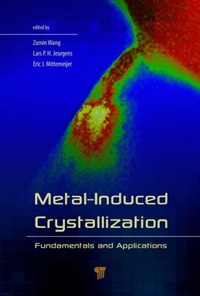
Metal-Induced Crystallization
Fundamentals and Applications
1st Edition
Published on 28. January 2015
Book
Hardback
320 pages
978-981-4463-40-9 (ISBN)
Description
Crystalline semiconductors in the form of thin films are crucial materials for many modern, advanced technologies in fields such as microelectronics, optoelectronics, display technology, and photovoltaic technology. Crystalline semiconductors can be produced at surprisingly low temperatures (as low as 120 ?C) by crystallization of amorphous semiconductors, which are put in contact with a metal. This so-called metal-induced crystallization process has attracted great scientific and technological interest because it allows the production of crystalline semiconductor-based advanced devices at very low temperatures, for example, directly on low-cost (but often heat-sensitive) substrates.
This book provides the first comprehensive and in-depth overview of the current fundamental understanding of the metal-induced crystallization process and further elucidates how to employ this process in different technologies, for example, in thin-film solar cells and display technologies. It aims to give the reader a comprehensive perspective of the metal-induced crystallization process and thereby stimulate the development of novel crystalline semiconductor-based technologies.
This book provides the first comprehensive and in-depth overview of the current fundamental understanding of the metal-induced crystallization process and further elucidates how to employ this process in different technologies, for example, in thin-film solar cells and display technologies. It aims to give the reader a comprehensive perspective of the metal-induced crystallization process and thereby stimulate the development of novel crystalline semiconductor-based technologies.
More details
Language
English
Place of publication
Singapore
Singapore
Target group
College/higher education
Professional and scholarly
Academic and Postgraduate
Illustrations
131 s/w Abbildungen, 19 farbige Abbildungen
19 Illustrations, color; 131 Illustrations, black and white
Dimensions
Height: 229 mm
Width: 152 mm
Weight
582 gr
ISBN-13
978-981-4463-40-9 (9789814463409)
Copyright in bibliographic data and cover images is held by Nielsen Book Services Limited or by the publishers or by their respective licensors: all rights reserved.
Schweitzer Classification
Other editions
Additional editions
Zumin Wang | Lars P. H. Jeurgens | Eric J. Mittemeijer
Metal-Induced Crystallization
Fundamentals and Applications
E-Book
01/2015
Pan Stanford Publishing Pte Ltd
€185.99
Available for download
Persons
Zumin Wang obtained his PhD in condensed matter physics at the University of Science and Technology of China in 2005. He was a postdoctoral fellow (2005-2008) and since 2008 is a senior scientist in Department Mittemeijer at the Max Planck Institute for Intelligent Systems, Stuttgart, Germany. His work contributed pronouncedly to the achievement of fundamental understanding and advanced applications of metal-induced crystallization.
Lars P. H. Jeurgens obtained his PhD in materials sciences at the Delft University of Technology, Netherlands, in 2001. After a postdoctoral period working for the Dutch Technology Foundation, Netherlands, he moved to the Max Planck Institute for Intelligent Systems in 2003 to lead a research group working on "reactions and phase transformations at surfaces and interfaces" within Department Mittemeijer. He joined the Swiss Federal Laboratories for Materials Science and Technology, Switzerland, in 2012 and is the head of the laboratory for "Joining Technologies and Corrosion."
Eric J. Mittemeijer was full professor of solid-state chemistry at the Delft University of Technology from 1985 to 1998. Since 1998, he is director at the Max Planck Institute for Intelligent Systems and a full professor of materials science at the University of Stuttgart, Germany. He leads a research department in the field of phase transformations. He has co-authored more than 600 scientific papers in international scientific journals and has received numerous honors for his scientific work.
Lars P. H. Jeurgens obtained his PhD in materials sciences at the Delft University of Technology, Netherlands, in 2001. After a postdoctoral period working for the Dutch Technology Foundation, Netherlands, he moved to the Max Planck Institute for Intelligent Systems in 2003 to lead a research group working on "reactions and phase transformations at surfaces and interfaces" within Department Mittemeijer. He joined the Swiss Federal Laboratories for Materials Science and Technology, Switzerland, in 2012 and is the head of the laboratory for "Joining Technologies and Corrosion."
Eric J. Mittemeijer was full professor of solid-state chemistry at the Delft University of Technology from 1985 to 1998. Since 1998, he is director at the Max Planck Institute for Intelligent Systems and a full professor of materials science at the University of Stuttgart, Germany. He leads a research department in the field of phase transformations. He has co-authored more than 600 scientific papers in international scientific journals and has received numerous honors for his scientific work.
Content
Preface, 1. Introduction to Metal-Induced Crystallization, 2. Thermodynamics and Atomic Mechanisms of Metal-Induced Crystallization of Amorphous Semiconductors at Low Temperatures, 3. Diffusion, Crystallization, and Layer Exchange upon Low-Temperature Annealing of Amorphous Si/Polycrystalline Al Layered Structures, 4. Metal-Induced Crystallization by Homogeneous Insertion of Metallic Species in Amorphous Semiconductors, 5. Aluminum-Induced Crystallization: Applications in Photovoltaic Technologies, 6. Applications of Metal-Induced Crystallization Polycrystalline Silicon for Advanced Flat-Panel Displays, 7. Laser-Assisted Metal-Induced Crystallization and Its Applications in Data Storage