

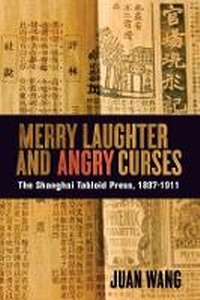
Merry Laughter and Angry Curses
The Shanghai Tabloid Press, 1897-1911
Published on 23. October 2012
Book
Hardback
248 pages
978-0-7748-2338-8 (ISBN)
Description
The end of the Qing dynasty in China saw an unprecedented explosion of print journalism. By the turn of the twentieth century, not only had Chinese-owned newspapers become more influential than anyone could have anticipated, but it was the supposedly frivolous xiaobao, the "little" or "minor" papers, that captivated and empowered the public.
Merry Laughter and Angry Curses reveals how the late-Qing-era tabloid press became the voice of the people. As periodical publishing reached a fever pitch, tabloids had free rein to criticize officials, mock the elite, and scandalize readers. Tabloid writers produced a massive amount of anti-establishment literature, whose distinctive humour and satirical style were both potent and popular. This book shows the tabloid community to be both a producer of meanings and a participant in the social and cultural dialogue that would shake the foundations of imperial China and lead to the 1911 Republican Revolution.
Merry Laughter and Angry Curses reveals how the late-Qing-era tabloid press became the voice of the people. As periodical publishing reached a fever pitch, tabloids had free rein to criticize officials, mock the elite, and scandalize readers. Tabloid writers produced a massive amount of anti-establishment literature, whose distinctive humour and satirical style were both potent and popular. This book shows the tabloid community to be both a producer of meanings and a participant in the social and cultural dialogue that would shake the foundations of imperial China and lead to the 1911 Republican Revolution.
More details
Series
Language
English
Place of publication
Vancouver
Canada
Product notice
sewn/stitched
Illustrations
12 b&w illustrations
Dimensions
Height: 229 mm
Width: 152 mm
Weight
500 gr
ISBN-13
978-0-7748-2338-8 (9780774823388)
Copyright in bibliographic data and cover images is held by Nielsen Book Services Limited or by the publishers or by their respective licensors: all rights reserved.
Schweitzer Classification
Person
Juan Wang is an independent scholar of Chinese history.
Content
Introduction
1 Community of Fun
2 Officialdom Unmasked
3 Imagining the Nation
4 Confronting the "New"
5 Questioning the Appropriators
6 The Market, Populism, and Aesthetics
Conclusion
Notes
Glossary of Chinese Terms and Names
Bibliography
Index
1 Community of Fun
2 Officialdom Unmasked
3 Imagining the Nation
4 Confronting the "New"
5 Questioning the Appropriators
6 The Market, Populism, and Aesthetics
Conclusion
Notes
Glossary of Chinese Terms and Names
Bibliography
Index