

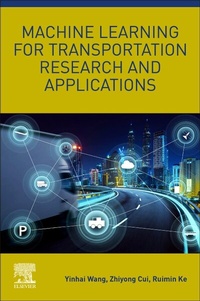
Machine Learning for Transportation Research and Applications
Published on 25. April 2023
Book
Paperback/Softback
252 pages
978-0-323-96126-4 (ISBN)
Description
Transportation is a combination of systems that presents a variety of challenges often too intricate to be addressed by conventional parametric methods. Increasing data availability and recent advancements in machine learning provide new methods to tackle challenging transportation problems. This textbook
is designed for college or graduate-level students in transportation or closely related fields to study and understand fundamentals in machine learning. Readers will learn how to develop and apply various types of machine learning models to transportation-related problems. Example applications include traffic sensing, data-quality control, traffic prediction, transportation asset management, traffic-system control and operations, and traffic-safety analysis.
is designed for college or graduate-level students in transportation or closely related fields to study and understand fundamentals in machine learning. Readers will learn how to develop and apply various types of machine learning models to transportation-related problems. Example applications include traffic sensing, data-quality control, traffic prediction, transportation asset management, traffic-system control and operations, and traffic-safety analysis.
More details
Language
English
Place of publication
Philadelphia
United States
Target group
College/higher education
Researchers and grad students in transportation and transportation engineering
Practitioners in transportation
Product notice
Paperback (trade)
Dimensions
Height: 221 mm
Width: 153 mm
Thickness: 17 mm
Weight
428 gr
ISBN-13
978-0-323-96126-4 (9780323961264)
Copyright in bibliographic data and cover images is held by Nielsen Book Services Limited or by the publishers or by their respective licensors: all rights reserved.
Schweitzer Classification
Other editions
Additional editions
Yinhai Wang | Zhiyong Cui | Ruimin Ke
Machine Learning for Transportation Research and Applications
E-Book
04/2023
Elsevier
€109.00
Available for download
Persons
Yinhai Wang - Ph.D., P.E., Professor, Transportation Engineering, University of Washington, USA. Dr. Yinhai Wang is a fellow of both the IEEE and American Society of Civil Engineers (ASCE). He also serves as director for Pacific Northwest Transportation Consortium (PacTrans), USDOT University Transportation Center for Federal Region 10, and the Northwestern Tribal Technical Assistance Program (NW TTAP) Center. He earned his Ph.D. in transportation engineering from the University of Tokyo (1998) and a Master in Computer
Science from the UW (2002). Dr. Wang's research interests include traffic sensing, transportation data science, artificial intelligence methods and applications, edge computing, traffic operations and simulation, smart urban mobility, transportation safety, among others. Zhiyong Cui - Ph.D., Associate Professor, School of Transportation Science and Engineering, Beihang University. Dr. Cui received the B.E. degree in software engineering from Beijing University in 2012, the M.S. degree in software engineering from Peking University in 2015, and the Ph.D. degree in civil engineering (transportation engineering) from the University of Washington in 2021. Dr. Cui's primary research focuses on intelligent transportation systems, artificial intelligence, urban computing, and connected and autonomous vehicles. Ruimin Ke - Ph.D., Assistant Professor, Department of Civil Engineering, University of Texas at El Paso, USA. Dr. Ruimin Ke received the B.E. degree in automation from Tsinghua University in 2014, the M.S. and Ph.D. degrees in civil engineering (transportation) from the University of Washington in 2016 and 2020, respectively, and the M.S. degree in computer science from the University of Illinois Urbana-Champaign.Dr. Ke's research interests include intelligent transportation systems, autonomous driving, machine
learning, computer vision, and edge computing.
Science from the UW (2002). Dr. Wang's research interests include traffic sensing, transportation data science, artificial intelligence methods and applications, edge computing, traffic operations and simulation, smart urban mobility, transportation safety, among others. Zhiyong Cui - Ph.D., Associate Professor, School of Transportation Science and Engineering, Beihang University. Dr. Cui received the B.E. degree in software engineering from Beijing University in 2012, the M.S. degree in software engineering from Peking University in 2015, and the Ph.D. degree in civil engineering (transportation engineering) from the University of Washington in 2021. Dr. Cui's primary research focuses on intelligent transportation systems, artificial intelligence, urban computing, and connected and autonomous vehicles. Ruimin Ke - Ph.D., Assistant Professor, Department of Civil Engineering, University of Texas at El Paso, USA. Dr. Ruimin Ke received the B.E. degree in automation from Tsinghua University in 2014, the M.S. and Ph.D. degrees in civil engineering (transportation) from the University of Washington in 2016 and 2020, respectively, and the M.S. degree in computer science from the University of Illinois Urbana-Champaign.Dr. Ke's research interests include intelligent transportation systems, autonomous driving, machine
learning, computer vision, and edge computing.
Author
Professor of Transportation Engineering and Founding Director of the Smart Transportation Applications and Research Laboratory, Department of Civil and Environmental Engineering, University of Washington, Seattle, WA, USA.
Ph.D. Candidate in Civil Engineering (Intelligent Transportation Systems), University of Washington (UW), USA.
Assistant Professor, Department of Civil Engineering, University of Texas at El Paso,USA.
Content
Part One: Overview
1. General Introduction and Overview
2. Fundamental Mathematics
3. Machine Learning Basics
Part Two: Methodologies and Applications
4. Classical ML Methods
5. Convolutional Neural Network
6. Graph Neural Network
7. Sequence Modeling
8. Probabilistic Models
9. Reinforcement Learning
10. Generative Models
11. Meta/Transfer Learning
Part Three: Future Research and Applications
The Future of Transportation and AI
1. General Introduction and Overview
2. Fundamental Mathematics
3. Machine Learning Basics
Part Two: Methodologies and Applications
4. Classical ML Methods
5. Convolutional Neural Network
6. Graph Neural Network
7. Sequence Modeling
8. Probabilistic Models
9. Reinforcement Learning
10. Generative Models
11. Meta/Transfer Learning
Part Three: Future Research and Applications
The Future of Transportation and AI