

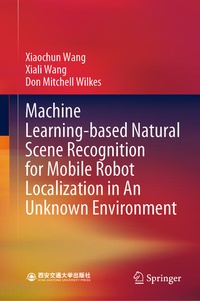
Machine Learning-based Natural Scene Recognition for Mobile Robot Localization in An Unknown Environment
Published on 24. August 2019
Book
Hardback
XXII, 328 pages
978-981-13-9216-0 (ISBN)
Description
This book advances research on mobile robot localization in unknown environments by focusing on machine-learning-based natural scene recognition. The respective chapters highlight the latest developments in vision-based machine perception and machine learning research for localization applications, and cover such topics as: image-segmentation-based visual perceptual grouping for the efficient identification of objects composing unknown environments; classification-based rapid object recognition for the semantic analysis of natural scenes in unknown environments; the present understanding of the Prefrontal Cortex working memory mechanism and its biological processes for human-like localization; and the application of this present understanding to improve mobile robot localization. The book also features a perspective on bridging the gap between feature representations and decision-making using reinforcement learning, laying the groundwork for future advances in mobile robot navigation research.
More details
Edition
2020 ed.
Language
English
Place of publication
Singapore
Singapore
Target group
Professional and scholarly
Illustrations
21 s/w Abbildungen, 78 farbige Abbildungen
XXII, 328 p. 99 illus., 78 illus. in color. With Jointly published with Xi'an Jiaotong University Press, Xi'an, China.
Dimensions
Height: 241 mm
Width: 160 mm
Thickness: 25 mm
Weight
694 gr
ISBN-13
978-981-13-9216-0 (9789811392160)
DOI
10.1007/978-981-13-9217-7
Schweitzer Classification
Other editions
Additional editions
Xiaochun Wang | Xiali Wang | Don Mitchell Wilkes
Machine Learning-based Natural Scene Recognition for Mobile Robot Localization in An Unknown Environment
Book
08/2020
Springer
€106.99
Shipment within 15-20 days
Xiaochun Wang | Xiali Wang | Don Mitchell Wilkes
Machine Learning-based Natural Scene Recognition for Mobile Robot Localization in An Unknown Environment
E-Book
08/2019
1st Edition
Springer
€96.29
Available for download
Persons
Xiaochun Wang received her BS degree from Beijing University and the PhD degree from the Department of Electrical Engineering and Computer Science, Vanderbilt University. She is currently an associate professor of School of Software Engineering at Xi'an Jiaotong University. Her research interests are in computer vision, signal processing, and pattern recognition.
Xia Li Wang received the PhD degree from the Department of Computer Science, Northwest University, China, in 2005. He is a faculty member in the Department of Computer Science, Changan University, China. His research interests are in computer vision, signal processing, intelligent traffic system, and pattern recognition.
D. Mitchell Wilkes received the BSEE degree from Florida Atlantic, and the MSEE and PhD degrees from Georgia Institute of Technology. His research interests include digital signal processing, image processing and computer vision, structurally adaptive systems, sonar,as well as signal modeling. He is a member of the IEEE and a faculty member at the Department of Electrical Engineering and Computer Science, Vanderbilt University. He is a member of the IEEE.
Xia Li Wang received the PhD degree from the Department of Computer Science, Northwest University, China, in 2005. He is a faculty member in the Department of Computer Science, Changan University, China. His research interests are in computer vision, signal processing, intelligent traffic system, and pattern recognition.
D. Mitchell Wilkes received the BSEE degree from Florida Atlantic, and the MSEE and PhD degrees from Georgia Institute of Technology. His research interests include digital signal processing, image processing and computer vision, structurally adaptive systems, sonar,as well as signal modeling. He is a member of the IEEE and a faculty member at the Department of Electrical Engineering and Computer Science, Vanderbilt University. He is a member of the IEEE.
Content
Part I Introduction.- Part II Unsupervised Learning.- Part III Supervised Learning and Semi-Supervised Learning.- Part IV Reinforcement Learning.