

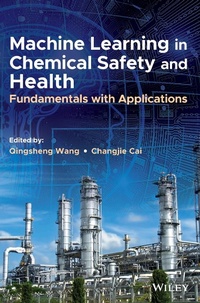
Machine Learning in Chemical Safety and Health: Fu ndamentals with Applications
Fundamentals with Applications
1st Edition
Published on 19. January 2023
Book
Hardback
320 pages
978-1-119-81748-2 (ISBN)
Description
Introduces Machine Learning Techniques and Tools and Provides Guidance on How to Implement Machine Learning Into Chemical Safety and Health-related Model Development
There is a growing interest in the application of machine learning algorithms in chemical safety and health-related model development, with applications in areas including property and toxicity prediction, consequence prediction, and fault detection. This book is the first to review the current status of machine learning implementation in chemical safety and health research and to provide guidance for implementing machine learning techniques and algorithms into chemical safety and health research.
Written by an international team of authors and edited by renowned experts in the areas of process safety and occupational and environmental health, sample topics covered within the work include:
An introduction to the fundamentals of machine learning, including regression, classification and cross-validation, and an overview of software and tools
Detailed reviews of various applications in the areas of chemical safety and health, including flammability prediction, consequence prediction, asset integrity management, predictive nanotoxicity and environmental exposure assessment, and more
Perspective on the possible future development of this field
Machine Learning in Chemical Safety and Health serves as an essential guide on both the fundamentals and applications of machine learning for industry professionals and researchers in the fields of process safety, chemical safety, occupational and environmental health, and industrial hygiene.
There is a growing interest in the application of machine learning algorithms in chemical safety and health-related model development, with applications in areas including property and toxicity prediction, consequence prediction, and fault detection. This book is the first to review the current status of machine learning implementation in chemical safety and health research and to provide guidance for implementing machine learning techniques and algorithms into chemical safety and health research.
Written by an international team of authors and edited by renowned experts in the areas of process safety and occupational and environmental health, sample topics covered within the work include:
An introduction to the fundamentals of machine learning, including regression, classification and cross-validation, and an overview of software and tools
Detailed reviews of various applications in the areas of chemical safety and health, including flammability prediction, consequence prediction, asset integrity management, predictive nanotoxicity and environmental exposure assessment, and more
Perspective on the possible future development of this field
Machine Learning in Chemical Safety and Health serves as an essential guide on both the fundamentals and applications of machine learning for industry professionals and researchers in the fields of process safety, chemical safety, occupational and environmental health, and industrial hygiene.
More details
Language
English
Place of publication
Hoboken
United States
Publishing group
John Wiley and Sons Ltd
Target group
Professional and scholarly
Dimensions
Height: 250 mm
Width: 175 mm
Thickness: 22 mm
Weight
736 gr
ISBN-13
978-1-119-81748-2 (9781119817482)
Copyright in bibliographic data and cover images is held by Nielsen Book Services Limited or by the publishers or by their respective licensors: all rights reserved.
Schweitzer Classification
Other editions
Additional editions
Qingsheng Wang | Changjie Cai
Machine Learning in Chemical Safety and Health
Fundamentals with Applications
E-Book
10/2022
1st Edition
Wiley
€143.99
Available for download
Qingsheng Wang | Changjie Cai
Machine Learning in Chemical Safety and Health
Fundamentals with Applications
E-Book
10/2022
1st Edition
Wiley
€143.99
Available for download
Person
Qingsheng Wang is Associate Professor of Chemical Engineering and George Armistead '23 Faculty Fellow at Texas A&M University. He has over 15 years of experience in the areas of process safety and fire protection. His experience is wide ranging, involving machine learning in chemical safety, flame retardant materials, fire and explosion dynamics, and composite manufacturing for safety and sustainability. He is a registered professional engineer (PE) and certified safety professional (CSP), and currently a principal member of the NFPA 18 and NFPA 30 committees. Professor Wang has established the Multiscale Process Safety Laboratory at Texas A&M and is currently leading the lab. He published 150 peer-reviewed journal publications and 6 book chapters. His work has been internationally recognized and heavily cited, and he is recognized as a world leader in the field of process safety.
Changjie Cai is Assistant Professor of Occupational and Environmental Health from Hudson College of Public Health at the University of Oklahoma Health Sciences Center. Dr. Cai has formed an interdisciplinary research lab, the Occupational and Environmental Health & Artificial Intelligence (OEH-AI) Lab. Research in the lab focuses on three major areas: (1) identifying and assessing exposure of safety and health hazards; (2) integrating AI techniques into occupational and environmental health fields; (3) studying the environmental hazards and their climate effects using regional chemical transport models.
Changjie Cai is Assistant Professor of Occupational and Environmental Health from Hudson College of Public Health at the University of Oklahoma Health Sciences Center. Dr. Cai has formed an interdisciplinary research lab, the Occupational and Environmental Health & Artificial Intelligence (OEH-AI) Lab. Research in the lab focuses on three major areas: (1) identifying and assessing exposure of safety and health hazards; (2) integrating AI techniques into occupational and environmental health fields; (3) studying the environmental hazards and their climate effects using regional chemical transport models.