

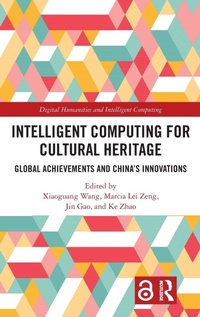
Intelligent Computing for Cultural Heritage
Global Achievements and China's Innovations
1st Edition
Published on 11. July 2024
Book
Hardback
252 pages
978-1-032-70540-8 (ISBN)
Description
This book offers a global perspective on the latest advancements and trends in digital humanities and intelligent computing of cultural heritage, covering both academic research and case studies within cultural institutions.
This edited volume brings together views and practices from different regions, including Asia, Europe, Africa, North America, and Australia. It offers innovative approaches and case studies related to humanities data and digital methods, with a focus on digital humanities research and pedagogy and cultural heritage organisation and preservation, in particular the development of digital knowledge repositories and methods for digital intelligence in cultural heritage. Each case study highlights unique cultural characteristics and academic histories, resulting in diverse development priorities and thematic directions. However, this diversity can also lead to imbalances and isolation within the field. To gain a better understanding of the complex trends in the development of the digital humanities, this book offers valuable insights from case studies and research practices, showcasing global contributions from scholars and institutions.
This title will appeal to scholars and students of digital humanities and information science, particularly those studying heritage management and intelligent computing. Professionals working at the intersection of technology and cultural heritage will also find this book of great interest.
The Open Access version of this book, available at http://www.taylorfrancis.com, has been made available under a Creative Commons Attribution-Non Commercial-No Derivatives (CC-BY-NC-ND) 4.0 license.
This edited volume brings together views and practices from different regions, including Asia, Europe, Africa, North America, and Australia. It offers innovative approaches and case studies related to humanities data and digital methods, with a focus on digital humanities research and pedagogy and cultural heritage organisation and preservation, in particular the development of digital knowledge repositories and methods for digital intelligence in cultural heritage. Each case study highlights unique cultural characteristics and academic histories, resulting in diverse development priorities and thematic directions. However, this diversity can also lead to imbalances and isolation within the field. To gain a better understanding of the complex trends in the development of the digital humanities, this book offers valuable insights from case studies and research practices, showcasing global contributions from scholars and institutions.
This title will appeal to scholars and students of digital humanities and information science, particularly those studying heritage management and intelligent computing. Professionals working at the intersection of technology and cultural heritage will also find this book of great interest.
The Open Access version of this book, available at http://www.taylorfrancis.com, has been made available under a Creative Commons Attribution-Non Commercial-No Derivatives (CC-BY-NC-ND) 4.0 license.
More details
Series
Language
English
Place of publication
London
United Kingdom
Publishing group
Taylor & Francis Ltd
Target group
College/higher education
Professional and scholarly
Academic, Postgraduate, Professional Practice & Development, Undergraduate Advanced, and Undergraduate Core
Illustrations
24 s/w Photographien bzw. Rasterbilder, 27 s/w Zeichnungen, 20 s/w Tabellen, 51 s/w Abbildungen
20 Tables, black and white; 27 Line drawings, black and white; 24 Halftones, black and white; 51 Illustrations, black and white
Dimensions
Height: 240 mm
Width: 161 mm
Thickness: 20 mm
Weight
590 gr
ISBN-13
978-1-032-70540-8 (9781032705408)
Copyright in bibliographic data and cover images is held by Nielsen Book Services Limited or by the publishers or by their respective licensors: all rights reserved.
Schweitzer Classification
Other editions
Additional editions
Xiaoguang Wang | Marcia Lei Zeng | Jin Gao
Intelligent Computing for Cultural Heritage
Global Achievements and China's Innovations
Book
12/2025
1st Edition
Routledge
€58.70
Shipment within 10-20 days
Persons
Xiaoguang Wang is Professor and Vice Dean of the School of Information Management and Executive Vice Dean of the Big Data Institute, Director of the Intellectual Computing Laboratory for Cultural Heritage, and Director of the Centre for Digital Humanities at Wuhan University, China. His research interests are digital asset management, knowledge organisation, semantic publishing, and digital humanities.
Marcia Lei Zeng is Professor of Information Science at Kent State University (USA), with a PhD from the University of Pittsburgh (USA). Her research interests include knowledge organisation systems, metadata, semantic technologies, and digital humanities.
Jin Gao is Lecturer in Digital Archives at University College London, UK, and Research Fellow at the Victoria and Albert Museum. Gao's research interests focus on Digital Humanities history, network analysis, and digital cultural heritage.
Ke Zhao is a PhD researcher in Publishing Science at the School of Information Management, Wuhan University, China. Her research interests include digital humanities, digital publishing, digital storytelling, and human-centred design.
Marcia Lei Zeng is Professor of Information Science at Kent State University (USA), with a PhD from the University of Pittsburgh (USA). Her research interests include knowledge organisation systems, metadata, semantic technologies, and digital humanities.
Jin Gao is Lecturer in Digital Archives at University College London, UK, and Research Fellow at the Victoria and Albert Museum. Gao's research interests focus on Digital Humanities history, network analysis, and digital cultural heritage.
Ke Zhao is a PhD researcher in Publishing Science at the School of Information Management, Wuhan University, China. Her research interests include digital humanities, digital publishing, digital storytelling, and human-centred design.
Content
Part I: Global Creative Approaches 1. Towards an Open Humanities Data: Current States, Challenges, and Cases 2. Data Modelling for Digital Archiving of Intangible and Experiential Entities 3. Military History on the Semantic Web: Lessons Learned from Developing Three In-use Linked Open Data Services and Semantic Portals for Digital Humanities 4. Identifying Main Topics of Digital Humanities Courses Across Countries: A Topic Modelling BERTopic Technique 5. Empowering Global Engagement: The Development of Digital Humanities Research and Pedagogy at UCL 6. Digitalisation-preparedness of Cultural Heritage Institutions: To What Extent is Africa Ready? Part II: Innovative Practices in China 7. Digitising Cultural Heritage in Hong Kong: An Overview 8. Digital Memory Construction for Cultural Heritage: Methodology and Applications in China 9. China's Exploration and Experience in Digital Twinning of Tangible Cultural Heritage 10. Digital Deduction Theatre: An Experimental Methodological Framework for the Digital Intelligence Revitalisation of Cultural Heritage 11. Combining Ontology and Nanopublication Models to Reconstruct Digital Commentaries on Ancient Chinese Books