

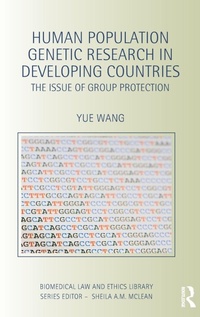
Human Population Genetic Research in Developing Countries
The Issue of Group Protection
1st Edition
Published on 20. November 2013
Book
Hardback
255 pages
978-0-415-83539-8 (ISBN)
Description
Human population genetic research (HPGR) seeks to identify the diversity and variation of the human genome and how human group and individual genetic diversity has developed. This book asks whether developing countries are well prepared for the ethical and legal conduct of human population genetic research, with specific regard to vulnerable target group protection. The book highlights particular issues raised by genetic research on populations as a whole, such as the potential harm specific groups may suffer in genetic research, and the capacity for current frameworks of Western developed countries to provide adequate protections for these target populations.
Using The People's Republic of China as a key example, Yue Wang argues that since the target groups of HPGR are almost always from isolated and rural areas of developing countries, the ethical and legal frameworks for human subject protection need to be reconsidered in order to eliminate, or at least reduce, the vulnerability of those groups. While most discussion in this field focuses on the impact of genetic research on individuals, this book breaks new ground in exploring how the interests of target groups are also seriously implicated in genetic work. In evaluating current regulations concerning prevention of harm to vulnerable groups, the book also puts forward an alternative model for group protection in the context of human population genetic research in developing countries. The book will be of great interest to students and academics of medical law, ethics, and the implications of genetic research.
Using The People's Republic of China as a key example, Yue Wang argues that since the target groups of HPGR are almost always from isolated and rural areas of developing countries, the ethical and legal frameworks for human subject protection need to be reconsidered in order to eliminate, or at least reduce, the vulnerability of those groups. While most discussion in this field focuses on the impact of genetic research on individuals, this book breaks new ground in exploring how the interests of target groups are also seriously implicated in genetic work. In evaluating current regulations concerning prevention of harm to vulnerable groups, the book also puts forward an alternative model for group protection in the context of human population genetic research in developing countries. The book will be of great interest to students and academics of medical law, ethics, and the implications of genetic research.
More details
Series
Language
English
Place of publication
London
United Kingdom
Publishing group
Taylor & Francis Ltd
Target group
College/higher education
Dimensions
Height: 240 mm
Width: 161 mm
Thickness: 19 mm
Weight
564 gr
ISBN-13
978-0-415-83539-8 (9780415835398)
Copyright in bibliographic data and cover images is held by Nielsen Book Services Limited or by the publishers or by their respective licensors: all rights reserved.
Schweitzer Classification
Other editions
Additional editions
Book
07/2015
1st Edition
Routledge
€48.20
Shipment within 10-20 days
E-Book
11/2013
1st Edition
Routledge
€41.99
Available for download
E-Book
11/2013
1st Edition
Routledge
€41.99
Available for download
Person
Yue Wang is a lecturer in Xi'an Jiaotong University, PR China, Research Staff of Information Security Law Research Centre at Xi'an Jiaotong University.
Content
1. Introduction 2. Human Gene, Genetic Information and Genetic Research 3. Consent and Human Subject Protection 4. Human Population Genetic Research and its Harms 5. Group Protection in Human Population Genetic Research 6. Developing Countries: Mother Loads of Genes? 7. Conclusion 8. Appendix 1 9. Appendix 2