

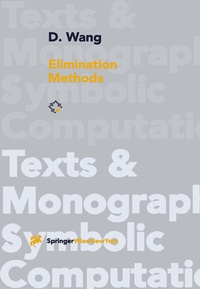
Elimination Methods
Published on 30. November 2000
Book
Paperback/Softback
XIII, 244 pages
978-3-211-83241-7 (ISBN)
Description
The development of polynomial-elimination techniques from classical theory to modern algorithms has undergone a tortuous and rugged path. This can be observed L. van der Waerden's elimination of the "elimination theory" chapter from from B. his classic Modern Algebra in later editions, A. Weil's hope to eliminate "from algebraic geometry the last traces of elimination theory," and S. Abhyankar's sug gestion to "eliminate the eliminators of elimination theory. " The renaissance and recognition of polynomial elimination owe much to the advent and advance of mod ern computing technology, based on which effective algorithms are implemented and applied to diverse problems in science and engineering. In the last decade, both theorists and practitioners have more and more realized the significance and power of elimination methods and their underlying theories. Active and extensive research has contributed a great deal of new developments on algorithms and soft ware tools to the subject, that have been widely acknowledged. Their applications have taken place from pure and applied mathematics to geometric modeling and robotics, and to artificial neural networks. This book provides a systematic and uniform treatment of elimination algo rithms that compute various zero decompositions for systems of multivariate poly nomials. The central concepts are triangular sets and systems of different kinds, in terms of which the decompositions are represented. The prerequisites for the concepts and algorithms are results from basic algebra and some knowledge of algorithmic mathematics.
Reviews / Votes
"... the algorithms are presented in a 'crescendo' sequence, that is, the versions are improved step by step with the introduction of new techniques and concepts, which allows the readers to follow the construction of the ideas; furthermore, this style makes it a very good textbook ... it is a very good text to have on hand for anyone interested in the theories and techniques of elimination methods." American Mathematical Society "... This book, therefore, is not only topical, but is also the first book that contains all major currently available algorithmic approaches on elimination theory in one conceptional frame ... The book is well suited both as a textbook and as a research reference for the state of the art in algorithmic elimination theory. Theorems and proofs are presented in such a way that the correctness of the algorithms based on them can easily be verified. Well-chosen examples make it easy to understand the concepts and the methods. The main contents of this book - altough not all details - should enter standard curricula on algebra." Association for Computing MachineryMore details
Series
Edition
Softcover reprint of the original 1st ed. 2001
Language
English
Place of publication
Vienna
Austria
Publishing group
Springer Wien
Target group
Professional and scholarly
Research
Illustrations
8 s/w Abbildungen
XIII, 244 p. 8 illus.
Dimensions
Height: 244 mm
Width: 170 mm
Thickness: 15 mm
Weight
462 gr
ISBN-13
978-3-211-83241-7 (9783211832417)
DOI
10.1007/978-3-7091-6202-6
Schweitzer Classification
Other editions
Additional editions
Content
Polynomial arithmetic and zeros.- 1.1 Polynomials.- 1.2 Greatest common divisor, pseudo-division, and polynomial remainder sequences.- 1.3 Resultants and subresultants.- 1.4 Field extension and factorization.- 1.5 Zeros and ideals.- 1.6 Hilbert's Nullstellensatz.- Zero decomposition of polynomial systems.- 2.1 Triangular systems.- 2.2 Characteristic-set-based algorithm.- 2.3 Seidenberg's algorithm refined.- 2.4 Subresultant-based algorithm.- Projection and simple systems.- 3.1 Projection.- 3.2 Zero decomposition with projection.- 3.3 Decomposition into simple systems.- 3.4 Properties of simple systems.- Irreducible zero decomposition.- 4.1 Irreducibility of triangular sets.- 4.2 Decomposition into irreducible triangular systems.- 4.3 Properties of irreducible triangular systems.- 4.4 Irreducible simple systems.- Various elimination algorithms.- 5.1 Regular systems.- 5.2 Canonical triangular sets.- 5.3 Gröbner bases.- 5.4 Resultant elimination.- Computational algebraic geometry and polynomial-ideal theory.- 6.1 Dimension.- 6.2 Decomposition of algebraic varieties.- 6.3 Ideal and radical ideal membership.- 6.4 Primary decomposition of ideals.- Applications.- 7.1 Solving polynomial systems.- 7.2 Automated geometry theorem proving.- 7.3 Automatic derivation of unknown relations.- 7.4 Other geometric applications.- 7.5 Algebraic factorization.- 7.6 Center conditions for certain differential systems.- Bibliographic notes.- References.