

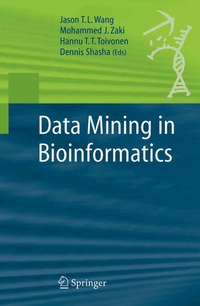
Data Mining in Bioinformatics
Published on 22. October 2010
Book
Paperback/Softback
XII, 340 pages
978-1-84996-894-2 (ISBN)
Description
8. 1. 1 Protein Subcellular Location The life sciences have entered the post-genome era where the focus of biologicalresearchhasshiftedfromgenomesequencestoproteinfunctionality. Withwhole-genomedraftsofmouseandhumaninhand,scientistsareputting more and more e?ort into obtaining information about the entire proteome in a given cell type. The properties of a protein include its amino acid sequences, its expression levels under various developmental stages and in di?erenttissues,its3Dstructureandactivesites,itsfunctionalandstructural binding partners, and its subcellular location. Protein subcellular location is important for understanding protein function inside the cell. For example, the observation that the product of a gene is localized in mitochondria will support the hypothesis that this protein or gene is involved in energy metabolism. Proteins localized in the cytoskeleton are probably involved in intracellular tra?cking and support. The context of protein functionality is well represented by protein subcellular location. Proteins have various subcellular location patterns [250]. One major category of proteins is synthesized on free ribosomes in the cytoplasm. Soluble proteins remain in the cytoplasm after their synthesis and function as small factories catalyzing cellular metabolites. Other proteins that have a target signal in their sequences are directed to their target organelle (such as mitochondria) via posttranslational transport through the organelle membrane. Nuclear proteins are transferred through pores on the nuclear envelope to the nucleus and mostly function as regulators. The second major category of proteins is synthesized on endoplasmic reticulum(ER)-associated ribosomes and passes through the reticuloendothelial system, consisting of the ERand the Golgi apparatus.
More details
Series
Edition
1st ed. Softcover of orig. ed. 2005
Language
English
Place of publication
London
United Kingdom
Target group
Professional and scholarly
Research
Illustrations
110 s/w Abbildungen
XII, 340 p. 110 illus.
Dimensions
Height: 235 mm
Width: 155 mm
Thickness: 20 mm
Weight
534 gr
ISBN-13
978-1-84996-894-2 (9781849968942)
DOI
10.1007/b138131
Schweitzer Classification
Other editions
Additional editions
Jason T. L. Wang | Mohammed J. Zaki | Hannu Toivonen
Data Mining in Bioinformatics
E-Book
09/2005
1st Edition
Springer
€149.79
Available for download
Jason T. L. Wang | Mohammed J. Zaki | Hannu Toivonen
Data Mining in Bioinformatics
Book
10/2004
Springer
€160.49
Shipment within 15-20 days
Content
Overview.- to Data Mining in Bioinformatics.- Survey of Biodata Analysis from a Data Mining Perspective.- Sequence and Structure Alignment.- AntiClustAl: Multiple Sequence Alignment by Antipole Clustering.- RNA Structure Comparison and Alignment.- Biological Data Mining.- Piecewise Constant Modeling of Sequential Data Using Reversible Jump Markov Chain Monte Carlo.- Gene Mapping by Pattern Discovery.- Predicting Protein Folding Pathways.- Data Mining Methods for a Systematics of Protein Subcellular Location.- Mining Chemical Compounds.- Biological Data Management.- Phyloinformatics: Toward a Phylogenetic Database.- Declarative and Efficient Querying on Protein Secondary Structures.- Scalable Index Structures for Biological Data.