

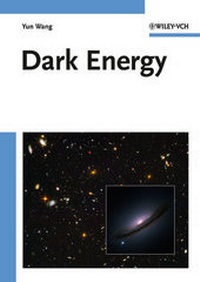
Dark Energy
1st Edition
Published on 27. January 2010
Book
Hardback
XII, 244 pages
978-3-527-40941-9 (ISBN)
Description
A systematic, carefully authored review of our current observational and theoretical knowledge of dark energy. Providing a brief and concise overview, the book covers theory and experiment in equal detail, directly linking the two. A final section also looks at future developments.
Indispensable for researchers entering this rapidly evolving field.
Was wissen wir über Dunkle Energie? Welche direkten Hinweise gibt es, und in welche Richtung gehen moderne Theorien? Wer eine ausgewogene Darstellung des aktuellen Forschungsstandes sucht, ist hier richtig. Auch zum Einarbeiten empfehlenswert; mit einem interessanten Ausblick in die Zukunft des Gebietes.
Indispensable for researchers entering this rapidly evolving field.
Was wissen wir über Dunkle Energie? Welche direkten Hinweise gibt es, und in welche Richtung gehen moderne Theorien? Wer eine ausgewogene Darstellung des aktuellen Forschungsstandes sucht, ist hier richtig. Auch zum Einarbeiten empfehlenswert; mit einem interessanten Ausblick in die Zukunft des Gebietes.
Reviews / Votes
"For those needing a useful introduction to this exciting area of research, these two textbooks, taken together, provide just that." (Physics Today, 1 June 2011)More details
Series
Edition
1. Auflage
Language
English
Place of publication
Berlin
Germany
Target group
Professional and scholarly
Illustrations
48
7 s/w Tabellen, 48 s/w Abbildungen
Dimensions
Height: 24 cm
Width: 17 cm
Thickness: 1.7 cm
Weight
614 gr
ISBN-13
978-3-527-40941-9 (9783527409419)
Schweitzer Classification
Other editions
Additional editions
Person
Yun Wang is a leading expert in dark energy research, with over thirty refereed publications on this subject. She has worked on advancing the methods for interpreting dark energy data, and developing optimal observational strategies for probing the nature of dark energy. She is an associate professor at the University of Oklahoma. Before that, she worked as a postdoctoral researcher at Fermilab Astrophysics Center and the Department of Astrophysical Sciences at Princeton University.
Content
1 The dark energy problem
2 Observational method I: Type Ia supernovae as dark energy probe
3 Observational method II: Galaxy redshift survey as dark energy
probe
4 Observational method III: Weak lensing as dark energy probe
5 Observational method IV: Clusters as dark energy probe
6 Other observational methods for probing dark energy
7 Framework for interpreting data
8 Basic Instrumentation for Dark Energy Experiments
9 Future Prospects for Probing Dark Energy
Bibliography
2 Observational method I: Type Ia supernovae as dark energy probe
3 Observational method II: Galaxy redshift survey as dark energy
probe
4 Observational method III: Weak lensing as dark energy probe
5 Observational method IV: Clusters as dark energy probe
6 Other observational methods for probing dark energy
7 Framework for interpreting data
8 Basic Instrumentation for Dark Energy Experiments
9 Future Prospects for Probing Dark Energy
Bibliography