

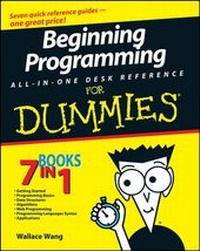
Beginning Programming All-In-One Desk Reference For Dummies
Published on 30. May 2008
Book
Paperback/Softback
720 pages
978-0-470-10854-3 (ISBN)
Description
7 books in 1 -- your key to programming success!
Your one-stop guide to programming concepts in a variety of languages
If you've been curious about what it takes to program a computer and make it do your bidding, here's the place to start! Each of these handy minibooks covers an important element of programming. You'll find out about compiling, algorithms, best practices, debugging your programs, and more, illustrated in several programming languages.
Discover how to:
* Decide what you want your program to do
* Program in different languages
* Turn your instructions into machine language
* Use programming best practices
* Understand data structures, algorithms, and syntax
More details
Product info
Book with CD-ROM
Edition
1. Auflage
Language
English
Place of publication
United States
Publishing group
John Wiley & Sons Inc
Target group
Professional and scholarly
Dimensions
Height: 23.4 cm
Width: 18.7 cm
Thickness: 3.6 cm
Weight
1025 gr
ISBN-13
978-0-470-10854-3 (9780470108543)
Schweitzer Classification
Other editions
New editions
Book
08/2022
2nd Edition
Wiley
€36.50
Shipment within 15-20 days
Additional editions
E-Book
02/2011
Wiley
€23.99
Available for download
E-Book
01/2009
Wiley
€23.99
Available for download
Person
Wallace Wang is a bestselling author with more than 2.3 million For Dummies books in print. He wrote Beginning Programming For Dummies and moonlights as a stand-up comic.
Content
Introduction.
Book I: Getting Started.
Chapter 1: Getting Started Programming a Computer.
Chapter 2: Different Methods for Writing Programs.
Chapter 3: Types of Programming Languages.
Chapter 4: Programming Tools.
Chapter 5: Managing Large Projects with Software Engineering.
Book II: Programming Basics.
Chapter 1: How Programs Work.
Chapter 2: Variables, Data Types, and Constants.
Chapter 3: Manipulating Data.
Chapter 4: Making Decisions by Branching.
Chapter 5: Repeating Commands by Looping.
Chapter 6: Breaking a Large Program into Subprograms.
Chapter 7: Breaking a Large Program into Objects.
Chapter 8: Reading and Saving Files.
Chapter 9: Documenting Your Program.
Chapter 10: Principles of User Interface Design.
Book III: Data Structures.
Chapter 1: Structures and Arrays.
Chapter 2: Sets and Linked Lists.
Chapter 3: Collections and Dictionaries.
Chapter 4: Stacks, Queues, and Deques.
Chapter 5: Graphs and Trees.
Book IV: Algorithms.
Chapter 1: Sorting Algorithms.
Chapter 2: Searching Algorithms.
Chapter 3: String Searching.
Chapter 4: Data Compression Algorithms.
Chapter 5: Encryption Algorithms.
Book V: Web Programming.
Chapter 1: HyperText Markup Language.
Chapter 2: CSS.
Chapter 3: JavaScript.
Chapter 4: PHP.
Chapter 5: Ruby.
Book VI: Programming Language Syntax.
Chapter 1: C and C++.
Chapter 2: Java and C#.
Chapter 3: Perl and Python.
Chapter 4: Pascal and Delphi.
Chapter 5: Visual Basic and REALbasic.
Book VII: Applications.
Chapter 1: Database Management.
Chapter 2: Bioinformatics.
Chapter 3: Computer Security.
Chapter 4: Artificial Intelligence.
Chapter 5: The Future of Computer Programming.
Index.