

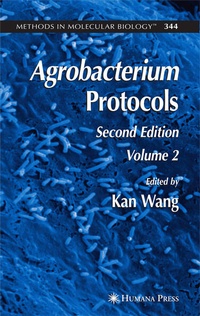
Agrobacterium Protocols
Volume II
2nd Edition
Published on 1. September 2006
Book
Hardback
512 pages
978-1-58829-843-0 (ISBN)
Description
Agrobacterium tumefaciens is a soil bacterium that for more than a century has been known as a pathogen causing the plant crown gall disease. Unlike many other pathogens, Agrobacterium has the ability to deliver DNA to plant cells and permanently alter the plant genome. The discovery of this unique feature 30 years ago has provided plant scientists with a powerful tool to genetically transform plants for both basic research purposes and for agric- tural development. Compared to physical transformation methods such as particle bomba- ment or electroporation, Agrobacterium-mediated DNA delivery has a number of advantages. One of the features is its propensity to generate single or a low copy number of integrated transgenes with defined ends. Integration of a single transgene copy into the plant genome is less likely to trigger "gene silencing" often associated with multiple gene insertions. When the first edition of Agrobacterium Protocols was published in 1995, only a handful of plants could be routinely transformed using Agrobacterium. Ag- bacterium-mediated transformation is now commonly used to introduce DNA into many plant species, including monocotyledon crop species that were previously considered non-hosts for Agrobacterium. Most remarkable are recent devel- ments indicating that Agrobacterium can also be used to deliver DNA to non-plant species including bacteria, fungi, and even mammalian cells.
Reviews / Votes
From the reviews of the second edition:
"This is, as the title suggests, a laboratory manual with protocols for using Agrobacterium tumefaciens to transform plant species . . the book will be a valuable addition to the laboratory bookshelf. The protocols . are clearly set out and the notes explain things . . I was also pleased that some chapters mentioned the need to consider regulatory issues regarding disposal of genetically modified materials, something that is often ignored in lab manuals." (Heather Macdonald, SGM - Society for General Microbiology, 2007)
More details
Series
Edition
2nd ed. 2007
Language
English
Place of publication
Totowa
United States
Target group
Professional and scholarly
Research
Edition type
Revised edition
Illustrations
81 s/w Abbildungen, 6 farbige Abbildungen
512 p. 87 illus., 6 illus. in color.
Dimensions
Height: 241 mm
Width: 160 mm
Thickness: 36 mm
Weight
1022 gr
ISBN-13
978-1-58829-843-0 (9781588298430)
DOI
10.1385/1597451312
Schweitzer Classification
Other editions
Additional editions
Book
12/2010
2nd Edition
Humana Press Inc.
€160.49
Shipment within 15-20 days
Content
Root Plants.- Carrot (Daucus carota L.).- Cassava (Manihot esculenta Crantz).- Potato (Solanum tuberosum L.).- Sweet Potato [Ipomoea batatas (L.) Lam.].- Turf Grasses.- Bermudagrass (Cynodon spp.).- Perennial Ryegrass (Lolium perenne L.).- Switchgrass (Panicum virgatum L.).- Tall Fescue (Festuca arundinacea Schreb.).- Turf Grasses.- Woody Species.- American Elm (Ulmus americana).- Cork Oak Trees (Quercus suber L.).- Eucalyptus.- Pine (Pinus radiata).- Poplar (Populus spp.).- Rubber Tree (Hevea brasiliensis Muell. Arg).- Tropic Plants.- Banana (Musa sp.).- Citrus.- Coffee (Coffea sp.).- Papaya (Carica papaya L.).- Pineapple [Ananas comosus (L.) Merr.].- Sugarcane (Saccharum spp.).- Nuts and Fruits.- American Chestnut [Castanea dentata (Marsh.) Borkh.].- Apple (Malus × domestica).- Blueberry (Vaccinium corymbosum L.).- Grapevine (Vitis vinifera L.).- Strawberry (Fragaria × ananassa).- Walnut (Juglans).- Ornamental Plants.- Carnation (Dianthus caryophylus L.).- Chrysanthemum (Dendranthema × grandiflora).- Orchids (Cymbidium spp., Oncidium, and Phalaenopsis).- Petunia (Petunia hybrida).- Rose (Rosa hybrida L.).- Medicinal Plants.- Ginseng (Panax ginseng).- Hemp (Cannabis sativa L.).- Opium Poppy (Papaver somniferum).- Non-Plants.- Actinomycetes (Streptomyces lividans).- Filamentous Fungi (Magnaporthe grisea and Fusarium oxysporum).- Green Alga (Chlamydomonas reinhardtii).- Mammalian Cells.- Mushroom (Agaricus bisporus).- Yeast (Saccharomyces cerevisiae).